Netanyahu's Coalition Fails to Secure Majority Support
Exit polls from Israel's television networks indicate that Prime Minister Benjamin Netanyahu's coalition has lost majority support among voters in Tuesday's election.
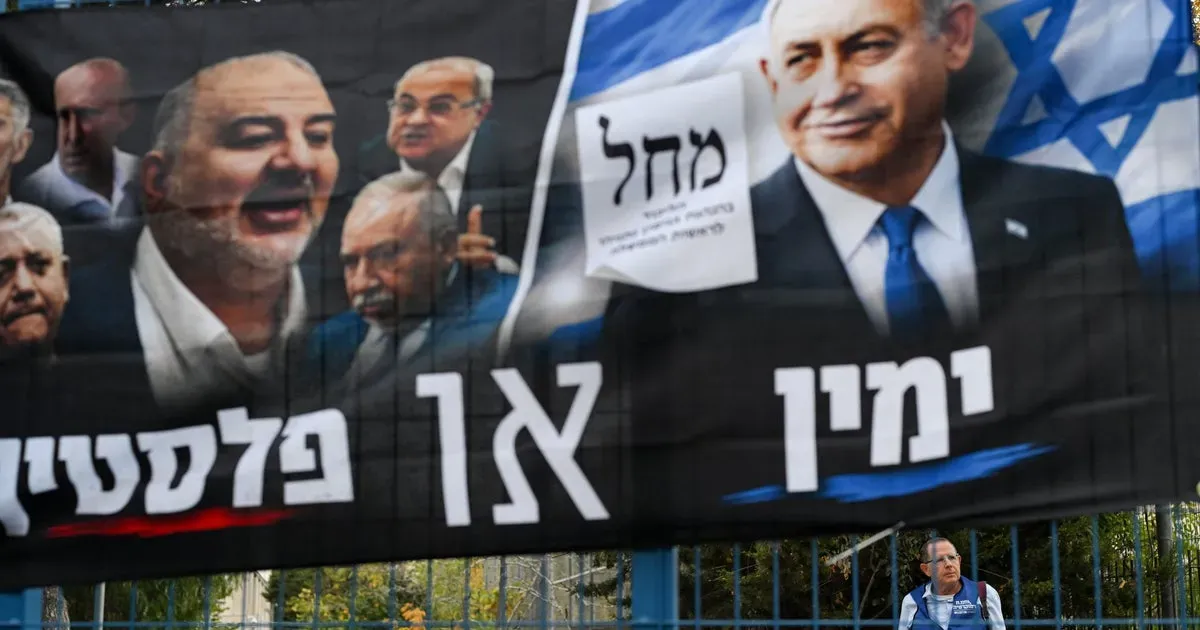
Exit polls from Israel's television networks indicate that Prime Minister Benjamin Netanyahu's coalition has lost majority support among voters in Tuesday's election. However, his Likud party still maintains its position as the largest party overall.
The results show a stalemate between Netanyahu and the opposition, with neither bloc having a clear majority to form a government. This outcome is significant, given the country's complex politics and multiple conflicts that require delicate negotiations.
Israel's Arab parties have made history by securing more seats in parliament than ever before, following a challenging time for the community under Netanyahu's hard-right government. Some Arab voters cited difficulties with the current administration as motivation to turn out in large numbers.
The opposition's chances of winning the Israeli election are looking increasingly plausible, according to exit polls. If they were to break their pre-election vow, it could potentially lead to a change in government and the removal of Prime Minister Netanyahu from office.
This outcome would be a significant departure from Netanyahu's campaign pledge to keep Arab parties out of power, which has been a central tenet of his election strategy. The country is still reeling from the devastating attacks by Hamas on October 7, 2023, widely regarded as Israel's worst security failure since its founding in 1948.
Grief-stricken Israeli politician Eisenkot has personal experience of loss during military conflicts in Gaza. His son and two nephews were tragically killed while serving in the military there. He was a key member of Israel's war cabinet for much of the first year of the Gaza conflict, working closely with Prime Minister Netanyahu.
The election outcome may be far from certain due to various scenarios that could unfold. In Israeli politics, it is not uncommon for parties or individual lawmakers to break their pre-election promises and switch sides. This has happened many times before in the country's electoral history.
If neither side secures a majority of the 120 seats available, there are two possible outcomes. The change bloc could try to form a minority government if they win a significant share of votes but fall short of an outright majority. Alternatively, parties can still come together and form a coalition with more collective seats than their opponents, even without exceeding 50% of the total.
The Israeli election exit polls are pointing towards a stalemate in the formation of a coalition government, which could lead to another round of voting if neither side can gather enough support.
If that scenario unfolds, Israel would be forced to hold new elections for the sixth time since 2019, following four years marked by electoral deadlock and five consecutive elections.
Facts based on reporting originally published by CBS News World.
You may republish this story, in full or in part, if you credit News Central Site and link to it (licence CC BY 4.0). Photos are not included.