Moon's Volcanic Past May Have Been More Active Than Thought
New research suggests that Earth's gravity played a key role in keeping the moon's interior hot for billions of years.
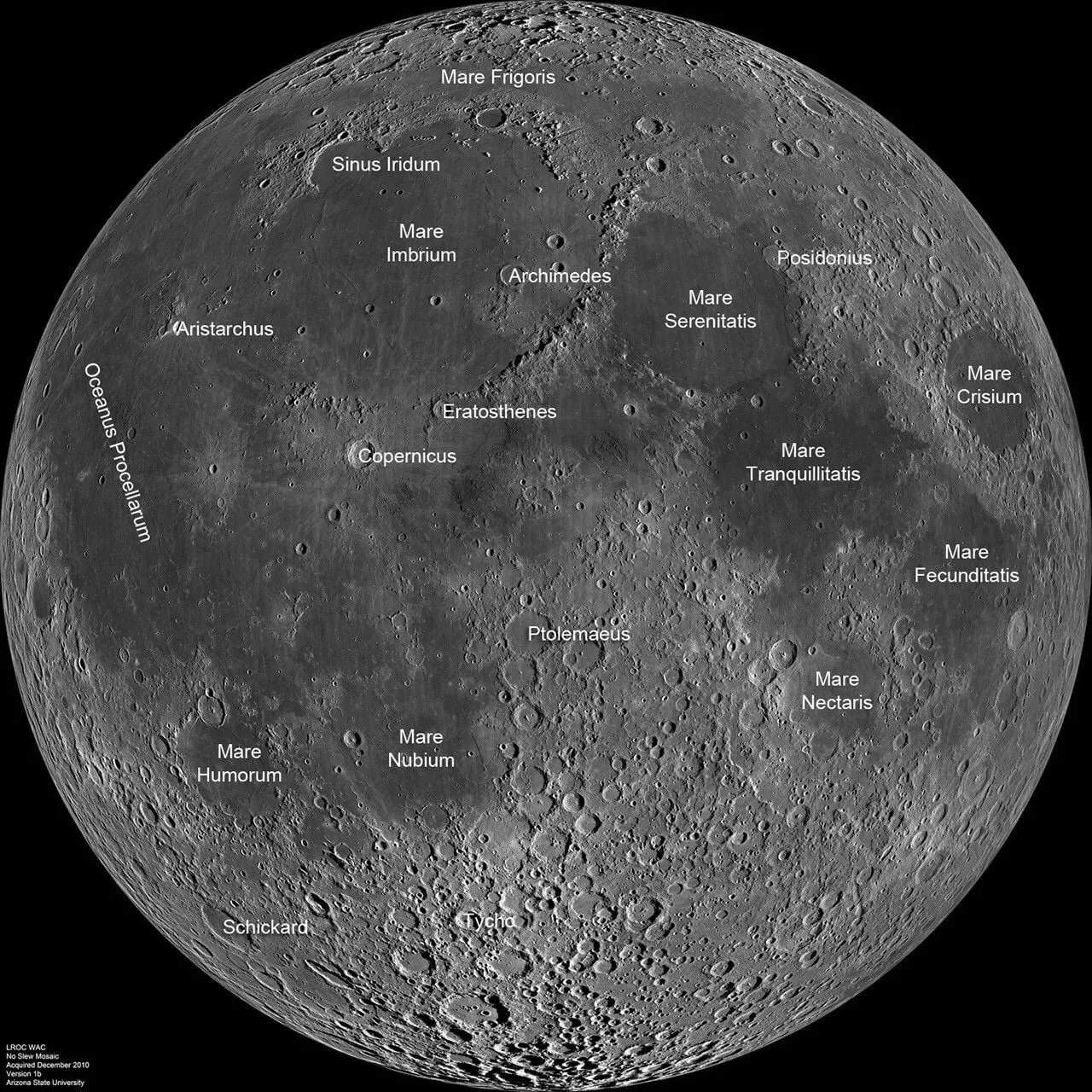
The moon's volcanic past may have been more active than previously thought, with new research suggesting that Earth's gravity played a key role in keeping its interior hot for billions of years.
For decades, scientists have believed that the moon cooled rapidly after its formation around 4.5 billion years ago, when a massive protoplanet collided with early Earth. However, samples returned from China's Chang'e-5 mission revealed surprising evidence of volcanic activity on the moon, dating back to just 2 billion years ago.
This finding has left scientists puzzled, as it seems to defy the laws of physics that dictate how planets and moons cool over time. With a relatively small size, the moon should have lost its internal heat quickly after forming, rendering it geologically dormant.
A new study published in the journal Planet proposes an explanation for this phenomenon: tidal heating caused by Earth's gravitational pull on the moon. The researchers suggest that this force may have kept the moon's interior hot and active, allowing for volcanic activity to persist long after its formation.
The idea of tidal heating is not new, but it has been largely overlooked in previous studies of the moon's evolution. According to the research team, Earth's gravity would have caused the moon's interior to heat up due to friction generated by the tidal forces acting on its crust and mantle.
The age of the lunar basalts returned by China's Chang'e-5 mission has raised questions about the moon's volcanic activity in the distant past. Laboratory analysis revealed that these rocks are approximately 2 billion years old, which is puzzling given that traditional geological theory suggests volcanoes should not have existed on the moon at this time.
Scientists have proposed various explanations for this anomaly, but none of them seem to fit the available data. Radioactive elements, such as potassium and uranium, could potentially contribute to heat generation through their decay process. However, there is insufficient undecayed material remaining on the moon to account for the required amount of heat.
The researchers considered asteroid impacts as another possible source of thermal energy. These events can cause localized high-impact heating, but the period of intense bombardment that shaped the moon's surface had long since ended by the time the basalts were formed. This means that asteroid strikes are unlikely to be responsible for the observed volcanic activity.
Tidal forces have been identified as a potential alternative explanation for the heat generated within the early moon. These forces, which occur when a celestial body is stretched and compressed as it orbits its parent body in an elliptical path, may have caused frictional heating within the moon's interior. This phenomenon is well-documented in other systems, such as Jupiter's moon Io, which experiences frequent volcanic eruptions due to tidal activity.
The moon's orbit has undergone significant changes over its history, and two billion years ago it was much closer to Earth than it is today. It orbited our planet in just 16 days, compared to the 27 days it takes now, and its path was more oval-shaped than circular. As a result, Earth's gravity exerted strong tidal forces on the moon's interior during each orbit.
Astronomers have long understood the impact of these gravitational squeezes, but their models of the moon's interior have been simplified to assume a uniform spherical shape. However, scientists knew that this was not entirely accurate, as there is a layer of rock with low viscosity between the moon's core and mantle. This zone plays a crucial role in how the tidal forces affect the moon.
When researchers used a more realistic 3D representation of the mantle setup in their convection simulations, they noticed a significant amount of energy being directed towards two specific regions along the lunar core-mantle boundary. These areas are now known as tidal heating anomaly zones (THAZs), and they have a profound impact on the moon's internal dynamics.
The researchers calculated that around 3.2 billion years ago, these THAZs were subjected to an enormous amount of energy due to tidal strain. Despite making up only a small portion of the mantle, just 2.5% of its total volume, they absorbed over 150 gigawatts of power. This is equivalent to more than four times the amount of energy generated by radioactive decay.
This immense energy input would have had a profound impact on the moon's volcanic activity, potentially keeping its internal heat sources active and driving geological processes for extended periods. The significance of this phenomenon is not unique to Earth's moon, as other systems, such as Jupiter's moon Io, also experience similar tidal effects that drive frequent volcanic eruptions.
The moon's geological history has long been a topic of study and debate among scientists. A new theory suggests that Earth's gravity played a significant role in keeping the lunar core warm for an extended period, which in turn helped sustain a magnetic field.
This prolonged warmth allowed the moon to maintain its magnetic field longer than previously thought, a discovery that was initially puzzling given the findings from Apollo missions. The samples collected during these missions indicated that they formed in a strong magnetic field, contradicting earlier predictions.
The theory also proposes that Earth's gravity drove massive mantle plumes towards the lunar crust. These plumes eventually cooled and solidified, producing the basalts seen in the Chang'e-5 samples.
Despite offering some answers to long-standing questions about the moon's geological history, this new model is still just a theory and requires further validation. The next decade promises to bring numerous lunar missions that could provide more definitive data on the moon's evolution.
The success of these missions will depend on their ability to gather accurate and comprehensive information on the moon's composition and internal structure.
The study suggests that Earth's gravitational pull may have played a crucial role in maintaining the moon's volcanic activity during its early stages. This theory is based on simulations of tidal heating at the core-mantle boundary of the moon.
The researchers propose that Earth's gravity caused tidal heating, which would have kept the moon's volcanic heart active for millions of years. If this scenario holds true, it could provide a new explanation for the moon's geological history and its unique composition. The study's findings offer valuable insights into the complex relationship between our planet and its satellite.
Facts based on reporting originally published by Phys.org.
You may republish this story, in full or in part, if you credit News Central Site and link to it (licence CC BY 4.0). Photos are not included.