Gerrothorax maritimus fossils discovered in Guizhou province China
Scientists from the University of California, Davis; Peking University; and the Geological Museum of Guizhou have uncovered fossil evidence of a previously unknown amphibian species that lived entirely at sea 237 million years ago.
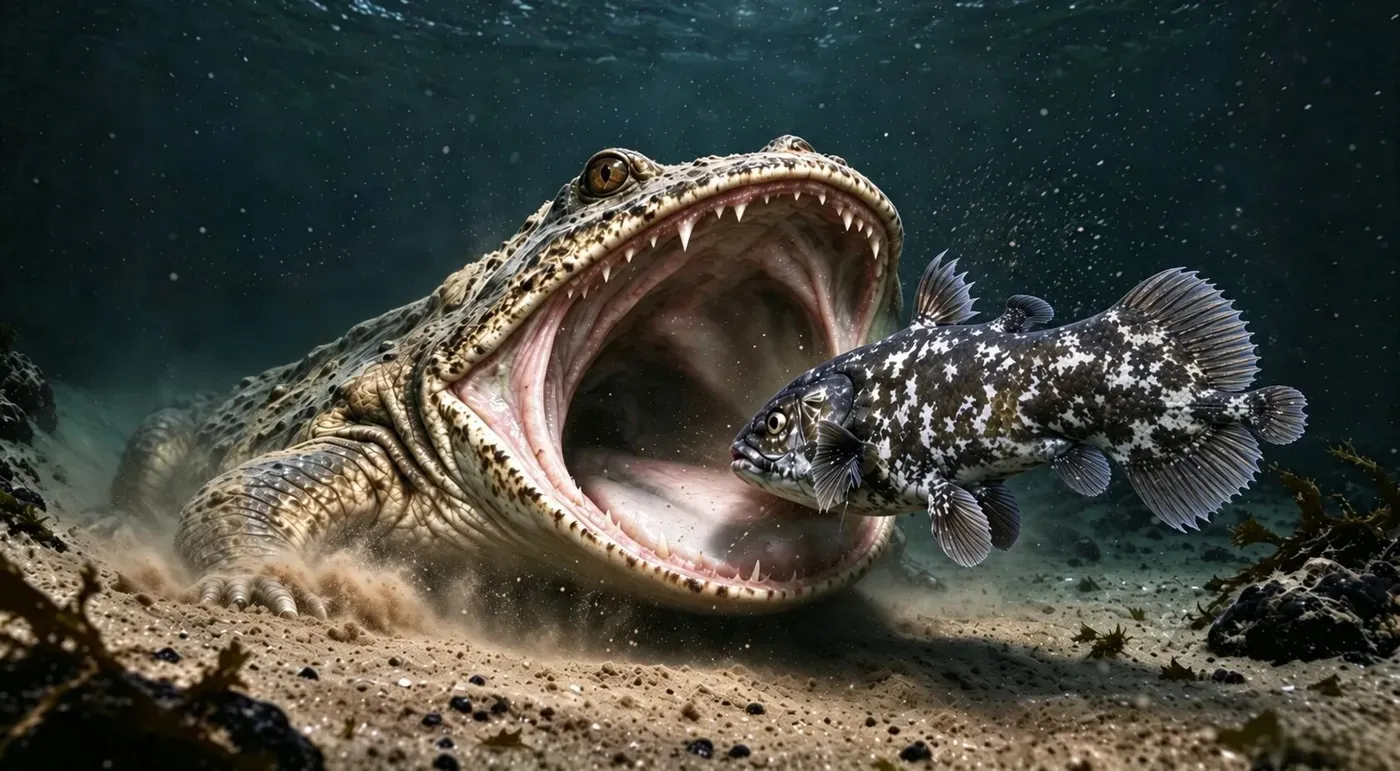
A groundbreaking discovery has emerged in the field of paleontology, shedding new light on the evolution of life on Earth. Scientists from the University of California, Davis; Peking University; and the Geological Museum of Guizhou have uncovered fossil evidence of a previously unknown amphibian species that lived entirely at sea 237 million years ago.
The creature, which has been named Gerrothorax maritimus, was an armored salamander-sized animal that dwelled on the ocean floor. It is the first fully marine amphibian to be identified in the fossil record. The researchers' findings are based on a detailed analysis of two nearly complete skeletons discovered in China's Guizhou province.
The fossils date back to the Late Triassic period, a time when the region was once covered by ocean and located hundreds of miles from large landmasses. This unique ecosystem has been the subject of study for researchers, who have previously focused on marine reptiles and fish from the area.
The discovery is significant because it reveals that amphibians were capable of living entirely at sea during this period, challenging previous assumptions about their evolution. The research team's findings are published in a recent issue of the journal Nature Ecology & Evolution.
The discovery of Gerrothorax maritimus has shed new light on the evolution of amphibians, particularly in relation to their ability to live in marine environments.
Its unique body shape and bony armor suggest that it had a defense mechanism against predators like ichthyosaurs, which were prevalent at the time. The flattened body was likely an adaptation for living in the ocean, where stability is key. This is evident in its disk-shaped body, which would have helped it to move around on the seafloor.
The size of Gerrothorax maritimus is also noteworthy, with estimates suggesting that it was almost 3 feet long and had a similar mass to the giant salamander. However, unlike modern salamanders, its body shape is much more compact, which would have allowed it to move through tight spaces in the ocean.
The researchers believe that Gerrothorax maritimus was a bottom-dwelling suction feeder, using its bony armor and skull shape to capture prey. This feeding style is similar to that of modern carpet sharks like the wobbegong, which use their powerful jaws to suck in unsuspecting prey.
Studies suggest that this unique feeding behavior would have allowed Gerrothorax maritimus to thrive in its ocean environment, where it could feed on a variety of small marine animals.
The unique biology of modern amphibians makes it difficult for them to thrive in marine environments. Their skin is permeable and serves multiple purposes, allowing them to respire and take in water through their skin rather than relying on their mouths for these functions.
This means that most amphibians are limited to living in or near freshwater environments due to their inability to tolerate salt in the water. While some species have developed a degree of salt tolerance, they typically lose weight when exposed to brackish waters and require time to recover in freshwater areas.
The researchers studying Gerrothorax maritimus propose that this ancient amphibian was able to circumvent these limitations through its bony armor and more fishlike biology. The armor would have prevented water absorption through the skin, forcing the creature to drink saltwater with its mouth and absorb it through its digestive tract.
The presence of gills in Gerrothorax maritimus, a characteristic found within the genus, suggests that these creatures were able to filter out excess salt from the seawater. This adaptation would have been crucial for an ocean-dwelling creature like Gerrothorax maritimus, which is supported by the fact that nearly complete skeletons of the species were found in deep-sea sediments.
The preservation of Gerrothorax maritimus fossils has provided valuable insights into its life habits. Carcasses that sink to the ocean floor too slowly often dry out and lose limbs before reaching the bottom, but the presence of preserved fingers in these fossils suggests they died near their home.
Geochemical analysis of the fossils revealed a high proportion of strontium isotopes, which is consistent with the oceans' chemistry during the Late Triassic period. This finding provides further evidence that Gerrothorax maritimus lived entirely at sea and was not adapted to life on land like its terrestrial counterparts.
The discovery of nearly complete skeletons in deep-sea sediments supports the idea that this armored amphibian relied on its aquatic environment for survival, making it well-suited to life underwater.
Facts based on reporting originally published by Phys.org.
You may republish this story, in full or in part, if you credit News Central Site and link to it (licence CC BY 4.0). Photos are not included.