Late Triassic Marine Amphibian Fossil Found in China
A remarkable discovery has been made in China, shedding new light on the evolution of life on Earth.
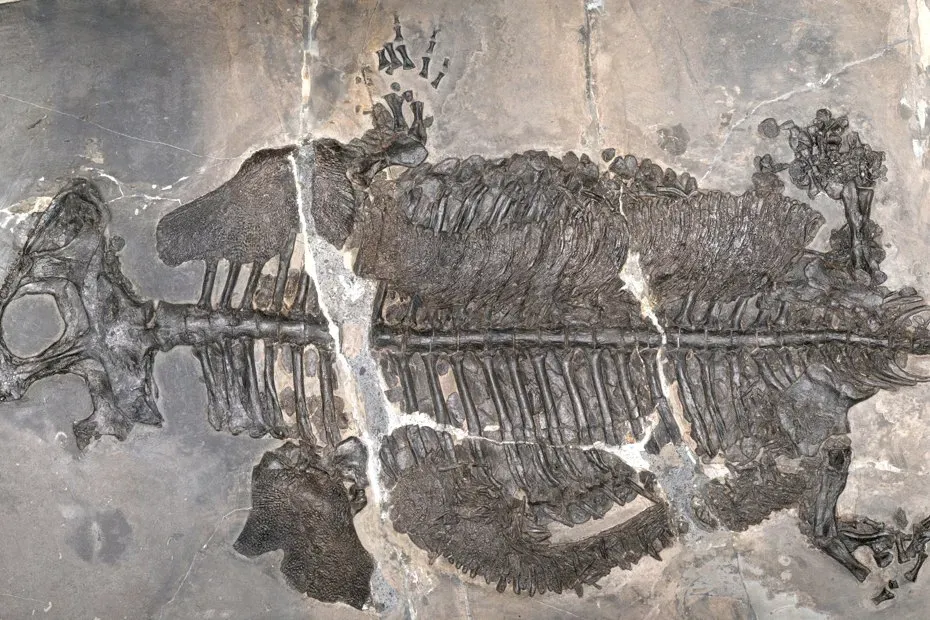
A remarkable discovery has been made in China, shedding new light on the evolution of life on Earth. Fossil evidence reveals that a marine amphibian existed 237 million years ago during the Late Triassic Period, defying conventional assumptions about the limitations of its species.
Found by farmers in a national geopark in Guanling county, China, the fossil is an almost complete specimen measuring 74 centimetres long. The exceptional preservation of the fossil has allowed researchers to study it in unprecedented detail, providing valuable insights into the anatomy and behaviour of this ancient creature.
The marine amphibian, named Gerrothorax maritimus, appears to have been a bottom-dwelling ambush predator that inhabited the sea floor during the Late Triassic. Its unique body armour likely played a crucial role in its ability to survive in saltwater environments, which are typically hostile to amphibians due to their permeable skin.
According to researchers, Gerrothorax maritimus had a flat body and lived on the sea floor, where it likely used suction feeding to ambush prey. The fossil's wide mouth and strong hyoid bone suggest that this feeding strategy was similar to that employed by modern bottom-dwelling predators like wobbegong sharks.
The discovery of Gerrothorax maritimus has sparked interest among scientists, who are eager to learn more about its habits and how it managed to thrive in the ocean. The study's findings have also raised questions about the adaptability of amphibians in different environments, sparking further investigation into this fascinating area of research.
The discovery of the ancient predator has provided valuable insights into its lifestyle and habits. The fossil's anatomy revealed four legs and gills, characteristic features of early amphibians. However, unlike modern amphibians that undergo metamorphosis from tadpoles to frogs, this creature did not exhibit such a transformation.
Researchers studied the strontium isotope ratios in the fossil bones to determine its origin. These ratios indicated a clear signature of sea water, suggesting that G. maritimus grew to adulthood while living in the ocean. This evidence was crucial in confirming the marine lifestyle of the ancient predator.
The location where the fossil was discovered provided further clues about the creature's environment. Palaeogeographic reconstructions revealed that 237 million years ago, during the Late Triassic Period, the area was at least 30 kilometres away from land. This confirmed that G. maritimus was not just a land-based animal washed into the sea after death.
The fossil was found alongside that of an ichthyosaur, Guizhouichthyosaurus, which reached lengths of 7 metres. The presence of this large marine reptile further supported the idea that G. maritimus lived in a marine environment. Interestingly, the closest relative to G. maritimus, Gerrothorax pulcherrimus, was found in freshwater environments.
This discovery has led researchers to suggest that the marine lifestyle of G. maritimus may have been an accident of evolution. They propose that this amphibian had the necessary body armour to colonise the sea but did not necessarily adapt to a marine environment. This raises questions about the adaptability of amphibians in different environments, sparking further investigation into this fascinating area of research.
The unique armour plating on ancient amphibians may have allowed them to thrive in both freshwater and seawater environments, challenging our understanding of their adaptability. This protective layer, which originally served as a defence against predators in freshwater habitats, could also have helped these creatures survive in saltwater conditions by forming an impermeable barrier.
However, it's essential to note that the term "amphibious" is often misused. Many modern newts remain in water their entire lives and are still classified as amphibians, despite not exhibiting the typical ability to live on land. This highlights a common misconception about what it means to be an amphibian.
The discovery of a 237-million-year-old fossil that suggests ancient amphibians could have potentially thrived in seawater environments raises questions about why they didn't diversify and adapt more fully to this niche, given the opportunity.
Facts based on reporting originally published by New Scientist.
You may republish this story, in full or in part, if you credit News Central Site and link to it (licence CC BY 4.0). Photos are not included.