James Webb Space Telescope Launch Delayed Due to Technical Issues
A new mission called the Habitable Worlds Observatory (HWO) aims to overcome challenges in detecting Earth-like planets beyond our solar system.
The search for Earth-like planets beyond our solar system has been a long-standing quest in exoplanet research. Since the discovery of the first confirmed exoplanet around a sun-like star in 1995, significant technological advancements have been made in detecting and studying these celestial bodies.
Ground- and space-based telescopes, such as the James Webb Space Telescope, have played a crucial role in this progress. However, directly imaging Earth-like planets orbiting sun-like stars remains an elusive goal due to their faintness compared to their host stars and proximity to them in the sky.
A proposed mission called the Habitable Worlds Observatory (HWO) aims to overcome these challenges and advance our understanding of exoplanet detection. Although still in development, HWO is expected to launch sometime in the 2040s after a decade-long planning phase.
Researchers are now working on new engineering concepts for HWO, which were discussed in a recent study published in June 2026. These ideas have the potential to accelerate the mission's progress and ensure its successful completion well before launch.
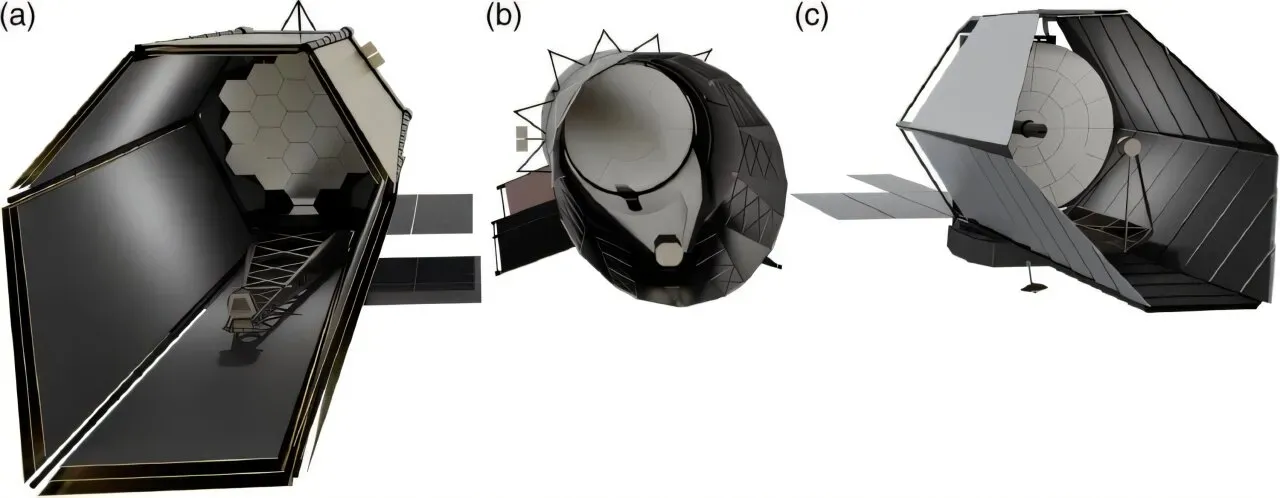
The Habitable Worlds Observatory (HWO) mission is being designed with multiple engineering concepts in mind, aimed at balancing scientific goals with practical needs. To achieve this balance, researchers introduced a framework called Exploratory Analytic Cases (EACs), which will guide the architecture design of the HWO telescope.
A key aspect of EACs is to determine the optimal size and type of telescope for the mission. This involves considering factors such as mirror diameter, aperture design, and whether an on-axis or off-axis design is required. The researchers focused on four types of mirrors: inscribed, circumscribed, round, and outer diameter.
The distinction between on-axis and off-axis designs lies in how components are positioned within the telescope. On-axis designs place all components within the field of view of incoming light, potentially obstructing a portion of the view. In contrast, off-axis designs keep all components outside the field of view, resulting in an unobstructed view.
The researchers developed three EACs to explore different design options for HWO's telescope architecture. EAC1 features a 6-m inscribed / 7.2-m circumscribed, off-axis design; EAC2 has a 6-m round, off-axis design; and EAC3 boasts an 8-m outer diameter, on-axis design.
The researchers ultimately favored the off-axis design for HWO's telescope, as it allows for greater light-gathering capabilities and larger aperture sizes to collect more light.
The Habitable Worlds Observatory's (HWO) design considerations continue to take shape as researchers weigh the importance of temperature properties on its telescope operations.
Temperature properties play a crucial role in light-collecting capabilities and overall performance of the coronagraph instrument (CI), which is tasked with blocking out the star's glare to enable direct imaging of orbiting exoplanets.
The Systems Engineering Team has made significant progress, developing end-to-end modeling for one of the Early Assembly Components (EACs) and sharing its models with industry partners to support technology maturation efforts. This collaboration will help inform independent architecture studies and ensure that the HWO's design is well-suited to meet its science goals.
As the HWO is set to replace the James Webb Space Telescope as the primary space telescope in the 2040s, its science objectives remain unchanged, directly imaging Earth-like exoplanets to determine whether our planet is unique in supporting life.
The Habitable Worlds Observatory (HWO) will be equipped with a segmented primary mirror, similar to that of the James Webb Space Telescope. This design choice allows for more precise control over the mirror's shape and minimizes vibrations caused by temperature fluctuations. The segmented design also enables the HWO to maintain its thermal stability during observations.
The mission's primary science objectives remain unchanged, focusing on direct imaging of Earth-like exoplanets to determine whether our planet is unique in terms of its habitability. This will involve analyzing the atmospheric composition and surface conditions of these distant worlds. As a result of this research, scientists hope to gain valuable insights into the formation and evolution of planetary systems similar to our own.
Facts based on reporting originally published by Phys.org.
You may republish this story, in full or in part, if you credit News Central Site and link to it (licence CC BY 4.0). Photos are not included.