European Southern Observatory's Very Large Telescope Discovers Rare Debris Disk
Astronomers have made a significant discovery using the European Southern Observatory's Very Large Telescope, uncovering a rare debris disk orbiting a dead star that offers insights into what may happen to our solar system in the future.
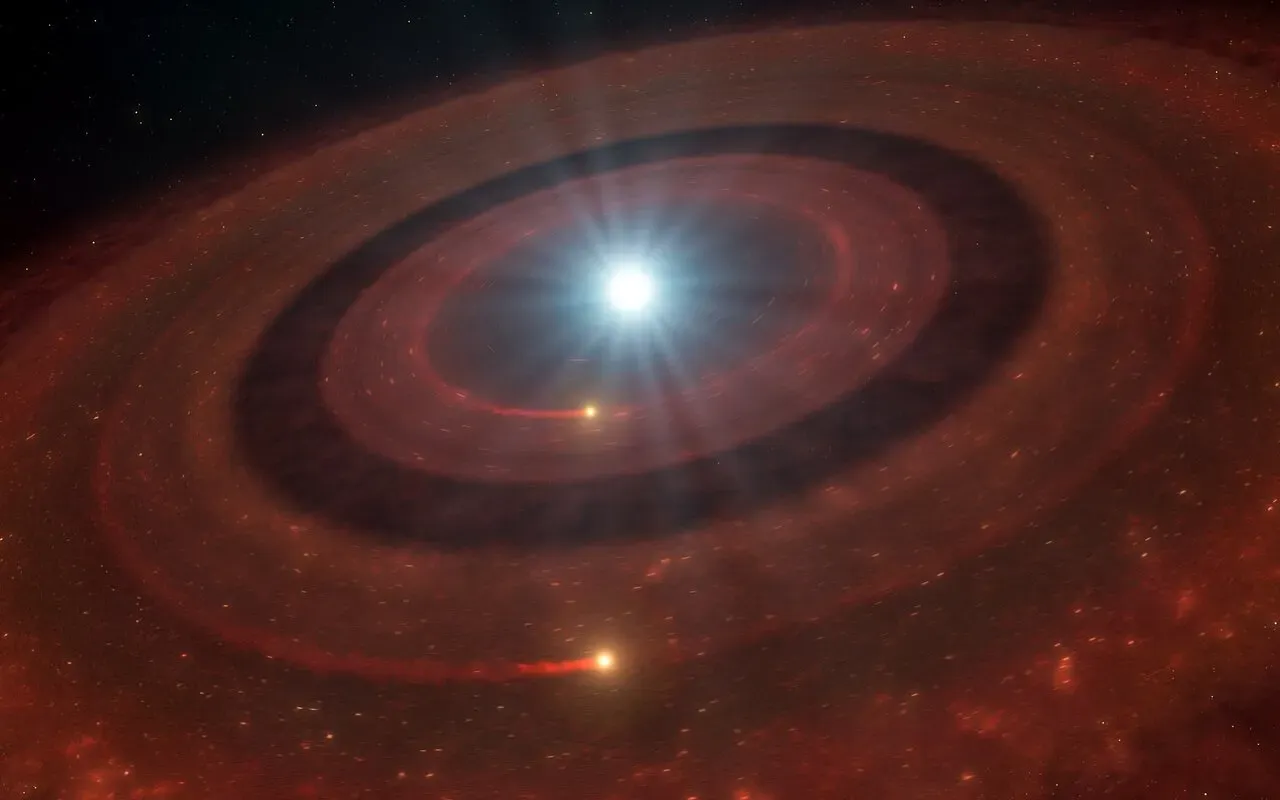
Astronomers have made an intriguing discovery using the European Southern Observatory's Very Large Telescope (ESO's VLT), uncovering a rare debris disk orbiting a dead star that offers insights into what may happen to our solar system in the future.
The debris disk is remarkable because it consists of two distinct parts, separated by a clear gap, unlike similar systems previously found. The organization of this double disk suggests it was shaped by two planetary bodies, with one potentially being as large as Pluto, which managed to survive the violent transformation of the star into a white dwarf.
Researchers believe that planets can indeed persist beyond their central star's transformation, but this is the first time a complex system with a double debris disk and potentially two surviving planetesimals has been observed. The discovery provides valuable information about planetary formation and evolution.
The central star in question is J1328−1450, a white dwarf left behind when a star similar to our sun exhausted its fuel supply. This dense and burned-out core is the remnant of a once vibrant stellar body.
Further study of this system could provide crucial insights into the long-term fate of our own solar system, with its own dead star waiting in the wings.
The unusual double debris disk surrounding J1328−1450 has sparked interest among astronomers due to its distinct characteristics. Unlike other dead stars surrounded by a single ring of vaporized planetary material, this star boasts two concentric rings.
Astronomer Felipe Lagos-Vilches notes that the stability and separation of these gaseous rings are particularly noteworthy. The gap between them is remarkably stable, setting this system apart from others observed in similar circumstances.
The presence of two separate debris rings suggests a complex process at play when a planetary system meets its end. Dead stars may have disk structures far more intricate than previously thought, according to Gentile Fusillo's observations.
Researchers believe the double structure is maintained by two surviving planet-like bodies on distinct orbits around J1328−1450. One of these objects is estimated to be roughly the size of a typical asteroid, with a diameter of just a few kilometers.
Observations made with the X-Shooter instrument on ESO's VLT in Chile have revealed a unique feature about the J1328−1450 system - its double debris disk orbiting a dead star. Unlike other known debris disks around white dwarfs, which exhibit a single, flat, rotating signature, this system breaks the pattern and shows the fingerprint of two distinct disks.
The presence of elements such as calcium, oxygen, magnesium, and iron in the disk suggests that it is composed of rocky planetary material similar to what can be found in our own solar system. This similarity raises questions about the origins of these materials and how they ended up orbiting a dead star.
Further analysis reveals that the two rings in the disk have different compositions, with the inner ring rich in magnesium gas and the outer largely devoid of it. This disparity suggests that the planetesimals feeding the rings originated from two distinct planets with unique chemical makeup. An alternative explanation is that they are remnants of different parts of a single celestial body.
The finding has significant implications for our understanding of planetary systems, including our own. As our sun ages and eventually becomes a white dwarf, it's likely to destroy Earth in the process. The J1328−1450 system offers a glimpse into what this future might look like for planetary systems.
This unique observation provides valuable insights into the fate that may await our solar system as it ages and evolves.
A recent study has shed light on the fate of planetary systems as they age by observing a double debris disk orbiting a white dwarf star. The disk is thought to be the remains of two planets that were destroyed in a catastrophic event, leaving behind a trail of debris.
This unique system provides valuable insights into the potential fate of our own solar system as it evolves and ages. The discovery suggests that planetary systems may eventually succumb to similar destructive forces, ultimately leading to the formation of a double debris disk around a dead star.
Facts based on reporting originally published by Phys.org.
You may republish this story, in full or in part, if you credit News Central Site and link to it (licence CC BY 4.0). Photos are not included.