Engineering Diamond Defects with Ultraviolet Laser Pulses Achieved
Researchers have successfully used ultraviolet laser pulses to selectively create quantum qubits in diamonds while leaving other defects intact.
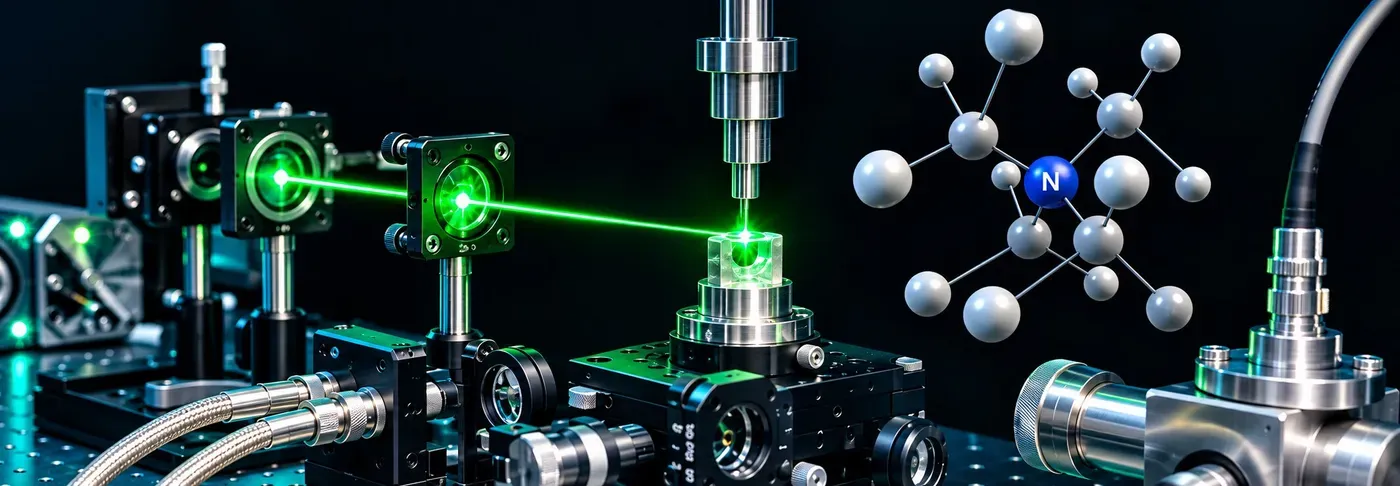
A breakthrough in engineering diamond defects has been achieved using ultraviolet laser pulses, allowing for the selective creation of quantum qubits while leaving other defects intact. This discovery is significant because it enables researchers to manipulate individual defect populations more precisely than before.
The imperfections within diamonds are of great interest to scientists due to their potential to grant new optical and electronic properties to the material. These atomic-scale defects can also be used as quantum systems, making them a valuable resource for developing future technologies. However, controlling these defects without affecting others has proven to be a challenging task.
Researchers have been working on solving this problem, particularly in the context of quantum technologies. One example is the nitrogen-vacancy (NV) center, which is formed when a nitrogen atom and its neighboring vacancy occur within the diamond lattice. This defect can function as a highly sensitive sensor of magnetic and electric fields, making it a crucial component for various applications.
The NV center's potential relies on its ability to store quantum information, but creating or modifying one type of defect often affects nearby defects, hindering progress in developing useful devices from diamond. As a result, scientists have been searching for ways to control individual defect populations more selectively and efficiently.
Researchers have now turned their attention to the use of ultraviolet laser pulses as a potential solution to this problem, exploring whether these pulses could provide the necessary control over diamond defects.
The researchers used a single-crystal chemical vapor deposition (CVD) diamond and focused 266-nanometer ultraviolet laser pulses on localized regions of the crystal to deliver energy precisely where needed.
To ensure that the observed effects were not due to pre-existing defects, the team first characterized the pristine diamond using various spectroscopic techniques. These included confocal photoluminescence spectroscopy, which mapped the initial optical defect landscape, and ultraviolet-visible absorption spectroscopy and Fourier-transform infrared spectroscopy, which provided information on the material's optical transparency and impurity content.
The measurements revealed that the low-nitrogen CVD diamond contained a very small concentration of substitutional nitrogen compared to nitrogen-rich materials. This was an important finding because it helped rule out pre-existing defects as a cause for any changes observed after laser irradiation.
The researchers then compared the optical response of the diamond before and after laser exposure, looking for signs that the pulses had modified the material's defect landscape. One key change they observed was in the photoluminescence spectrum.
A previously absent emission near 563 nanometers appeared in the laser-exposed regions, accompanied by a second feature near 579 nanometers. These emissions have been associated with specific defect configurations related to carbon self-interstitials, carbon atoms occupying unusual positions within the diamond lattice.
These findings suggest that ultraviolet laser pulses can be used to engineer defects selectively, leaving quantum qubits intact and potentially paving the way for new applications in quantum computing and other fields.
The observation of new optical defects was just the beginning, as researchers noticed something remarkable happening to the existing defects within the diamond.
The diamond already contained NV centers before undergoing irradiation, and after treatment with laser pulses, their optical signals remained largely unchanged compared to untreated regions. This suggests that the laser was able to produce a measurable change in one part of the defect landscape without affecting the existing NV-center population.
This distinction is crucial, as it highlights the ability to manipulate a specific defect population while preserving preexisting quantum-relevant defects.
Researchers observed that the newly generated 563-nanometer emission did not continue to increase with increasing laser exposure. Instead, the signal could decrease after reaching a maximum, indicating that the laser was driving defect transformations rather than simply creating new defects in a one-way process.
This behavior suggests that the optical excitation can generate and modify particular configurations within the diamond, allowing for more complex interactions between defects and potentially paving the way for new applications.
The exact atomic-scale mechanism behind this phenomenon remains unclear. However, our findings suggest that sub-bandgap ultraviolet photons interact with electronic states associated with defects, generating localized electronic excitation and energy transfer to the surrounding lattice.
This process could potentially facilitate rearrangement of carbon atoms near existing defect sites. But further research is needed to fully understand the microscopic pathway involved in these interactions.
The complexity of diamond's defect configurations poses a significant challenge. With multiple types of defects present, their optical signatures alone are not always sufficient to reveal their complete atomic structures. For instance, the 563-nanometer and 579-nanometer emissions have been linked to self-interstitial-related defects, but the specific atomic configuration responsible remains unknown.
Our research demonstrates that nanosecond ultraviolet laser irradiation can be used to selectively modify diamond's optical defect structure while leaving the background NV-center population largely unaffected. This technique opens up new possibilities for materials engineering in single-crystal CVD diamond.
The implications of this discovery extend beyond diamond itself, with potential applications in quantum technologies. The ability to control and manipulate defects within a material environment could be crucial for developing reliable quantum systems, where precise placement and modification of defects are essential.
To engineer diamond defects selectively, researchers must first understand how to control and manipulate them precisely.
The ability to link laser parameters to specific defect transformations is crucial for this goal. By making such a connection, scientists may be able to move from observing selective defect engineering to deliberately designing the defect landscape of diamond for particular applications.
This would allow researchers to address parts of the defect landscape selectively while leaving quantum-relevant defects intact. In other words, it might become possible to manipulate specific defects without disrupting others that are essential for certain uses.
Researchers believe this could be a significant breakthrough in developing reliable quantum systems. Precise placement and modification of defects within these materials are crucial for their functionality.
The demonstration of selective defect engineering would also mean that defects inside diamond do not have to be treated as an inseparable collection.
Emmanuel Ediri Umukoro is a graduate student in Physics at North Carolina Central University and a visiting researcher at Duke University, where he has been conducting research on quantum defect engineering and laser-based nanofabrication.
Umukoro's work focuses on the use of ultraviolet laser pulses to engineer defects in diamond, leaving quantum qubits intact. This approach allows for precise control over the creation and placement of defects, which is a crucial step in developing reliable quantum computing technology. His research has been recognized through various awards and grants from organizations such as the NSF Institute for Robust Quantum Simulation.
Umukoro's expertise in quantum defect engineering has also led to his involvement with IBM's Qiskit Global Summer School, where he earned an Advanced Tier Quantum Excellence Certificate.
Facts based on reporting originally published by Phys.org.
You may republish this story, in full or in part, if you credit News Central Site and link to it (licence CC BY 4.0). Photos are not included.