Nuclear Softening Crucial for Embryonic Development in Mice
A groundbreaking study has revealed that nuclear softening is essential for embryonic growth in mice.
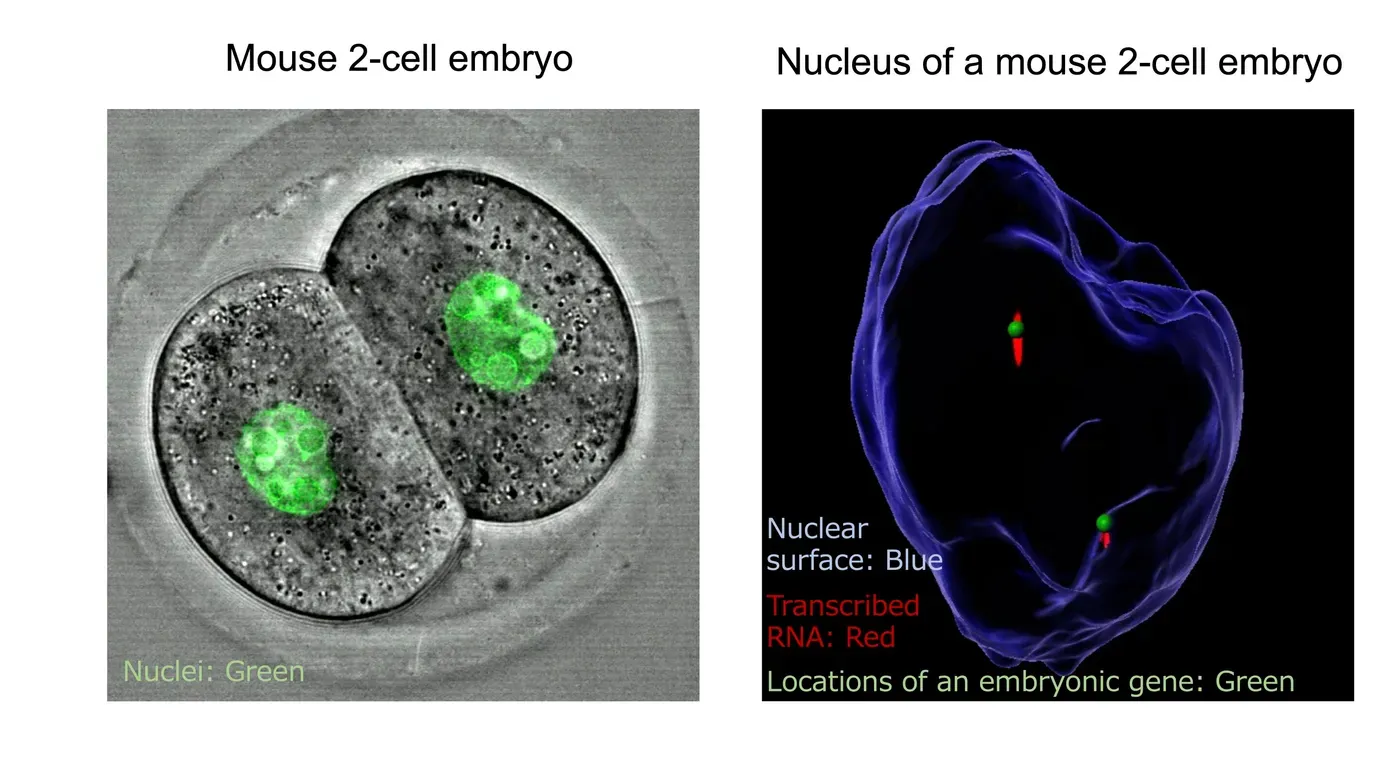
A groundbreaking study has revealed that a critical process occurs during the earliest stages of embryonic development in mice. Researchers have found that the nucleus, which contains the embryo's genetic material, undergoes significant softening and deformation at the two-cell stage.
This nuclear softening is essential for the activation of around 2,000 genes necessary for further embryonic growth. The simultaneous activation of these genes marks a crucial milestone in early development, highlighting the importance of this process.
The study was made possible by the invention of a new method to measure and manipulate the nucleus's physical properties. This innovative approach allowed the researchers to explore the role of nuclear softness in embryonic development with unprecedented precision.
A deeper understanding of the nucleus's behavior during early development may have significant implications for various fields, including fertility treatments and cancer research. Abnormalities in nuclear structure have been linked to diseases such as cancer, suggesting that further study could lead to new insights into these conditions.
The nucleus is a complex structure composed of molecules that form the nuclear envelope, which supports and protects the genetic material within. Its rigidity and shape can change depending on the cell's life cycle or role in the body, with improper maintenance leading to cellular dysfunction.
The nuclear structure of cells is crucial for their proper functioning, but its role in early embryonic development has remained poorly understood.
To measure the hardness of a nucleus without damaging it, researchers developed a nanocapillary-based system that inserts a thin glass tube into the cell and attaches to its surface. A small suction force then captures the nucleus through the capillary, causing the surrounding area to deform and stretch.
This innovative method allowed scientists to study the physical properties of mouse embryonic nuclei in unprecedented detail. The team began by examining what happens when a sperm cell fertilizes an egg, resulting in the fusion of two nuclei into one.
As the embryo develops over the next 48 hours, its nucleus undergoes significant changes. After fertilization, the combined nucleus divides twice, first reaching the two-cell stage and then the four-cell stage.
The researchers' findings suggest that nuclear softening at the two-cell stage may be a vital step for further embryonic development.
The researchers observed that during the two-cell stage, the nucleus undergoes significant deformation and loses its initial stiffness. This transformation is accompanied by a decrease in nuclear stiffness, which becomes softer and more plastic compared to the one-cell stage.
Further investigation revealed that lamin B1, a protein crucial for maintaining the structure of the nuclear envelope, begins to clear out at the two-cell stage. As a result, the nucleus softens, allowing it to adapt to changing conditions during embryonic development.
According to Miyamoto, this finding was particularly noteworthy because it coincides with a critical period in embryonic development known as major zygotic genome activation or ZGA. During ZGA, over 2,000 genes become active almost simultaneously, initiating the embryo's developmental process.
The team discovered that nuclear softening plays a vital role in facilitating gene expression during this critical phase. When the nucleus is stiff, necessary genes are unable to shift around freely within it, restricting their positional changes and hindering the activation of ZGA genes.
Active DNA transcription occurs near the softened nuclear envelope, but when nuclei remain stiffened, transcription of essential ZGA genes in that region becomes inhibited, underscoring the importance of nuclear softening for further embryonic development.
The findings of this study have significant implications for our understanding of embryonic development and gene function. The research shows that the physical properties of a cell's nucleus play a crucial role in determining which genes are expressed during early embryogenesis.
Active DNA transcription is only possible when the nuclear envelope is softened, allowing essential ZGA genes to be activated. Conversely, stiffened nuclei inhibit transcription of these vital genes, highlighting the importance of nuclear softening for normal development.
The study's conclusions have far-reaching potential in both basic and applied research fields. Scientists hope that future studies will uncover whether this phenomenon occurs in other animals, including humans, ultimately leading to a better understanding of embryonic development and its underlying mechanisms.
Facts based on reporting originally published by Phys.org.
You may republish this story, in full or in part, if you credit News Central Site and link to it (licence CC BY 4.0). Photos are not included.