Darwin Wasps' Parasitic Lifestyle Revealed in Genetic Study
A genetic analysis of 697 wasp species has provided insight into the evolutionary history of these parasitic insects.
The discovery of Darwin wasps has long been a subject of fascination for scientists. These parasitic insects have a gruesome lifestyle, laying their eggs on or inside living hosts such as caterpillars, beetles, and spiders.
Their larvae feed on the hosts, consuming them gradually until they eventually die. The biology of these creatures is disturbing, to say the least. It's little wonder that Charles Darwin was intrigued by their behavior, questioning how a benevolent God could have created such creatures.
Darwin's observations were made in an 1860 letter to American botanist Asa Gray. He couldn't help but wonder how such insects fit into the natural world. This curiosity later led to the naming of these wasps after him - a testament to their enduring impact on our understanding of evolution.
The Darwin wasp family, Ichneumonidae, comprises over 25,000 described species. Each employs its own unique strategies for survival and reproduction. Some permanently paralyze their hosts before laying eggs, turning them into immobile food supplies for their offspring. Others adopt a more complex approach, allowing their hosts to remain alive while the developing larvae feed on them.
The study of Darwin wasps has provided a unique insight into the fundamental question of how predictable evolution is.
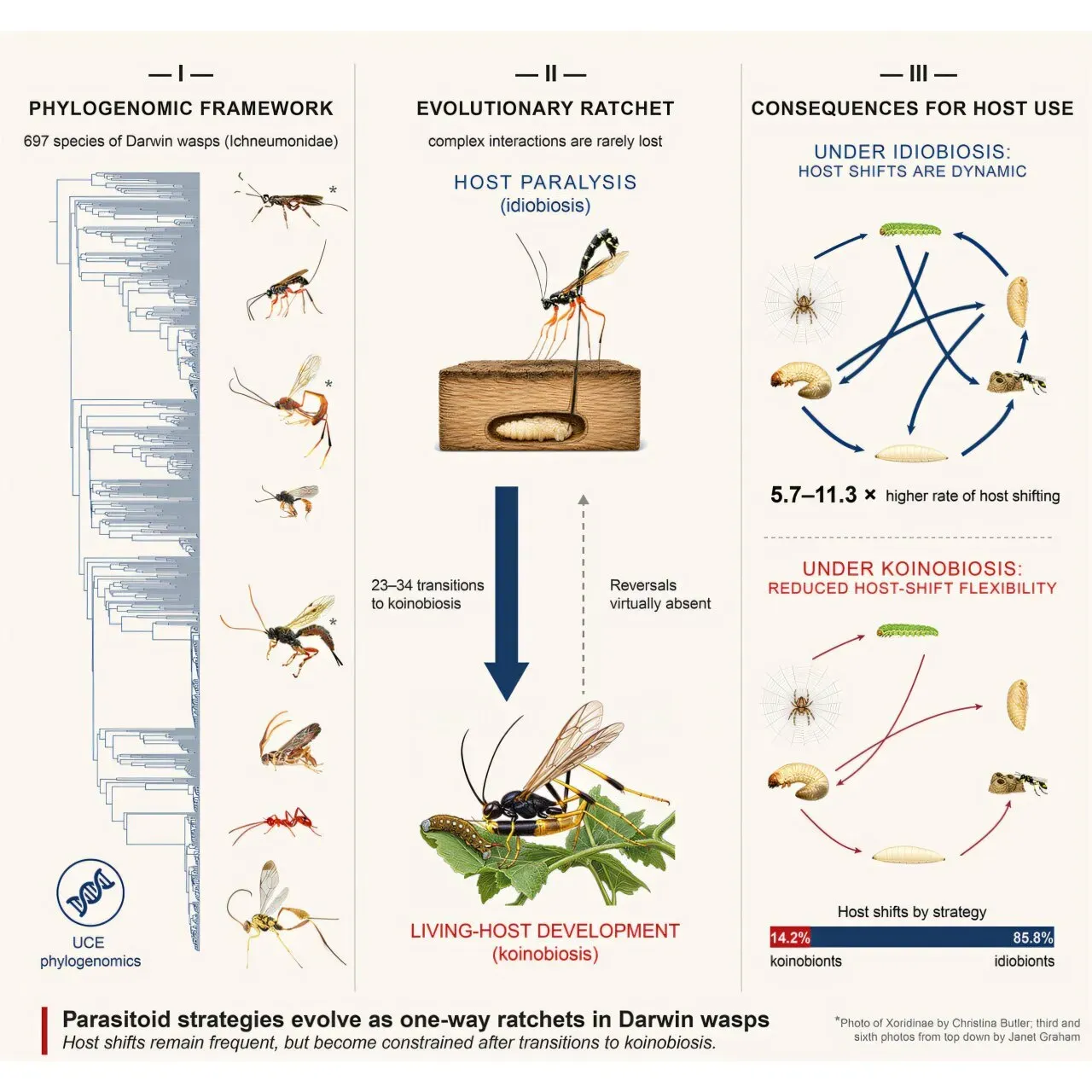
Genetic data from 697 wasp species revealed that similar adaptations can arise independently in different organisms, suggesting that evolution often takes a particular direction without reversing course.
However, researchers found a striking pattern when analyzing the evolutionary history of these strategies - the transition from paralyzing hosts to allowing them to continue developing occurred independently at least 23 times.
The study discovered no evidence of reversals in this process, indicating that once a wasp lineage evolves a close relationship with a living host, returning to its ancestral strategy becomes extremely difficult.
This phenomenon can be likened to an evolutionary ratchet - while it is possible for evolution to move forward and adopt new strategies, going backward becomes nearly impossible.
The study of Darwin wasps has revealed a striking aspect of evolution - its tendency to follow one-way paths. This phenomenon is evident in the fact that different lineages of these wasps independently developed similar strategies for survival and reproduction, yet rarely returned to their original ways of life.
The researchers found that evolution is not solely driven by chance and natural selection, but also by the constraints imposed by an organism's own evolutionary history. Once a particular path is taken, it becomes increasingly difficult to abandon, illustrating how evolution can be both repeatable and directional.
As a result, the radiation of Darwin wasps into diverse lineages has been shaped not only by their ability to adapt to new environments, but also by the contingent host shifts that have occurred over time.
Facts based on reporting originally published by Phys.org.
You may republish this story, in full or in part, if you credit News Central Site and link to it (licence CC BY 4.0). Photos are not included.