Czech and Slovak Roma Honored for World War II Heroism
The exhibition at the Museum of the Romani National Revival in Prague highlights the role of Romani resistance fighters against Nazi Germany during World War II.
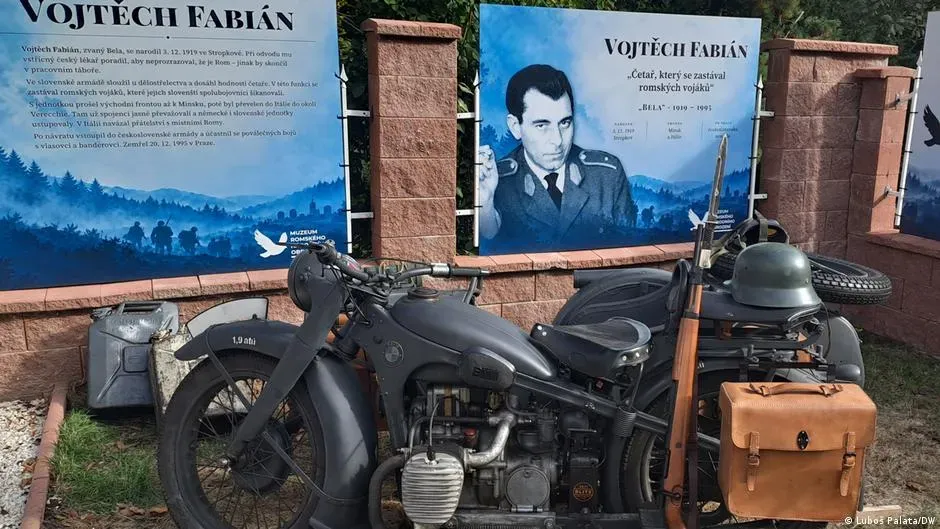
For the first time in history, an exhibition is being held to honor the unsung heroism of Czech and Slovak Roma who fought against Nazi Germany during World War II.
The exhibition, which opened on October 15 at the Museum of the Romani National Revival in Prague, sheds light on a previously overlooked chapter of Czech history. It highlights the significant role that Romani resistance fighters played in the fight against the Nazi occupation from 1938 to 1945.
Despite being victims of the Holocaust, many Roma actively participated in the Czechoslovak Underground Army and other partisan groups as soldiers or members of the resistance. Their bravery and sacrifice are now being recognized for the first time through this exhibition.
The museum's director, Emil Scuka, a well-known Czech Roma activist, hopes that the exhibition will mark a turning point in how the Roma are viewed during World War II. He believes that it is essential to acknowledge the heroism of these individuals who fought against Nazism and its collaborators.
According to Scuka, many people - including some Roma themselves - are unaware of this aspect of Romani history. He sees the exhibition as a way to repay the debt owed to these heroes by his generation.
The exhibition has drawn several hundred attendees, mostly Roma from Czechia and Slovakia, who gathered to see the display and hear Scuka's speech on the significance of this event.
The exhibition's curator, Radoslav Scuka, emphasized the importance of sharing these stories with younger generations. He encouraged attendees to bring their children and grandchildren to experience firsthand the history of Roma resistance fighters against Hitler.
Scuka also highlighted the lack of representation of Roma in Czech and Slovak historical accounts. In response, he explained that the Roma community decided to create its own documentation of war heroes, resulting in the current exhibition.
The exhibit showcases the lives of 100 significant Roma partisans and soldiers who fought against the Nazis. These individuals were chosen from a larger pool of over 1,400 Romani fighters discovered in archives.
Among those featured is Anton Facuna, a sergeant with the Office of Strategic Services (OSS), who was sent on a secret mission to Slovakia in October 1944.
Czech President Milos Zeman's decision to posthumously award Anton Facuna the Medal for Heroism has shed light on the lesser-known stories of Roma resistance fighters against Hitler. This recognition was made possible through the efforts of historian Jan Tesar, who collected and documented the memories of Serinek before his passing.
Tesar's work culminated in a three-volume book titled "Ceska cikanska rapsodie", which provides a detailed account of the Roma resistance during World War II. However, despite this effort, the history of Roma resistance against Nazism remains largely unexplored by Czech and Slovak historians to this day.
According to Prokop Tomek, a historian at the Military History Institute in Prague, there is still no scholarly historical work that deals with this aspect of Roma history. Tomek's statement underscores the significance of the recent exhibition on the Roma resistance against Nazism during the war, which he believes will be groundbreaking.
The number of Roma who fought against Nazism has been estimated to be around 1,400, a figure that corresponds to their proportion in Czechoslovakia at the time. This estimate is not seen as an exaggeration by Tomek, highlighting the importance of acknowledging and documenting this aspect of history.
Many Roma in Czechia and Slovakia continue to struggle with publicly acknowledging their ethnic identity due to the trauma inflicted upon them during the Holocaust. This has resulted in ongoing debates among Czech historians and politicians about the extent to which the authorities of the Protectorate were complicit in the extermination of the Czech Roma.
The legacy of World War II continues to have a profound impact on Czech society today, particularly for the Roma minority. The police registration system established in 1927, which required all Roma to be registered, played a significant role in facilitating their extermination by German Nazis.
Despite making up one of the largest ethnic minorities in the country, with an estimated population of over 250,000 people, the Roma face significant social and economic challenges. Only about 21,000 individuals identified as Roma during the 2021 census, highlighting the ongoing struggles faced by this group.
This has resulted in a stark reality where the Roma are among the most disadvantaged ethnic groups in Czechia, with limited political representation and influence.
Facts based on reporting originally published by DW English.
You may republish this story, in full or in part, if you credit News Central Site and link to it (licence CC BY 4.0). Photos are not included.