Election Posters in Sderot Highlight Divisions Within Israeli Jewish Community
Commuters arriving by train at Sderot are greeted by campaign posters from various parties, including the liberal Yashar party led by Gadi Eisenkot.
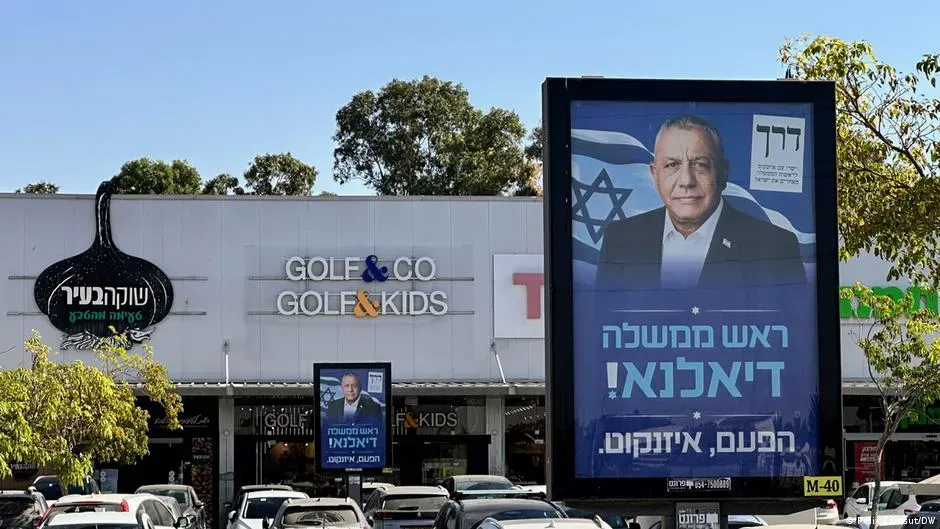
In the run-up to Tuesday's elections, commuters arriving by train at Sderot, a city on the outskirts of western Israel, are greeted by an array of campaign posters plastered on the walls and billboards. Among them, the advertisements for the right-wing Likud and far-right Otzma Yehudit parties stand out, with their bold slogans and familiar imagery.
However, one poster in particular is seen more frequently than any others: that of the liberal Yashar party, led by Gadi Eisenkot, a challenger to incumbent Prime Minister Benjamin Netanyahu. The Yashar poster's slogan is "Rosh Memshala Dialna, a phrase combining Hebrew and Moroccan Arabic words that roughly translates to prime minister of our own.
This emphasis on Eisenkot's Moroccan roots may seem unusual given the city's reputation as a stronghold of the Israeli right, particularly Netanyahu's Likud party. In 2022, Likud secured more than 40% of votes in Sderot, significantly higher than its national share of around 23%. The city has historically been considered a bastion of the Israeli right.
Sderot is situated in the Negev desert, approximately 45 miles south of Tel Aviv and just over a kilometer from the Gaza border. It has become synonymous with Moroccan-Jewish culture in Israel, as evident in its vibrant music scene, cinematic productions, and even state politics. The city's large Moroccan Jewish community plays a significant role in shaping its identity.
The fact that Eisenkot is focusing on his Moroccan roots in Sderot reflects the party's efforts to tap into the city's cultural heritage and potentially garner support from its sizable Moroccan-Jewish population.
Historical divisions between Ashkenazim and Mizrahim continue to shape Israel's social and economic landscape. The country's Jewish population is approximately evenly split, with around 4 million people identifying as Mizrahi, mostly from Middle Eastern and North African backgrounds.
Mizrahi Jews have faced significant challenges since the establishment of the Israeli state, including systemic discrimination and neglect. These issues persist in modern-day Israel, influencing both economic opportunities and social dynamics. This historical context has become a focal point in the current election campaign.
The Yashar party, led by Gadi Eisenkot, has criticized Likud for marginalizing its Mizrahi politicians. A notable example is the party's campaign slogan, which implies that Netanyahu favors Ashkenazi voices over those from North African backgrounds. This perceived bias has been at the forefront of election discourse.
The controversy surrounding Eisenkot's identity was further fueled by a live television exchange between right-wing journalist Yinon Magal and other commentators. In this heated discussion, Magal made an inflammatory remark about Eisenkot being controlled by elitist Ashkenazim, labeling him as a monkey".
The concept of "Dialna has been met with skepticism by some, who view it as a term that should not be proudly claimed. Israeli society has historically attempted to erase the Arab identities of North African Jews, leading to a suppression of their cultural heritage.
By embracing his identity and using terms like of our own," Eisenkot is challenging this societal norm. He is creating a new sense of identity that combines Moroccan roots with Israeli nationality, allowing individuals to proudly express their double identity without feeling out of place.
The legacy of discriminatory policies against Mizrahim continues to have an impact on Israeli society today. The ruling socialist party, Mapai, which was dominated by Ashkenazi leaders, implemented policies that encouraged Europeanization over preservation of Arab culture and heritage.
These inequalities had far-reaching consequences, not just in terms of cultural identity but also in material living conditions. Many North African Jews were sent to Ma'abarot, temporary transit camps with limited infrastructure, before being relocated to development towns that struggled with underfunding and poverty.
Development towns like Sderot in the south continue to face economic challenges compared to more central regions of Israel. The historical injustices faced by Mizrahim have had a lasting impact on their socio-economic status, making it essential for leaders like Eisenkot to address these disparities during his campaign.
The legacy of Mapai's establishment has left a lasting impact on Mizrahi communities, hindering their access to employment, education, and basic infrastructure. This systemic exclusion was effectively exploited by Likud under Menachem Begin, who leveraged Mizrahi discontent to achieve the Mahapach, or upheaval, when Likud first took power in 1973.
The city of Sderot has been a prime example of this trend, with its proximity to Gaza making it a frequent target of Hamas rocket attacks. The devastating October 7, 2023 attack killed over 50 people and had a profound impact on the community. Despite this trauma, the city's population has grown by approximately 5,000 people in the past three years, reaching 40,000 residents.
Sderot's demographics have undergone significant changes, with many young families settling in the town due to idealism or government incentives. The national-religious community is increasingly prominent in Sderot, with its members often voting for the far-right Religious Zionism party led by Bezalel Smotrich.
As a result of this shift, Likud's performance in Sderot may be compromised, as voters may opt for Smotrich's party or other coalitions. The influence of the national-religious community on local politics is undeniable, posing a challenge to Netanyahu's coalition and potentially altering the electoral landscape.
In this context, leaders like Eisenkot are navigating complex dynamics, seeking to address historical disparities between different communities while also appealing to voters in Sderot and beyond.
The city's strong ties to its Moroccan heritage are unlikely to fade regardless of the election outcome. This is because Sderot has become deeply associated with its large community of Moroccan Jews, a legacy that will endure long after the vote.
Eisenkot's potential victory could provide an opportunity for this community to redefine its identity and strengthen its connection to its Moroccan roots.
Facts based on reporting originally published by DW English.
You may republish this story, in full or in part, if you credit News Central Site and link to it (licence CC BY 4.0). Photos are not included.