SpaceX's Starship Successfully Completes Mid-Air Catch at Texas Facility
The Starship spacecraft landed safely back on Earth after a 22-hour journey in space, completing its first mid-air catch by giant robot arms.
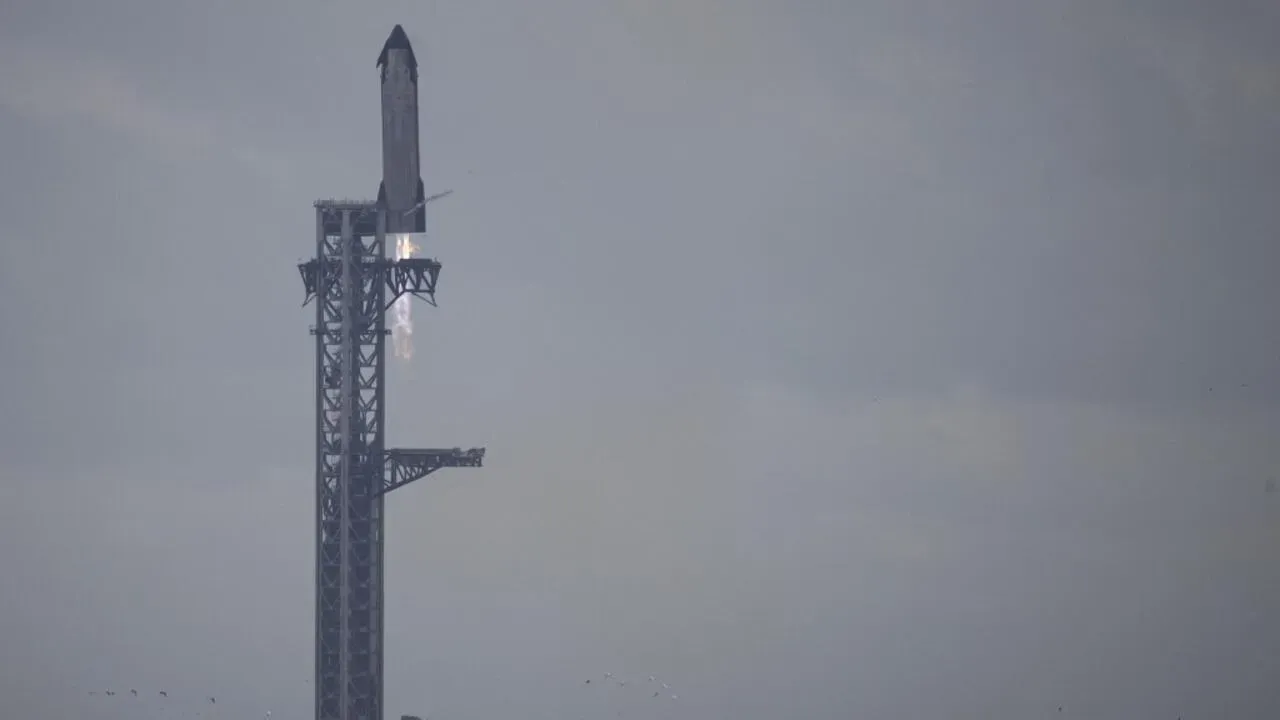
SpaceX's Starship spacecraft successfully landed back on Earth after a 22-hour journey in space, completing its first mid-air catch by giant robot arms at a facility in Texas.
The capture was a major milestone for Elon Musk and his team, who had hoped to achieve the feat with both the booster and the spacecraft returning safely. Unfortunately, the booster's recovery attempt ended in failure after it exploded shortly after launch from the same Texas site on Friday. Despite this setback, the Starship itself made it back intact.
The dramatic capture was a crucial step towards demonstrating the full reusability of the Starship, which is designed for missions to the moon and Mars. The technique had already been validated through three previous successful booster catches, but Saturday's feat marked its first application to a returning spacecraft.
Wreckage from the failed booster recovery attempt remains in the Gulf of Mexico, cordoned off by buoys, while the Starship was successfully lowered upright at the launch pad following its return.
NASA has expressed satisfaction with the outcome of Saturday's mission, which saw Starship successfully complete a mid-air catch after returning from orbit. The space agency is investing heavily in the project, with billions of dollars allocated to support Starship's role in landing Artemis astronauts on the moon and establishing a permanent lunar base. This ambitious endeavor aligns with NASA's long-term goals for space exploration.
The maiden orbital flight of this massive rocket was a remarkable achievement, with the 407-foot behemoth lifting off from SpaceX's launch site near the U.S.-Mexican border late Friday afternoon. The separation of the booster and upper-stage spacecraft proceeded smoothly, paving the way for the insertion into orbit and deployment of 26 cutting-edge Starlink satellites.
The autonomous Starship continued to circle the globe at an altitude of approximately 165 miles, with live video feeds transmitted via Starlink providing breathtaking views of the Earth from space. During its 14 orbits around our planet, this spacecraft surpassed previous missions in terms of duration and complexity.
This mission marks a significant milestone for SpaceX, which has now conducted 15 full-scale Starship flights since 2023, including only its second orbital deployment. Initial assessments indicate that all systems on the spacecraft functioned as intended during the flight, with no reported issues or anomalies.
Initial assessments indicate that all systems on the spacecraft functioned as intended during the flight, with no reported issues or anomalies. However, there was an unexpected development involving the booster, which experienced premature engine shutdown during descent. This caused the guidance system to take over and initiate a controlled self-destruction sequence.
The incident is currently under investigation by SpaceX engineers, who are working to determine the cause of the malfunction. Meanwhile, the company is pressing ahead with its plans to launch Starships from Florida's Kennedy Space Center in the coming months. The facility will serve as the starting point for NASA's Artemis mission, which will focus on lunar lander practice without actually landing on the moon.
The long-term goal of the Artemis program is a manned mission to the moon by 2028, with both SpaceX and Blue Origin playing key roles in the effort. As part of this initiative, astronauts will attempt to dock their capsule with Starship and Blue Moon, with the two companies taking turns delivering crews to the lunar surface in preparation for future missions.
Facts based on reporting originally published by France 24 English.
You may republish this story, in full or in part, if you credit News Central Site and link to it (licence CC BY 4.0). Photos are not included.