Cleopatra's Death Remains a Mystery
The exact circumstances of Egyptian Queen Cleopatra's death remain unclear despite extensive research and debate among scholars.
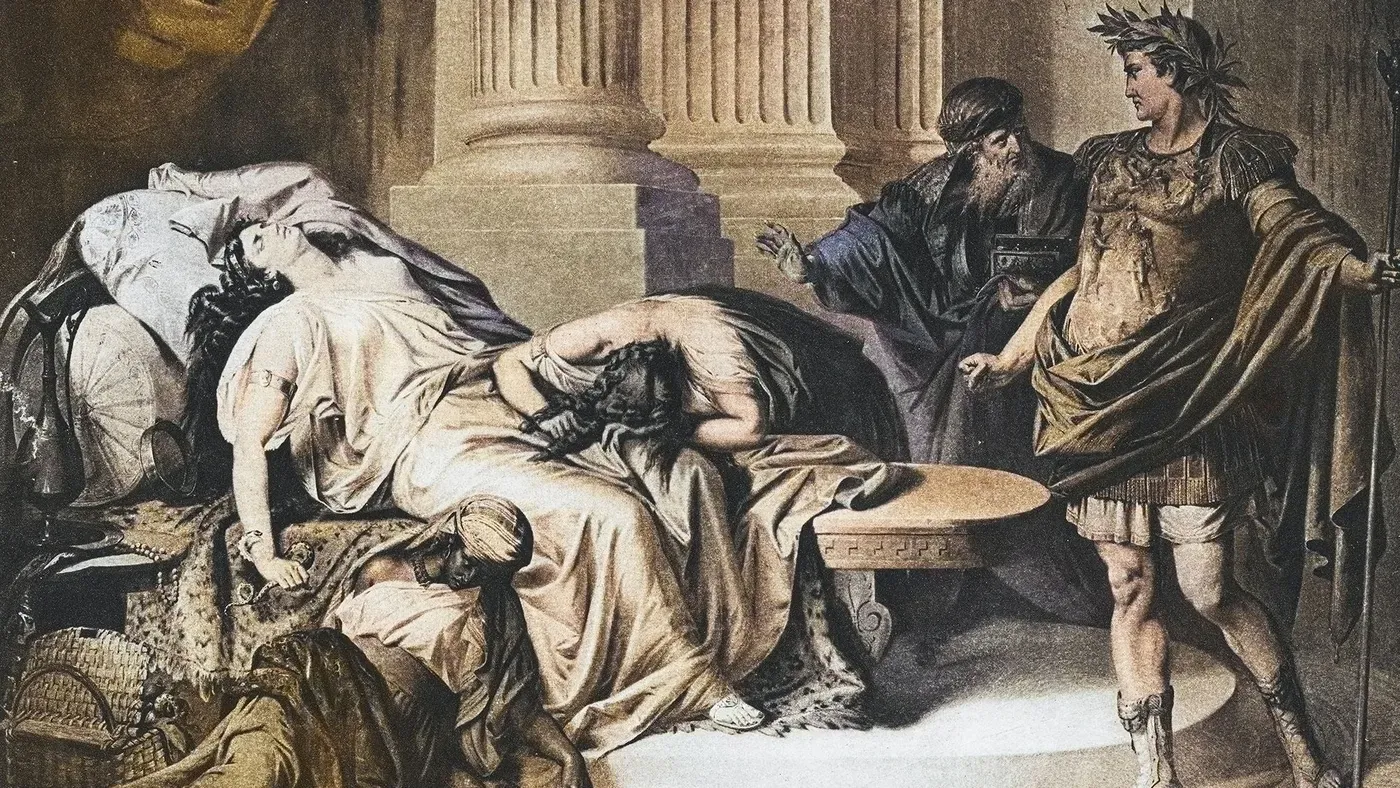
The death of Egyptian Queen Cleopatra remains one of history's most enduring mysteries. The queen and her Roman ally Mark Antony suffered a crushing defeat at the hands of Octavian in the Battle of Actium.
Following their loss, Cleopatra was captured by Octavian during a Roman ambush inside her royal tomb in Alexandria the following summer. According to Octavian's account, rather than face public humiliation, the queen deliberately allowed a venomous snake to bite her and succumbed quickly to its deadly poison.
However, not all historians accept this version of events. Some have questioned whether a snake was truly involved, instead suggesting that it may have been a convenient story concocted by Octavian as propaganda to legitimize his rise to power in Rome.
Roman writers like Velleius Paterculus repeated the account without hesitation or skepticism, but others expressed reservations about its accuracy. Today, most historians remain unconvinced by the snake theory and continue to speculate about Cleopatra's true fate.
Despite extensive research and debate among scholars, the exact circumstances of Cleopatra's death remain unclear. Experts such as Prudence Jones, a professor of classics at Montclair State University in New Jersey, agree that the truth behind her demise may never be fully known.
The search for physical evidence of Cleopatra's death has been a fruitless endeavor, with many aspects of Alexandria's royal quarter now submerged underwater.
Franck Goddio, an underwater archaeologist who has been excavating the area, has yet to locate the queen's mausoleum, according to Prudence Jones, a professor of classics at Montclair State University in New Jersey.
Even if Cleopatra's remains were somehow recovered, forensic analysis would likely be unable to detect the presence of snake venom, as bones do not retain such evidence.
The archaeological excavation off Abu Qir bay in Alexandria, Egypt, has yielded numerous artifacts, but none that shed light on the queen's demise, with divers celebrating each new discovery amidst the waters.
A personal account from Cleopatra's physician, Olympus, would have provided invaluable insight into her final days, but unfortunately, nothing of his writings remains.
Cleopatra's attempts to end her life after being captured by Roman soldiers suggest that she preferred death over captivity.
Her decision to starve herself was a desperate measure, halted only when Octavian threatened harm to her children, indicating the depth of her determination to avoid living as a prisoner.
According to historian Draycott, Cleopatra's reluctance to be paraded through Rome as a defeated foe is evident in her actions, showing that she would rather die than suffer such humiliation.
In contrast to later Christian attitudes, suicide was not stigmatized in the Greco-Roman world, allowing individuals like Cleopatra and Antony to choose death over capture.
The defeat of Antony's forces at Alexandria had already led him to take his own life, with Cleopatra following suit by visiting his tomb, bathing, eating, and sending a sealed letter to Octavian requesting burial beside her lover.
Ancient historians and biographers offer varied accounts of Cleopatra's death, each with its own twist on the circumstances surrounding her demise.
While most agree that a snake was involved, some propose alternative methods of poisoning, including the use of a poisonous ointment or poison hidden in a hollow hairpin.
Strabo, one of the few geographers who wrote about Cleopatra's death while still alive, is notable for being the only person present at her side to have left behind an account.
The Roman historian Cassius Dio provides a particularly intriguing detail: he reports that the sole clue to Cleopatra's cause of death was a pair of faint pricks on her arm.
It is widely accepted that Cleopatra's cause of death was a snake bite, but experts are divided on whether one asp could have delivered fatal blows to all three women involved.
Some historians believe it unlikely that a single snake would be capable of killing multiple people with its venom, given the variability in the amount injected with each bite and the possibility of "dry bites" that deliver no venom at all.
Snakes do not consistently administer the same dose of venom with every strike, which raises questions about the feasibility of attributing three deaths to a single asp.
On the other hand, others point out that the Egyptian cobra's body contains sufficient venom to be lethal to several individuals.
A more plausible explanation for Cleopatra's demise may be the ingestion of a quick-acting poison that did not cause seizures or vomiting.
Ancient Egyptian history is often shrouded in mystery, particularly when it comes to the death of its famous leaders.
The Roman view of women as deceitful and weak has left a lasting impact on the way we interpret ancient accounts, with historians warning against taking poison stories at face value. According to Draycott, Roman stereotypes portrayed men as brave warriors who clashed with swords, while women were seen as sneaky killers who would secretly administer poison to their victims.
Roman writers perpetuated these stereotypes, and it's likely that some of the poisoning allegations surrounding ancient Egyptian dynasties and Rome's imperial family had a grain of truth. However, Draycott suggests that others may have been misdiagnosed foodborne illnesses or other health conditions that were not understood at the time.
Facts based on reporting originally published by Live Science.
You may republish this story, in full or in part, if you credit News Central Site and link to it (licence CC BY 4.0). Photos are not included.