Event Horizon Telescope Collaboration Releases First-Ever Picture of Black Hole
The Event Horizon Telescope Collaboration has released a new study revisiting the original data sets used to create the first-ever picture of a black hole.
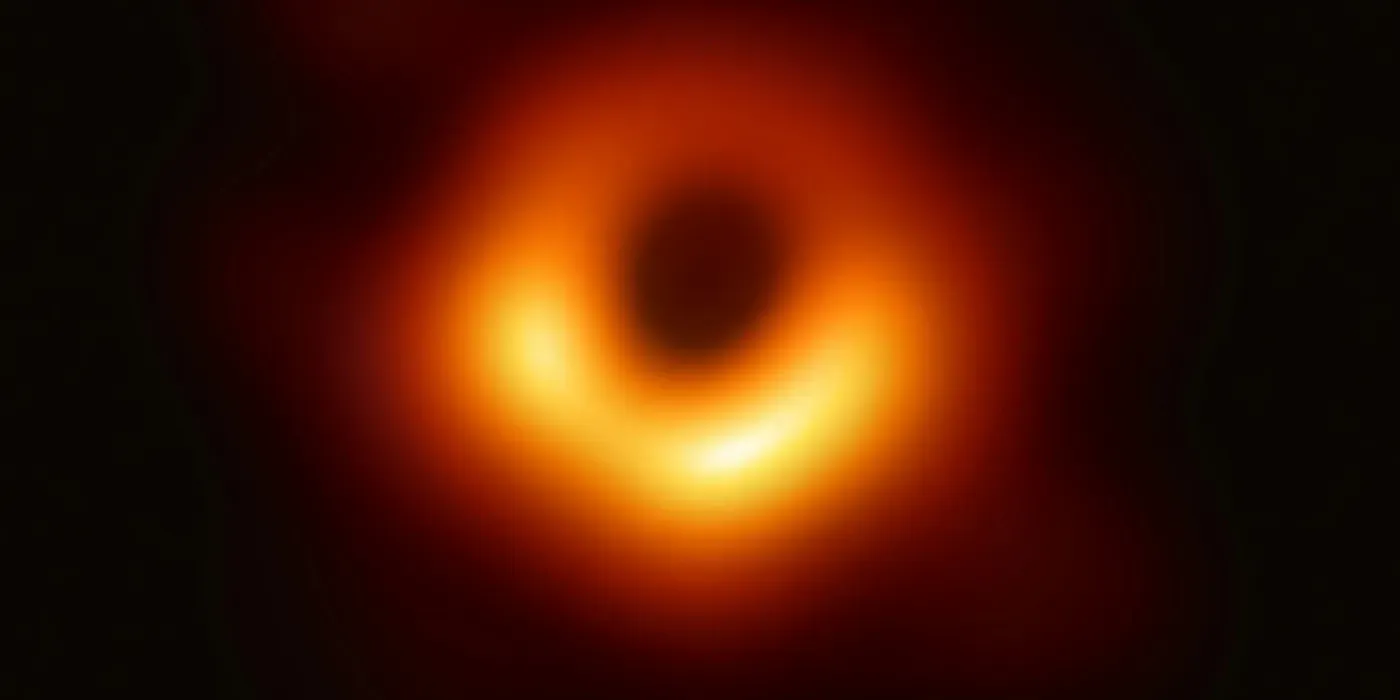
The Event Horizon Telescope Collaboration's release of the first-ever picture of a black hole has been one of the most significant scientific achievements in recent years. On April 10, 2019, the team revealed the image of a supermassive black hole at the center of galaxy M87, approximately 55 million light-years away.
The striking ring structure that surrounds the black hole's shadow has become an instantly recognizable symbol of modern science. The image was produced using data collected from observations of the galaxy's surroundings and is consistent with predictions made by Einstein's theory of general relativity regarding the bending of light around massive objects.
According to this theory, the centers of galaxies are home to supermassive black holes that have long been supported as a fundamental aspect of the universe. However, despite the widespread acceptance of the image's authenticity, there have been ongoing debates among scientists about its accuracy and the specifics of the ring structure captured in the original publication.
The research team behind our new study has revisited the original data sets using novel techniques to investigate whether the details of the ring are accurate.
The image of a supermassive black hole at the center of galaxy M87 has been a subject of debate since its release. While it was hailed as a groundbreaking achievement, some discrepancies have raised questions about its accuracy.
Imaging such an enormous object from millions of light-years away is incredibly challenging. It's akin to trying to capture the details of a distant landscape on Earth using a camera with a severely limited range and resolution. The Event Horizon Telescope (EHT) project combined signals from radio telescopes worldwide to achieve unprecedented sharpness and detail.
The EHT collaboration involved four independent imaging teams, each contributing to the final image. Although they produced similar ring-like structures, there were noticeable differences in how the black hole's finer features were represented. These variations can be attributed to human biases in the imaging process, as well as technical limitations inherent in combining data from multiple sources.
The sparse array of telescopes used for this project inevitably introduced discrepancies when their signals were combined into a virtual Earth-sized telescope. This limitation is not surprising and is an inherent challenge in attempting to capture such distant and elusive phenomena.
The accuracy of astronomical observations can be compromised by various factors, including instrumental errors and atmospheric interference. Each radio telescope involved in collecting data contributes to these inaccuracies, which are often difficult to correct.
A new method for combining data has been developed to address these issues, known as "closure invariants." This approach differs from the standard practice of analyzing pairs of telescope measurements by instead combining triplets of measurements at once. By doing so, it eliminates errors caused by Earth's atmosphere and instrumental limitations.
This innovative method reveals cleaner information about the object's structure and provides a more accurate representation of its characteristics. To further enhance the data collected through closure invariants, researchers designed a machine learning imaging technique called GenDIReCT.
The validation process for the model involved extensive testing across various non-ring structures to ensure its accuracy.
These tests included examining real datasets of galaxies such as Centaurus A, which helped refine the model's performance and minimize human bias in the imaging outcomes.
By December 4, 2025, the researchers were confident that their fully validated method could be applied to the Event Horizon Telescope's (EHT) observations of M87 without introducing any inaccuracies.
The EHT observations of M87 revealed a ring structure consistent across all data sets, with the appearance and diameter aligning with expectations for a black hole with a mass of 6.5 billion suns viewed nearly face-on.
When compared directly to images from the EHT Collaboration, our result showed consistency in diameter and overall orientation, although some differences emerged in fine details such as ring width and surface brightness along the circumference.
Our study has provided an independent confirmation of the supermassive black hole at the center of galaxy M87, demonstrating consistency in its diameter and overall orientation when compared to images from other researchers.
The technique used in our research could also have applications beyond astrophysics, such as combining data from multiple medical imaging sensors or mapping seismic activity during earthquakes.
Facts based on reporting originally published by Phys.org.
You may republish this story, in full or in part, if you credit News Central Site and link to it (licence CC BY 4.0). Photos are not included.