New species of giant fungus discovered in China's Yunnan province
A new species of giant fungus, D.rex, has been found in China's Yunnan province, with fruiting bodies that can grow up to 20 inches tall and weigh nearly five pounds.
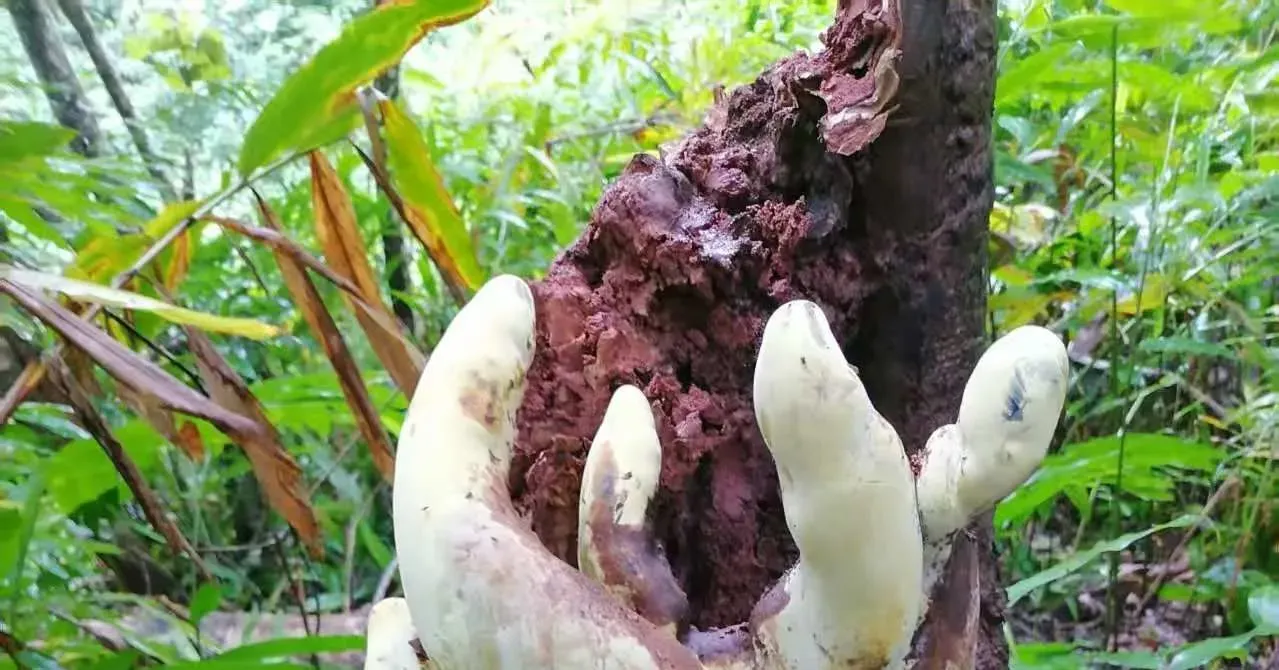
A new species of giant fungus has been discovered in China's Yunnan province, a region renowned for its rich biodiversity. The fungus, known as D.rex, belongs to the Ascomycete phylum, which comprises over 64,000 known species. This particular fungus produces massive fruiting bodies that are significantly larger than those of other Ascomycetes.
Unlike traditional mushrooms, Ascomycetes do not form caps and stems but instead produce structures called fruiting bodies to release spores for reproduction. D.rex's fruiting bodies can grow up to 20 inches tall and weigh nearly five pounds, making them enormous in size. This fungus constitutes an entirely new biological family within the Ascomycetes.
The discovery of D.rex highlights the vast fungal diversity that remains undiscovered in East Asian forests. Yunnan province is home to approximately 6,000 documented fungal species, but experts estimate that there could be as many as 100,000 more waiting to be discovered. The Nanban tropical rainforest was the site where Senanayake and his team first encountered large, whitish fruiting bodies growing near the roots of dying trees.
The lead author of the paper, Indunil C.Senanayake, an associate professor at the Kunming Institute of Botany, commented on the significance of this discovery in a press release. According to Senanayake, the finding demonstrates how much remains to be discovered about fungus biodiversity in East Asian forests.
The researchers documented an astonishing variety of fungal shapes, including cylindrical, spindle-like, and cupped palm forms, while collecting samples in the East Asian forests.
These peculiar growths developed distinctive finger-like branches as they matured, adding to their otherworldly appearance.
The above-ground portions of these fungi were covered with a fine white powder that darkened to yellow as they ripened, whereas the buried sections remained black and smooth.
Meanwhile, the rapid drying process observed when lab samples were taken appeared to preserve the intricate texture of the fungi's interiors.
The discovery of D.rex has left scientists puzzled by its surprisingly limited genetic makeup for decomposition-related genes.
D.rex's genomic analysis reveals a striking difference compared to its closest relatives that feed on plant matter - it has roughly half the expected number of such genes.
According to Dr. Senanayake, this anomaly may be explained by D.rex's potential double life: living within healthy trees and feeding on dead plant material when they die.
This theory is still unproven but could account for how D.rex accumulates enough energy to grow its massive fruiting bodies.
The giant fungi must have a significant surplus of energy to achieve such enormous size, and Dr. Senanayake hypothesizes that the benefit of these towering structures lies in their ability to disperse spores more efficiently through wind currents in dense forests.
By standing above surrounding plants and fallen leaves, D.rex's fruiting bodies can facilitate spore dispersal - a crucial aspect of its life cycle.
The notion that D.rex lives a double life is intriguing, but it remains a hypothesis for now.
Facts based on reporting originally published by Wired.
You may republish this story, in full or in part, if you credit News Central Site and link to it (licence CC BY 4.0). Photos are not included.