Heavy Rainfall Accelerates Glacier Movement in Alaska
Scientists have discovered that heavy rainfall can suddenly accelerate glacier movement in Alaska, causing significant damage to surrounding landscapes.
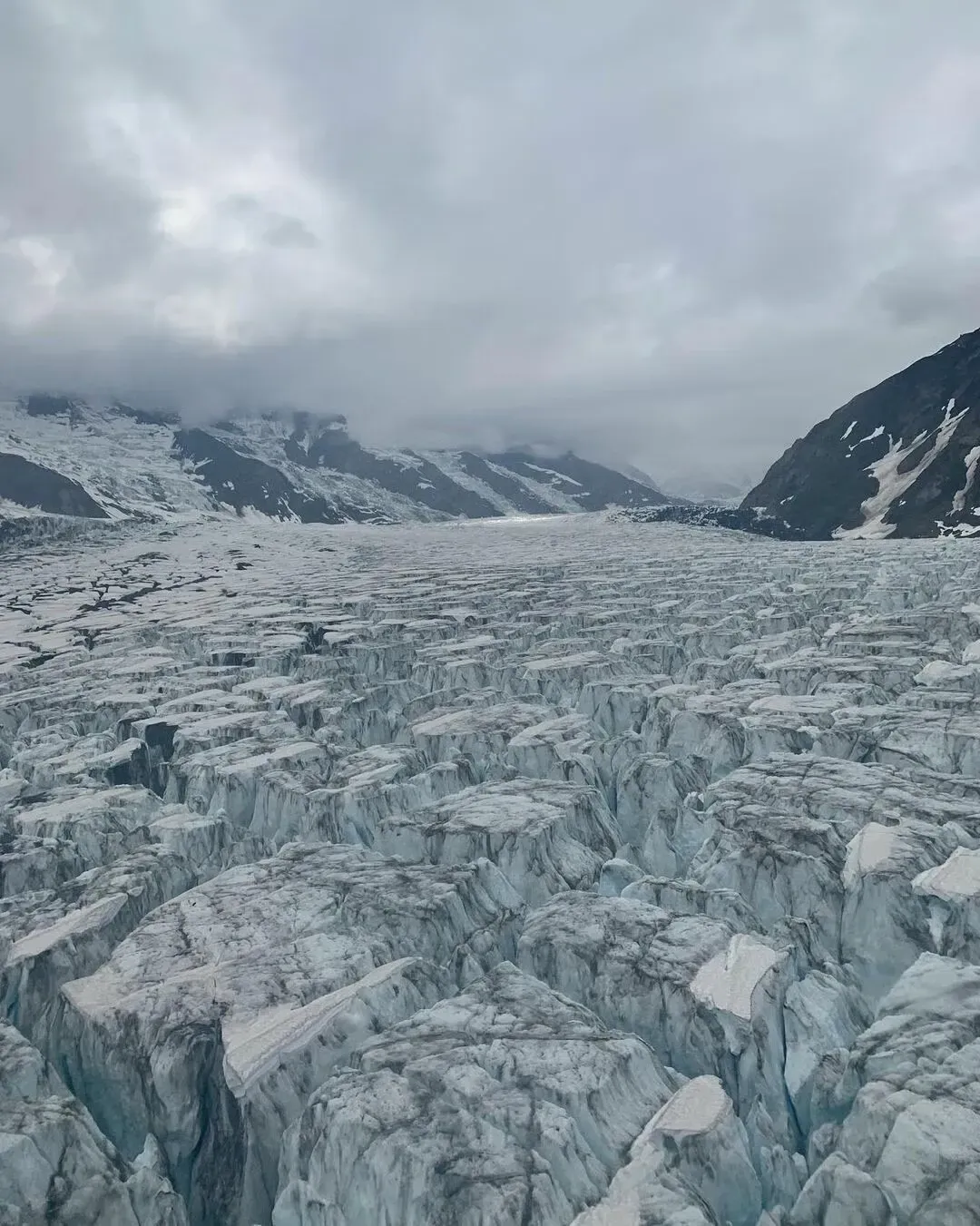
Glaciers in Alaska are known for their slow and steady movement down mountainsides, but researchers have discovered that heavy rainfall can suddenly accelerate them, causing significant damage to the surrounding landscape.
When glaciers surge, they can move at speeds many times faster than their normal pace, carving out valleys, creating crevasses on their surface, blocking side valleys with temporary lakes behind, or even triggering catastrophic flooding when these ice dams burst. This rapid movement has a profound impact on rising sea levels as glaciers melt and calve into the ocean.
Scientists are eager to understand the mechanisms behind glacier surges, particularly in relation to climate change, making it essential for them to monitor the instabilities of world's glaciers. By studying glacier behavior, researchers can gain valuable insights into the complex relationships between glaciers, rain, and sea levels.
To investigate how rain affects glacier movement, a team of researchers led by Parker Wilkerson from Boise State University chose to study the Sít' Kusá (Turner Glacier) in Alaska, which is known for its steep terrain and numerous crevasses.
The researchers used GPS measurements from instruments around the glacier to track its position every 15 seconds and monitor changes in short-term speeds compared to longer-term movement. These data were paired with rain estimates validated by nearby weather station readings at Yakutat Airport.
During a period of surge (2020–2021) versus slow flow (2022–2024), it was found that over half of rainfall events triggered speed-ups, with the highest daily increase reaching 7.5 meters in just one day - more than double the normal rate.
The surge also lasted twice as long as any during the quiescent period and typically began about 12 hours after heavy rain started, when precipitation exceeded at least 20 mm. The glacier returned to a stable state three days later.
Rain-induced speed-ups were less frequent during periods of slow flow but were more intense when they did occur, requiring 60 mm of rain since the start of the event and resulting in a much bigger percentage increase (251%) in speed.
These speed increases were proportionately larger given the glacier's slow background movement, even though they only peaked at an average of 1.5 meters per day - still more than double the normal rate.
Glacier acceleration was not uniform across both phases, with speeds increasing more rapidly in downhill sections compared to areas higher up in the valley. This disparity is thought to be influenced by a combination of factors, including the landscape topography and gravity.
The researchers attribute this phenomenon to the efficiency of the glacier's drainage system. An efficient drainage network allows rainwater and meltwater to drain away quickly, enabling the glacier to maintain its steady advance on the underlying bedrock.
However, an inefficient drainage system can hinder movement by trapping water in isolated pockets under the ice or in the sediment beneath it. As more water enters these areas, pressure builds up against the weight of the overlying ice, reducing friction and creating a lubricating layer that facilitates rapid sliding over the underlying ground.
This process is known as basal sliding, which can also occur when the weight of the ice reaches a critical point, causing high pressure to alter the temperature at which it melts.
The relationship between drainage efficiency and glacier speeds is crucial for scientists to refine their model projections of ice loss into the future. With shifting weather patterns leading to more frequent heavy rain events, glaciologists are likely to see an increase in surges in years to come.
These surges can have devastating consequences for coastal and island communities, particularly those at risk of flooding due to rising sea levels. The increased melting of glaciers in a warmer world will only exacerbate this problem, making it essential for scientists to understand the implications of glacier ice loss.
Glacier drainage systems are complex and dynamic, changing on various timescales from decadal to daily. This makes it challenging for scientists to predict how glaciers may behave in a warmer world, as some components of their behavior remain inherently unpredictable.
The ever-changing nature of glaciers means that models must be continually refined to account for new data and observations. As researchers strive to better understand the relationship between drainage efficiency and glacier speeds, they will need to incorporate emerging findings into their projections of ice loss.
Heavy rain can have a significant impact on glacier speeds in Alaska, with new research suggesting that it can more than double these rates.
The study found that during intense rainfall events, glaciers in Alaska's temperate regions experience rapid acceleration, which can lead to increased ice loss and potentially catastrophic consequences for the surrounding environment. This phenomenon is attributed to the increased drainage efficiency of the glacier due to heavy rain, allowing meltwater to flow more freely through the ice.
Facts based on reporting originally published by Phys.org.
You may republish this story, in full or in part, if you credit News Central Site and link to it (licence CC BY 4.0). Photos are not included.