Virtual Reality Setup Allows Scientists to Study Fish Interactions
Researchers created a virtual reality environment to observe how individual fish interact with their digital peers.
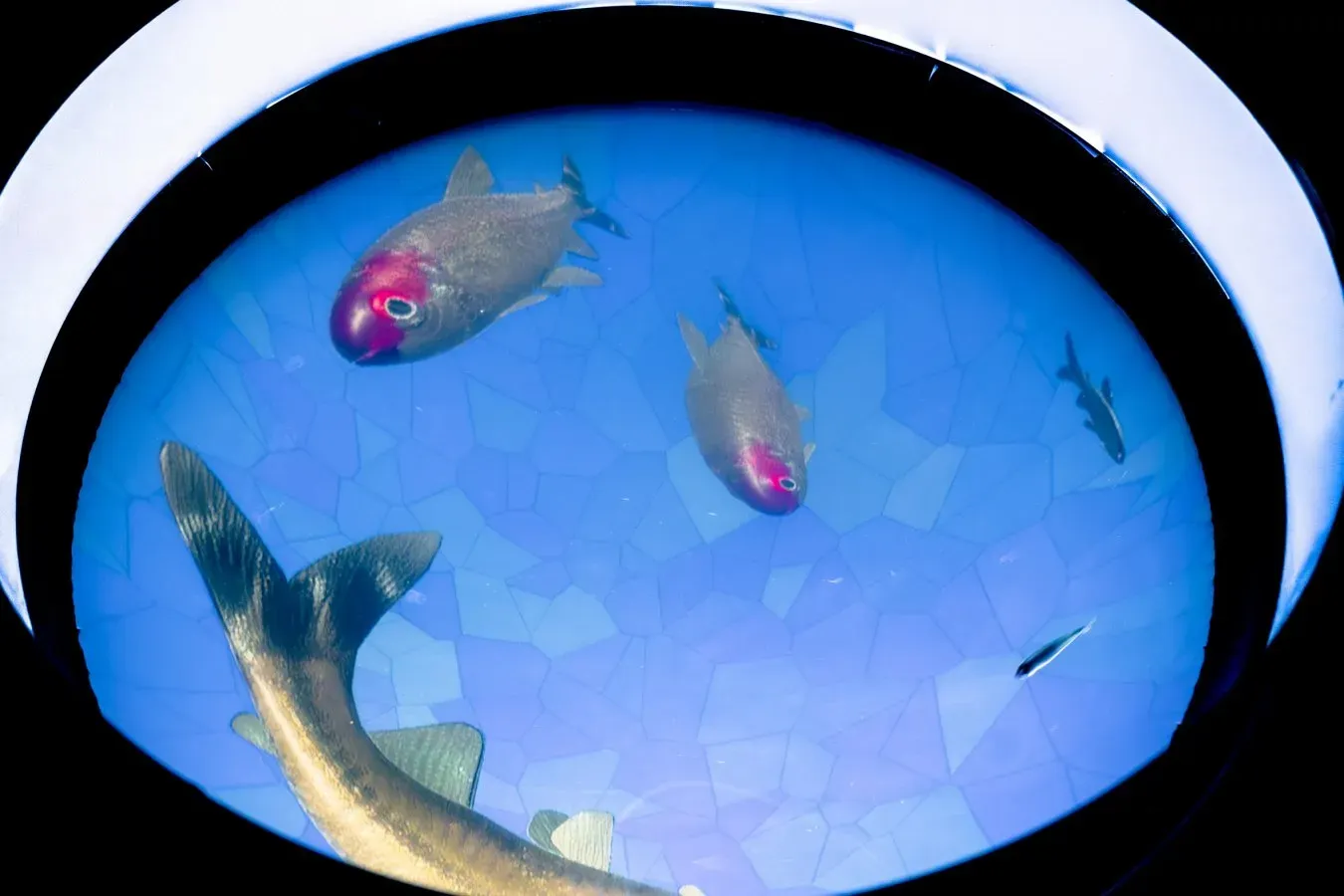
Researchers have created a virtual reality environment to study how individual fish interact within a group. The setup involves projecting four virtual fish onto a bowl containing a single live rummy-nose tetra, allowing scientists to observe and track the real fish's movements in relation to its digital counterparts.
The experiment aimed to understand how a single fish navigates a crowded school without becoming overwhelmed by the numerous interactions around it. According to Guy Theraulaz from the University of Toulouse in France, "a fish in a group can perceive, simultaneously, many, many individuals, but perception is not equivalent to influence."
The researchers used high-speed cameras and a sophisticated feedback loop system to monitor and control the virtual fish's behavior, making it seem as real as possible to the live tetra. This allowed them to create an immersive environment where the real fish could interact with its digital neighbors.
By studying how individual fish respond to their virtual peers, scientists hope to gain insight into the complex social dynamics of schooling behavior in fish.
In the virtual reality setup, researchers tested three hypotheses about how a real tetra would interact with its digital peers. They wanted to know if one influential fish could sway the behavior of the real tetra, or if it was more likely to be influenced by multiple fish working together.
The team's findings suggest that in fact, there is only one most influential fish at a time when it comes to the real tetra's behavior. This might seem counterintuitive, but according to researcher Gérard Theraulaz, it could simply be a matter of cognitive efficiency. By focusing on just one neighbor, the real tetra can reduce its sensory and cognitive demands.
Iain Couzin at the Max Planck Institute of Animal Behavior in Germany notes that this study confirms past observations about tetra behavior, which were pioneered by Theraulaz and his colleagues.
The study's findings have significant implications for understanding collective animal behavior, particularly in species that are difficult to study using traditional methods. By creating virtual environments, researchers can isolate individual animals and manipulate their surroundings without disrupting group behaviors.
This approach could revolutionize the field of behavioral research, allowing scientists to design complex virtual worlds tailored to specific hypotheses. In this case, researchers created a virtual environment where they could control the behavior of some tetras while observing the reactions of others in real-time.
The study's potential applications are vast, with possibilities for exploring the decision-making processes of various animal species and developing more accurate mathematical models to describe their behaviors.
Facts based on reporting originally published by New Scientist.
You may republish this story, in full or in part, if you credit News Central Site and link to it (licence CC BY 4.0). Photos are not included.