Strawberry powdery mildew caused by Podosphaera fragariae fungus affects global strawberry crops
Researchers led by Professor Teruo Nonomura investigated a Japanese fungus to control powdery mildew on strawberry plants, with contributions from Dr. Márk Z. Németh and Dr. Diána Seress.
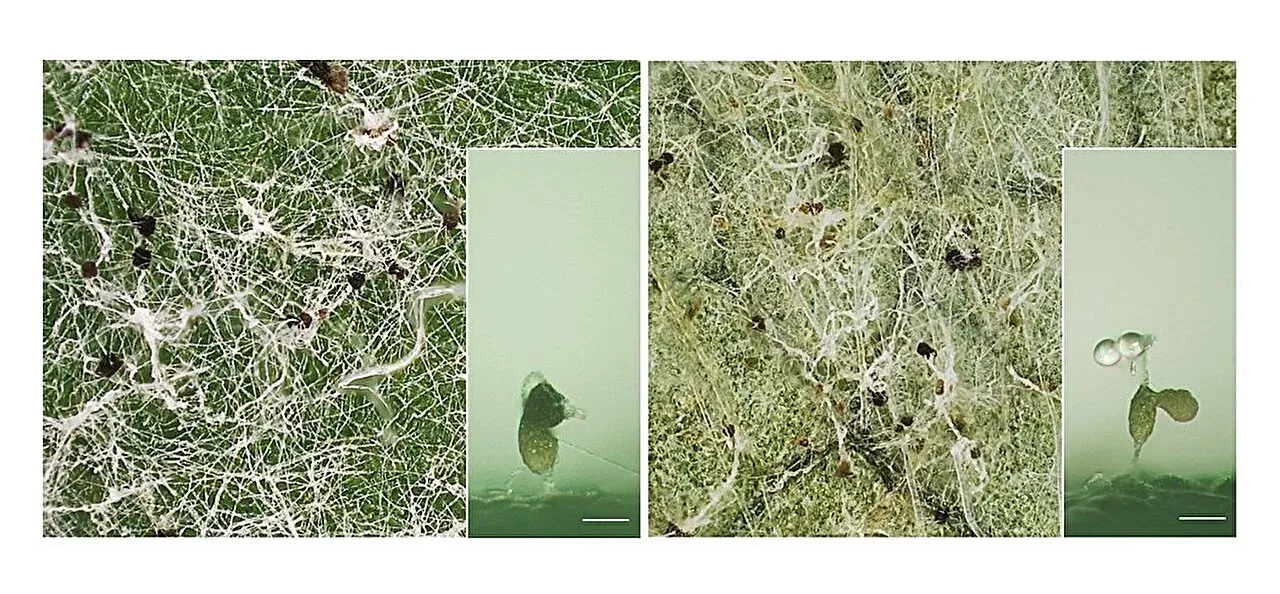
Strawberry powdery mildew is a serious disease affecting strawberry plants worldwide, caused by the fungus Podosphaera fragariae. This fungal infection can significantly reduce crop yields and fruit quality, making it a major concern for farmers.
The disease often manifests as white patches on the underside of leaves before spreading to the upper surface, which makes early detection challenging. White patches on leaves are an unmistakable sign that something is amiss with the plant's health.
Fungicides have been the primary method used to control powdery mildew, but repeated applications have led to the development of fungicide-resistant strains in many areas. This has prompted researchers to explore alternative methods to reduce chemical treatment reliance.
A team of researchers from Japan, Hungary, and Australia set out to investigate whether a specific Japanese fungus could suppress the growth of powdery mildew on strawberry plants. The research team was led by Professor Teruo Nonomura, with contributions from Dr. Márk Z. Németh, Dr. Diána Seress, and Professor Levente Kiss.
The researchers focused on Ampelomyces strain Xs-q, a mycoparasitic fungus from Japan that has shown promise in controlling various plant diseases. To test its efficacy against strawberry powdery mildew, the team applied Xs-q spores to 10-day-old PM colonies growing on strawberry leaves under controlled conditions.
The research team's online publication in Mycological Progress reveals a promising avenue for managing strawberry powdery mildew.
Under controlled greenhouse conditions, colonies treated with Xs-q showed a significant impact on the PM fungus, as no viable spores were detected from infected areas.
Microscopic analysis revealed that the parasite had invaded the host fungus, causing damage to its spore-producing structures, known as conidiophores. These damaged conidiophores eventually collapsed completely within 8-9 days after treatment, failing to form pycnidia where Ampelomyces produces its own spores.
In contrast, under growth chamber conditions, mature pycnidia developed inside the foot cells of PM conidiophores by around 11-12 days after inoculation with Xs-q. The new fungal structures predominantly formed in the foot cells near the base of the conidiophores on both upper and lower leaf surfaces.
The infection process was found to be consistent across different areas of the leaves, indicating that Xs-q can effectively combat PM in various environments.
These findings have significant implications for managing strawberry powdery mildew, particularly as it often develops on the underside of leaves where spore release can spread the disease to other plants.
The study on the beneficial fungus Xs-q has laid a foundation for further investigation into its potential as a biological control agent against strawberry powdery mildew and other similar diseases.
While the research shows promise, more work is needed to confirm Xs-q's effectiveness at the level of entire plants and crops. The development of practical methods for applying and producing this strain is also a crucial next step.
Researchers aim to eventually use this fungus as an alternative to chemical fungicides in agriculture.
Facts based on reporting originally published by Phys.org.
You may republish this story, in full or in part, if you credit News Central Site and link to it (licence CC BY 4.0). Photos are not included.