Solar Orbiter Spacecraft Discovers Origin of Switchbacks in Solar Wind
The European Space Agency-led Solar Orbiter spacecraft has made a groundbreaking discovery about the mysterious magnetic field lines known as "switchbacks in the solar wind.
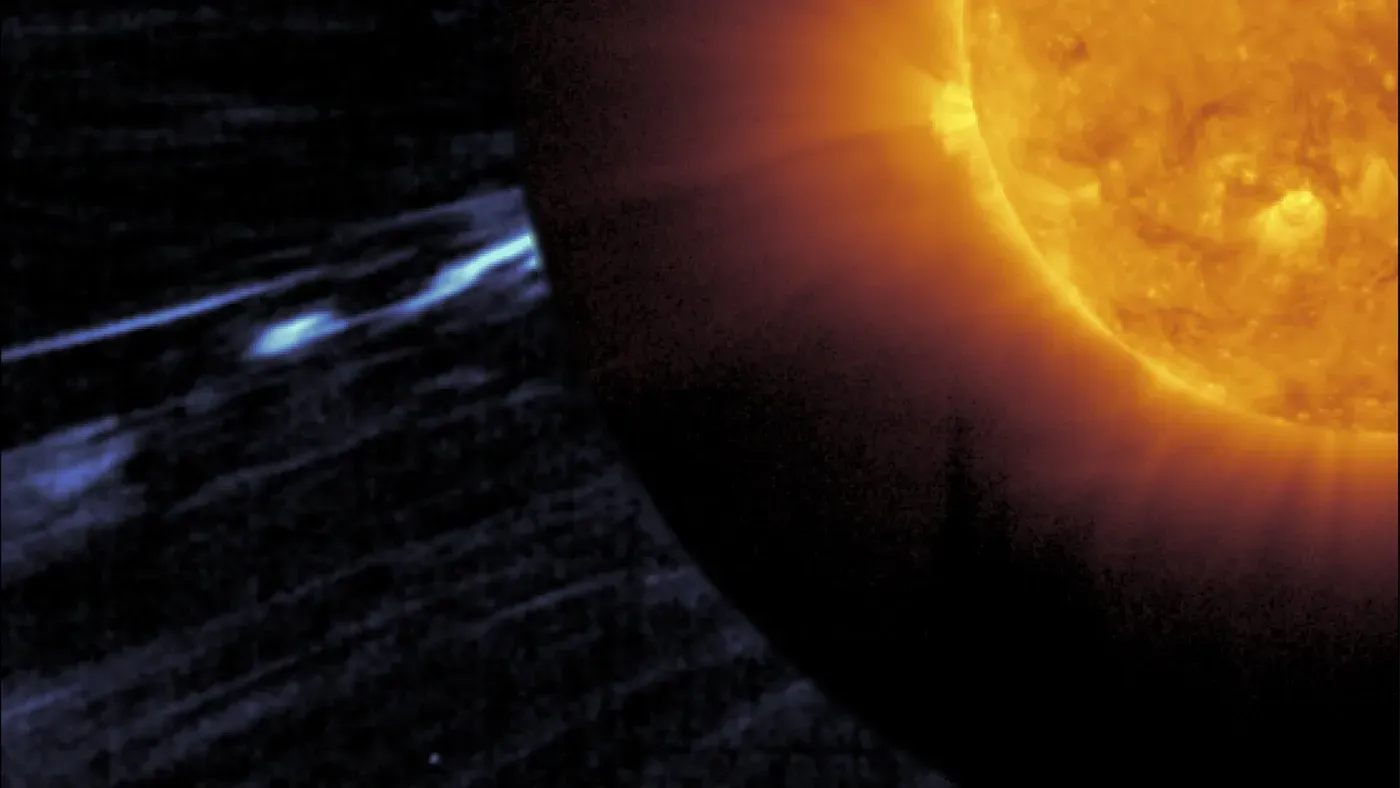
The European Space Agency-led Solar Orbiter spacecraft has made a groundbreaking discovery about the mysterious magnetic field lines known as "switchbacks in the solar wind. By flying through one of these S-shaped kinks, the spacecraft was able to identify the origin of the switchback and shed more light on the complex behavior of the sun's magnetic field.
The sun's magnetic field is incredibly dynamic and plays a crucial role in governing the star itself, as well as its impact on the surrounding space. The solar wind, a stream of hot charged particles that constantly flows away from the sun, carries this magnetic field with it into space, creating complex patterns along the way. These lines can twist, fold back on themselves, and even snap under the intense forces at play.
The interaction between the solar wind and its dynamic magnetic field lines is responsible for a wide range of phenomena in our solar system. By studying these events, scientists can gain valuable insights into what's happening on and around the sun.
In 2022, the European Space Agency reported that Solar Orbiter had detected a kink in the solar wind's magnetic field known as a switchback." While switchbacks have been observed near the sun before, there is still much to be learned about how they form. By witnessing one up close, Solar Orbiter provided crucial evidence for scientists looking to unravel this mystery.
The S-shaped structure of the switchback was something that scientists had predicted but never directly observed until now. The discovery made by Solar Orbiter has helped to advance our understanding of solar magnetism and its role in creating potentially hazardous solar storms.
The Solar Orbiter spacecraft has made another significant discovery in its exploration of the sun's magnetic field. By tracing a switchback - a region where the solar wind's magnetic field reverses direction - back to its source at the sun, scientists have gained valuable insights into the formation process.
To achieve this breakthrough, researchers used data from Solar Orbiter's Solar Wind Analyser instrument, which sampled the plasma making up the switchback. The spacecraft was positioned roughly halfway between Earth and the sun when it encountered the switchback, allowing for a unique opportunity to collect data on its composition.
The analysis revealed a mix of charged oxygen and carbon particles that could only have formed within hot magnetic field loops at the surface of the sun. This finding is crucial in understanding the origins of solar wind and the mechanisms that drive its formation.
According to scientists, there are two main theories about how switchbacks form: interchange reconnection and another process yet to be identified. The discovery on Solar Orbiter suggests that interchange reconnection is the correct explanation, as it involves the interaction of parts of the sun with different magnetic properties.
The formation of switchbacks in the sun's magnetic field is a complex process that has puzzled scientists for some time. New evidence suggests that these mysterious structures are formed when an open region of the sun's magnetic field interacts with a closed one.
When this interaction occurs, the lines of magnetic force can become crowded and snap open, allowing plasma to escape into space. This process, known as interchange reconnection, is thought to be a key factor in the formation of switchbacks.
However, another theory proposes that switchbacks are formed through the action of waves and turbulence in the sun's corona. While this theory was initially considered an alternative explanation, new data suggests that both processes may play a role in the formation and movement of switchbacks.
The interaction between interchange reconnection and waves and turbulence seems to be a crucial aspect of switchback formation, with each process dominating at different stages of their lifetime.
A closer look at switchbacks has revealed that they form through a combination of interchange reconnection and wave-turbulence interactions.
The researchers created a new model that linked measurements from Solar Orbiter's SWA instrument to data from NASA's Solar Dynamics Observatory, allowing them to pinpoint the solar source of individual switchbacks in unprecedented detail.
This discovery sheds light on how the sun heats its atmosphere and accelerates solar wind particles into space. The findings also show that the sun's atmosphere leaves a unique signature on the particles making up this wind, potentially enabling scientists to reconstruct the history of solar plasma even from great distances.
As Daniel Müller, ESA project scientist for Solar Orbiter, points out, understanding the dynamics of the solar wind is crucial for protecting our planet from extreme space weather events.
The data collected by Solar Orbiter has revealed a crucial link between magnetic switchbacks in the solar wind and their origin in the sun's corona. This discovery is made possible by the spacecraft's unique proximity to the sun and its specialized instruments.
This research demonstrates the mission's ability to uncover new insights into our star and its interactions with its surroundings, providing a more detailed understanding of the complex processes at play. The findings highlight the importance of continued space exploration and monitoring of the solar wind for predicting and mitigating extreme space weather events that can impact Earth.
Facts based on reporting originally published by Phys.org.
You may republish this story, in full or in part, if you credit News Central Site and link to it (licence CC BY 4.0). Photos are not included.