Scientists Develop Materials with Tailored Properties through Metal-organic Frameworks
A new class of materials has been created that can be modified to suit specific needs by adjusting their metallic composition.
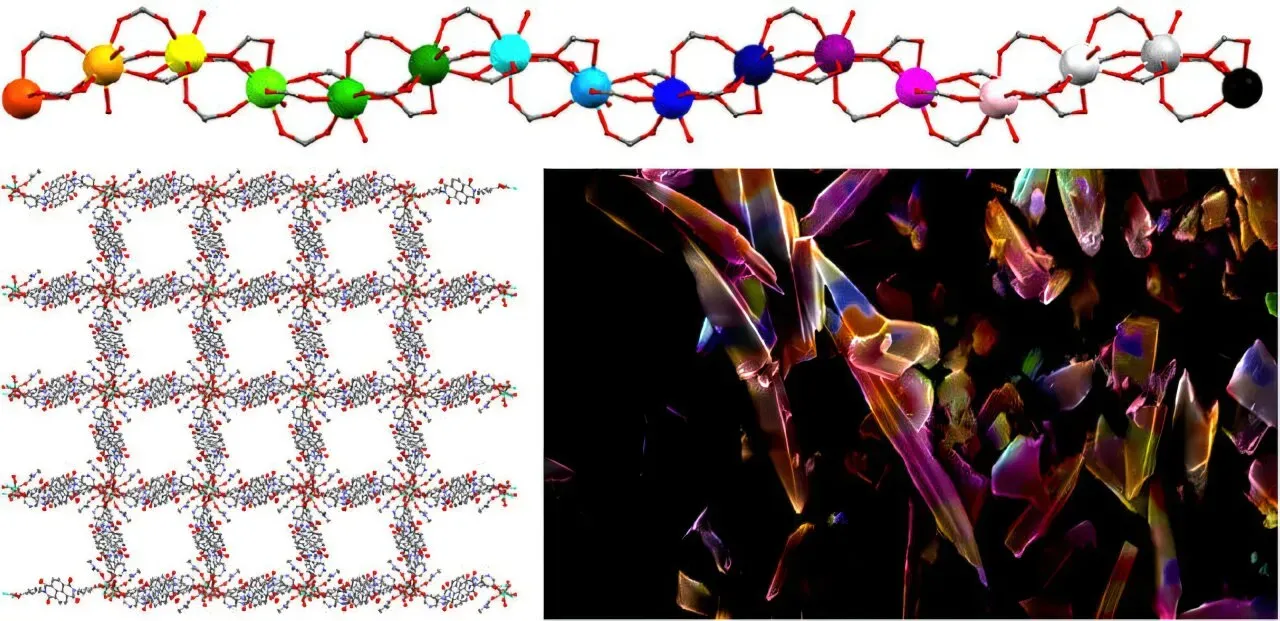
Scientists have developed a new class of materials that can be tailored to suit specific needs by modifying their metallic composition. This breakthrough has been made possible through the creation of metal-organic frameworks (MOFs) - highly ordered structures comprising tiny pores and metal atoms connected by organic molecules.
Led by researchers at the University of Birmingham, the team has successfully created MOFs with remarkably adaptable properties. By adjusting the proportions of metals within these materials, scientists can alter characteristics such as magnetism, porosity, light absorption, and carbon dioxide uptake.
Our research has made significant progress in developing 'programmable' porous materials that can be tailored to specific properties by adjusting their metallic composition.
This breakthrough is based on the concept of metal-organic frameworks (MOFs), which have a unique structure comprising internal spaces that enable interactions with target molecules. The porosity of MOFs makes them suitable for various applications, including gas storage and separation, sensing, catalysis, bioimaging, and magnetic materials.
To achieve this level of control over material properties, researchers first created 15 individual versions of UoB-116, each incorporating a different rare-earth metal. By structurally characterizing these versions, they gained insight into how the metals interact with the framework.
The next step involved combining multiple metals within the same underlying structure, progressively increasing the number from two to 12 and 15.
The researchers continued to push the boundaries of their "mix-and-match" material by adding indium to create a metal-organic framework (MOF) that contains 16 different metals simultaneously. This MOF, known as UoB-116, is notable for combining metals from three distinct regions of the periodic table: the d-block, p-block, and f-block.
By adjusting the proportions of two of these metals, dysprosium and lanthanum, the team discovered that it is possible to alter several properties of the MOF. This finding has significant implications for the development of custom materials with tailored properties across various industries.
MOFs are already being utilized as molecular sponges in a range of sectors, including major industries such as pharmaceuticals, catalysis, and energy storage, due to their unique ability to selectively absorb specific molecules.
Facts based on reporting originally published by Phys.org.
You may republish this story, in full or in part, if you credit News Central Site and link to it (licence CC BY 4.0). Photos are not included.