Researchers at University of Oxford Simulate Complex Particle Interactions Using Quantum Computer Setup
A breakthrough in simulating complex particle interactions has been made by researchers using a unique quantum computer setup, allowing for the study of lattice gauge theories in higher dimensions.
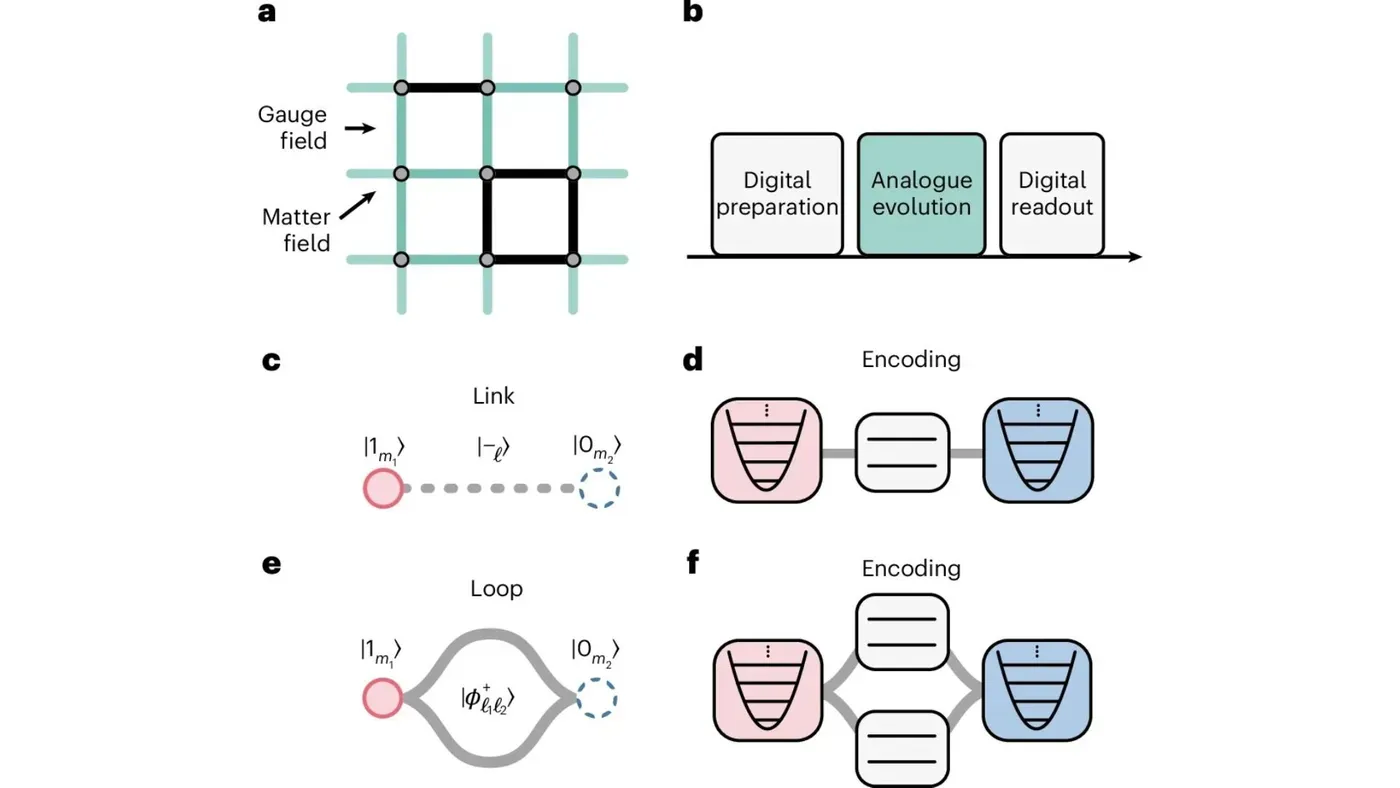
Researchers at the University of Oxford have made a significant breakthrough in simulating complex particle interactions using a unique quantum computer setup. In a new study published in Nature Physics, they successfully demonstrated the Aharonov-Bohm effect in a lattice gauge theory.
Lattice gauge theories are crucial for understanding how matter interacts with fundamental forces such as electromagnetism and the strong nuclear force. These theories form the foundation of the Standard Model of particle physics, which describes the behavior of subatomic particles. In a lattice gauge theory, space is represented as a grid with particles located at its vertices and gauge fields connecting them.
Quantum simulators have emerged as powerful tools for studying these complex interactions. However, most previous simulations of the simplest version of lattice gauge theory, known as Z₂, were limited to one spatial dimension, where certain effects cannot appear. This restriction has hindered scientists' ability to fully explore the behavior of particles in higher dimensions.
To overcome this limitation, the Oxford researchers employed a novel approach using trapped ions, which serve two purposes simultaneously. The electronic states of these ions encode gauge fields, while their vibrations represent matter. By harnessing the unique properties of trapped ions, the team was able to simulate a Z₂ lattice gauge theory in a quasi-two-dimensional loop.
The experiment's success has opened up new avenues for researchers seeking to understand complex particle interactions. To learn more about this groundbreaking study, Phys.org spoke with Sebastian Saner, the first author of the research paper.
Saner revealed that the idea of using entangled qubits to encode gauge-field flux was a pivotal moment in the project's development. This innovative approach allowed the team to simulate lattice gauge theories in higher dimensions and explore effects previously inaccessible to researchers.
The team's innovative approach used two trapped ions to create a closed loop, allowing them to study the effects of stored entangled qubit flux on a moving particle. This setup is crucial in understanding how particles interact with each other through gauge fields.
Gauge theories describe how particles such as electrons repel or attract each other through various fields. In these theories, matter fields represent the particles themselves, while gauge fields mediate their interactions. For instance, two electrons interacting through the electromagnetic field would be described by a gauge theory.
Some of the most fascinating materials in physics, including quantum spin liquids and high-temperature superconductors, are also governed by gauge theories. In these cases, the collective behavior of electrons gives rise to gauge fields that emerge from their interactions. Physicists often use Z₂ lattice gauge theories to study these materials, as they provide a simplified yet still accurate representation.
Z₂ lattice gauge theories describe systems where links on a grid can take only two values: present or absent. This is the simplest type of gauge theory and has been used to model topological quantum error correction. Theories in this category are particularly relevant when studying materials with complex electron behavior.
Simulating these theories on classical computers poses significant challenges, especially as the system size increases. Computational complexity grows exponentially with system size, making it difficult to study systems in higher dimensions. As a result, researchers often rely on experimental methods to study gauge theories.
In two spatial dimensions, links can form closed loops that can be pierced by magnetic flux, giving rise to quasiparticles called visons. These particles have no counterpart in one dimension, where loop formation is not possible. Researchers have used various experimental approaches to study Z₂ lattice gauge theories, but most of these methods are limited to one-dimensional setups or simplified models.
The researchers have found a way to simulate Aharonov-Bohm interference in a lattice gauge theory using trapped ions. These ions are unique because they possess both qubits and vibrational modes, but typically their vibrations are cooled down to facilitate interactions between qubits.
However, the team decided to utilize both properties of the ions. The electronic energy levels of a strontium ion were used as qubits to represent the gauge field on a link, while its vibrations behaved like harmonic oscillators to serve as matter sites. This dual approach allowed for a more efficient storage of matter fields in the vibrational modes.
In this simulation, a single phonon represents a matter particle, and an oscillator can hold any number of units of vibrational energy or phonons. The advantage of using vibrational modes is that they can store matter fields much more efficiently than usual methods.
The geometry of the lattice is determined by which qubits and vibrational modes are coupled together, rather than the physical positions of the ions. This allows for the creation of synthetic dimensions, even with the ions in a single line, where loops and other geometries can be formed.
To make the phonon hop between sites, the researchers applied two forces using a laser, each acting on a different vibrational mode and pushing in a direction set by the qubit's state. This process ties the particle's motion to the gauge field, as required by the theory.
The hopping of particles between sites causes the field line on the link to switch between present and absent, mimicking the behavior described in lattice gauge theories.
To further explore the behavior of particles within a lattice gauge theory, the team introduced a second ion into the system, effectively creating a loop and giving the particle two paths to choose from when traversing between matter sites.
The addition of this second qubit allowed for the encoding of flux through the loop by entangling the link qubits. This resulted in two distinct entangled states: one corresponding to zero flux, and the other representing a nonzero flux or vison.
According to Saner, the researchers faced significant challenges in translating theoretical concepts into practical experiment design. They needed to achieve precise control over hybrid interactions, develop effective state preparation techniques, and optimize readout methods.
The team observed that when a single ion was used to simulate one link between two matter sites, the particle exhibited tunneling behavior, switching between present and absent field lines as it moved back and forth between the sites. This phenomenon aligns with the Z₂ version of Gauss's law.
As the particle moved away from its starting site, a field line would emerge behind it but disappear upon return to the initial site. Initially, the researchers set the energy cost for creating a field line to zero, resulting in oscillations that were both fast and large-scale. However, when this cost was introduced, the particle's movement became energetically costly due to the need to constantly create new field lines.
The introduction of an energy cost led to significant changes in particle behavior, as moving between sites became increasingly difficult due to the energetic expense of creating a field line with each move. This suppression of tunneling is seen as a precursor to confinement in larger systems, where quarks are bound together within hadrons.
The researchers have observed that the trapped ions exhibit behavior consistent with the Aharonov-Bohm effect when they pass through a loop of two entangled qubits in a lattice gauge theory.
In this setup, each link in the loop acts as one of the paths around a region with magnetic flux. As the ion crosses a link, it acquires a phase determined by that link's gauge field, which is either positive or negative in the Z₂ case.
The experiment demonstrates how the entanglement state of the qubits affects the motion of the ions. When the qubits are in a zero-flux state, both paths contribute positively to the ion's phase, resulting in free tunneling between sites, twice as fast as on a single link.
However, when the qubits are entangled in a vison state, representing magnetic flux, the two paths give opposite contributions to the ion's phase. As a result, the particle remains stationary, with its tunneling completely suppressed due to interference.
The researchers also verified that the magnetic flux within the loop remains constant over time, except for a gradual decay caused by decoherence from environmental noise sources such as heating of vibrational modes.
Numerical simulations incorporating these noise effects matched closely with the experimental data obtained from the trapped ions.
According to the team, this study showcases how the hybrid approach can accurately capture the impact of magnetic flux on matter transport in lattice gauge theories.
The researchers are looking to expand their approach beyond its current limitations. They plan to apply it to more complex lattice gauge theories by allowing the gauge field to take on multiple values.
This would involve extending the Z₂ model to higher dimensions, such as Zₙ, where n represents a larger number of possible gauge field values. The team is also considering pushing the limit of the number of gauge field values towards infinity.
The ultimate goal is to develop a more comprehensive understanding of how magnetic flux affects matter transport in lattice gauge theories.
Facts based on reporting originally published by Phys.org.
You may republish this story, in full or in part, if you credit News Central Site and link to it (licence CC BY 4.0). Photos are not included.