Latin America's Mega-Prison Trend Gains Momentum
The El Salvador government has proposed building mega-prisons as a solution to organized crime, with some countries already planning similar facilities.
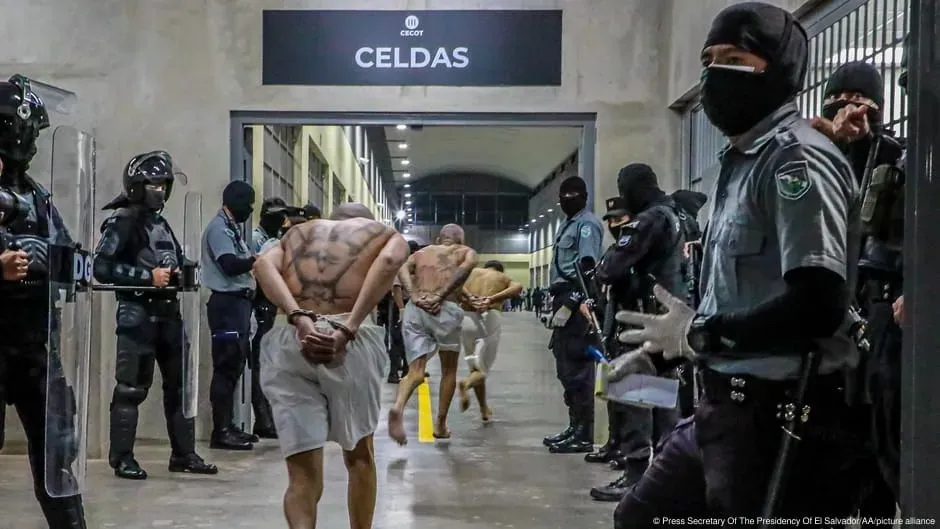
El Salvador's Terrorism Confinement Center (CECOT) has become a symbol of President Nayib Bukele's security policy and is being touted as a model for other Latin American countries to combat organized crime.
A dozen or so governments in the region have proposed building similar "mega-prisons, although most would have a far smaller capacity than CECOT, which can accommodate up to 40,000 inmates despite housing around 15,000. Prison sentences of up to 1,000 years are also being implemented, along with strict security measures and an extreme isolation regime.
Critics argue that these initiatives are not only ineffective but also unsustainable in the long term. Criminologists consulted by DW express concerns about the merits of building mega-prisons as a solution to organized crime.
The concept of mega-prisons is not new to Latin America, with overcrowded prisons having existed for decades. Lurigancho Prison in Lima, designed to hold 3,000 inmates, has been housing nearly 11,000 people for years.
Experts point out that the association between mega-prisons and maximum-security facilities can have a profound impact on prison populations, implying that all inmates require extremely severe punishment, according to Olga Espinoza, an academic specializing in prison systems at the School of Government of the University of Chile.
The notion of placing all prisoners in maximum-security facilities has been met with skepticism by experts who argue that it would be an inefficient and costly approach to corrections.
This strategy, they say, requires significant investments in infrastructure, technology, specialized staff, anti-corruption measures, and social reintegration programs, which can be overwhelming for governments already struggling with budget constraints.
When individuals from diverse backgrounds are housed together, there is a heightened risk of the spread of criminal behavior, as international evidence has shown, making maximum-security facilities an ineffective solution to overcrowding.
Several Latin American countries have seen the rise of powerful prison gangs that originated in overcrowded prisons, including Tren de Aragua in Venezuela and Primeiro Comando da Capital (PCC) in Brazil.
The idea of building mega-prisons as a cost-effective solution has been disputed by analysts who point out that there is not enough evidence to support this claim.
The mega-prison model in El Salvador has raised eyebrows among experts who question its effectiveness and potential for abuse. Critics point to the country's largest facilities as examples of where things can go wrong, citing the 2021 prison massacres in Ecuador that left a trail of bloodshed.
Reports suggest that mass incarceration has contributed to a decline in violence in El Salvador, but at what cost? The public may feel safer, but behind closed doors, allegations of arbitrary arrests and human rights abuses continue to surface. In fact, over 500 people have lost their lives while in state custody since the mega-prison model was implemented.
For some analysts, the image presented by the government, of a strong state cracking down on organized crime, is misleading. They warn that true success hinges on more than just symbolism; it requires tangible commitments to external oversight, human rights protections, and social reintegration programs. Without these measures in place, the benefits of mass incarceration are unlikely to last.
Perez Guadalupe's scathing assessment of El Salvador's mega-prison model is telling: he views it as a tool for propaganda rather than an effective solution to crime. He argues that images released from CECOT, such as those showing inmates in cramped, unsanitary conditions, are an affront to human dignity and a far cry from the promise of rehabilitation.
El Salvador's incarceration rate is one of the highest globally, thanks to mass arrests carried out under a state of emergency declared by President Bukele. The country's prisons are designed to hold members of notorious gangs like MS-13 and Barrio 18, which pose significant threats to public safety.
However, experts point out that the real challenge lies in rehabilitation, rather than simply locking people away indefinitely. Perez Guadalupe argues that society's ultimate goal should be to improve the lives of those who will eventually return to their communities. How we want them to leave: worse or better," he poses, highlighting the stark reality of recidivism.
In theory, there are guidelines in place for treating prisoners with dignity and respect. The UN Nelson Mandela Rules, updated in 2015, outline principles for modern prison management, including an absolute ban on torture and degrading treatment, as well as social reintegration as a central goal of imprisonment.
Prison systems across Latin America have implemented innovative approaches to rehabilitation, such as the APAC model in Brazil, which operates facilities without guards or violence. Other examples include Conflict Prevention and Resolution Committees in Argentina and the Alternative Criminal Justice Center in the Mexican state of Sonora.
In addition to addressing specific needs through maximum-security prisons, experts suggest a more nuanced approach to inmate classification and population management within these facilities.
Prisons, including mega-prisons like El Salvador's model, primarily deal with the aftermath of organized crime rather than its underlying causes, which include poverty, social exclusion, and limited opportunities.
Facts based on reporting originally published by DW English.
You may republish this story, in full or in part, if you credit News Central Site and link to it (licence CC BY 4.0). Photos are not included.