Landsat 9 Satellite Captures Green Cloud Off Canadian Coast
A stunning green cloud has been spotted off the coast of Vancouver Island in Canada, captured by Landsat 9 satellite imagery in February this year.
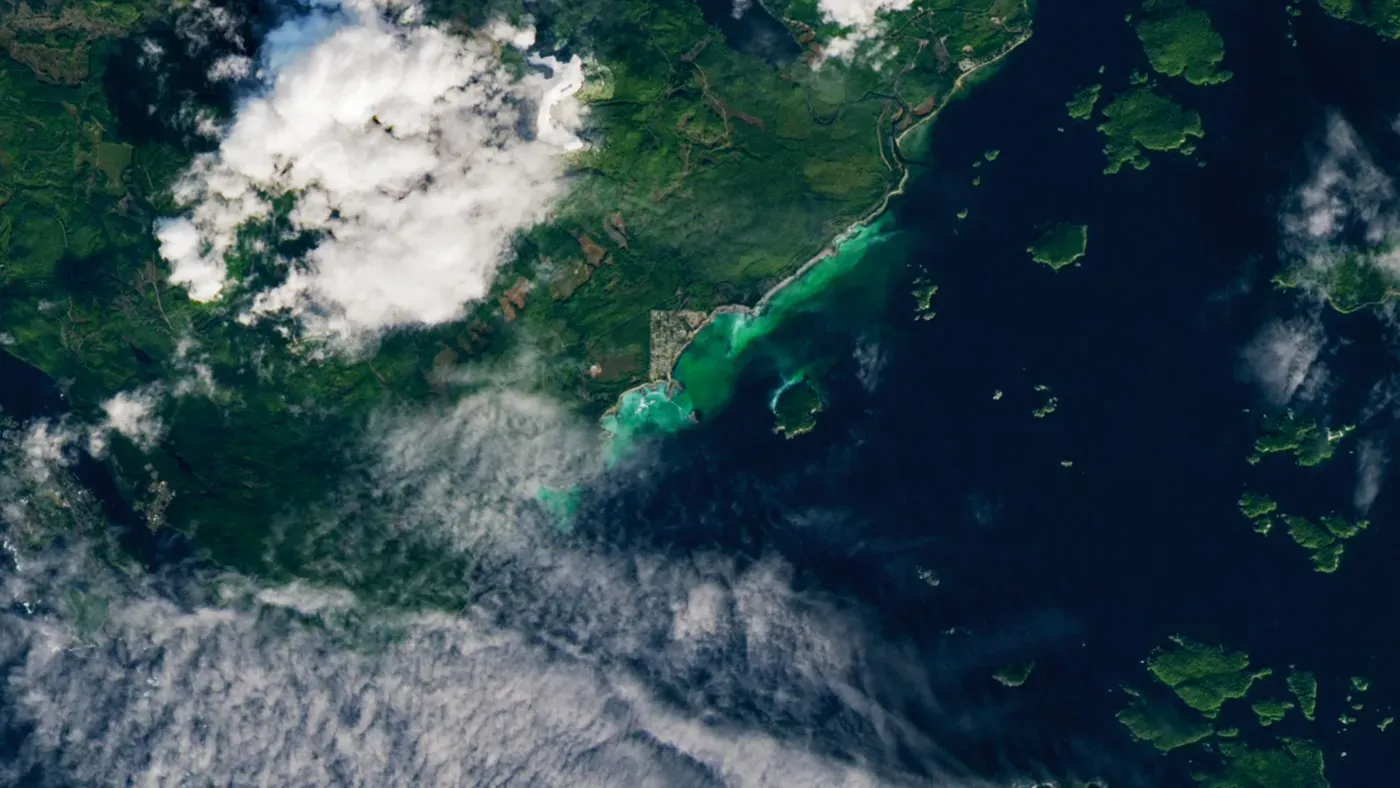
A stunning green cloud has been spotted off the coast of a Canadian island, captured by Landsat 9 satellite imagery in February this year. The vibrant plume is actually an underwater mass of fish sperm, released during a Pacific herring spawning event.
The reproductive "sweet spot" where this phenomenon occurred lies along Canada's western coastline, near the border with the United States. The cloud appears to glow green beneath the waves and stretches approximately 4 miles from end to end, its most concentrated section situated between Salmon Beach and Forbes Island.
The Pacific herring's unique reproductive process involves large groups of females laying eggs on underwater surfaces such as kelp or rocky areas, while males release their sperm in a dispersed manner, fertilizing the eggs in the process.
This phenomenon is not exclusive to the Pacific herring, as many other fish species also reproduce by congregating in large groups. The specific timing and location of these events are crucial for scientists studying marine life, who often rely on satellite images to monitor and track such occurrences.
In the case of the Pacific herring off Vancouver Island, the spawning event is a significant spectacle that attracts local residents and photographers like Ryan Cutler, who captured close-up photos using a drone.
The milky substance that appears green in photos of the Pacific herring spawn off Vancouver Island's coast is actually white when viewed up close.
This phenomenon occurs because the milt cloud is closer to the surface than the surrounding seafloor, resulting in less reflected light being absorbed by the water and giving it a greenish hue.
The coastline alongside Salmon Beach provides an ideal environment for herring to spawn due to its unique combination of protection from strong currents and rocky substrate that allows the fish to select areas with reduced salinity.
The herring population's annual migration to the Canadian coast is not only attracting marine life but also drawing in local hunters from First Nation groups, who rely on the fish as a vital food source.
As the herring spawn, they become a magnet for other predators, with large fish, whales, and sea lions converging on the area to feed on the abundance of fish. This influx of wildlife is not limited to marine life alone, however, as eagles, wolves, and bears also take advantage of the increased availability of food.
The distinctive green coloration visible in images of the herring's milt is due to a phenomenon where certain wavelengths of light are absorbed by water, causing the appearance of an eerie glow. This unusual display has captivated scientists and observers alike, providing a rare glimpse into the complex dynamics of marine ecosystems.
In a bizarre coincidence, this particular stretch of ocean was once host to a remarkable oceanographic event - a rogue wave that appeared seemingly out of nowhere in 2020, reaching heights equivalent to a four-story building.
A series of unusual phenomena have been observed in recent satellite images of the world's oceans. One such occurrence is a swarm of underwater earthquakes that took place around 150 miles south of Vancouver Island in March 2024. This event suggests that a section of the seafloor was experiencing significant stress, leading to a chain reaction of seismic activity.
The same region has also been host to other remarkable events, including a giant cloud of fish sperm that glowed green along its coast. This unusual spectacle is not an isolated incident, as similar occurrences have been documented in various parts of the world's oceans. In some cases, these phenomena are linked to changes in ocean currents or the presence of underwater structures.
The intersection of natural wonders and human activity has resulted in a complex tapestry of events that continue to unfold on our planet. The interplay between geological processes and marine ecosystems is still not fully understood, but ongoing research aims to shed light on these fascinating phenomena and their implications for the world's oceans.
Facts based on reporting originally published by Live Science.
You may republish this story, in full or in part, if you credit News Central Site and link to it (licence CC BY 4.0). Photos are not included.