IBM Achieves Breakthrough in Modular Quantum Computer Development
A team at IBM Research has successfully linked two large superconducting processors using four separate high-quality quantum links.
A breakthrough has been achieved in the development of modular quantum computers, where separate processors are linked to work together as a single machine. Researchers have long believed that this approach holds the key to more ambitious quantum computing projects, but creating reliable connections between these processors has proven to be a significant challenge.
The fragile nature of quantum information requires that any connections between processors must be able to carry this data without destroying it. For superconducting processors, which are cooled to just above absolute zero, building reliable links is particularly difficult due to the need for equipment that can withstand extreme cold and maintain signal integrity over long distances.
A team at IBM Research has now successfully linked two large superconducting processors using four separate high-quality quantum links. This achievement marks a significant milestone in the development of modular quantum computers, where multiple processors are connected to form a larger machine. The researchers' work is detailed in a new paper published on the arXiv preprint server.
The team's accomplishment builds upon previous research involving single connections between small experimental processors. These early links allowed for the transfer of quantum states and the creation of quantum entanglement, but they were not designed to handle the demands of larger machines.
To build more complex systems, engineers will need to develop techniques for installing multiple connections between processors that are already mounted in their refrigerators. These attachments must be able to withstand repeated warming and cooling cycles while maintaining signal integrity and minimizing signal loss over long distances.
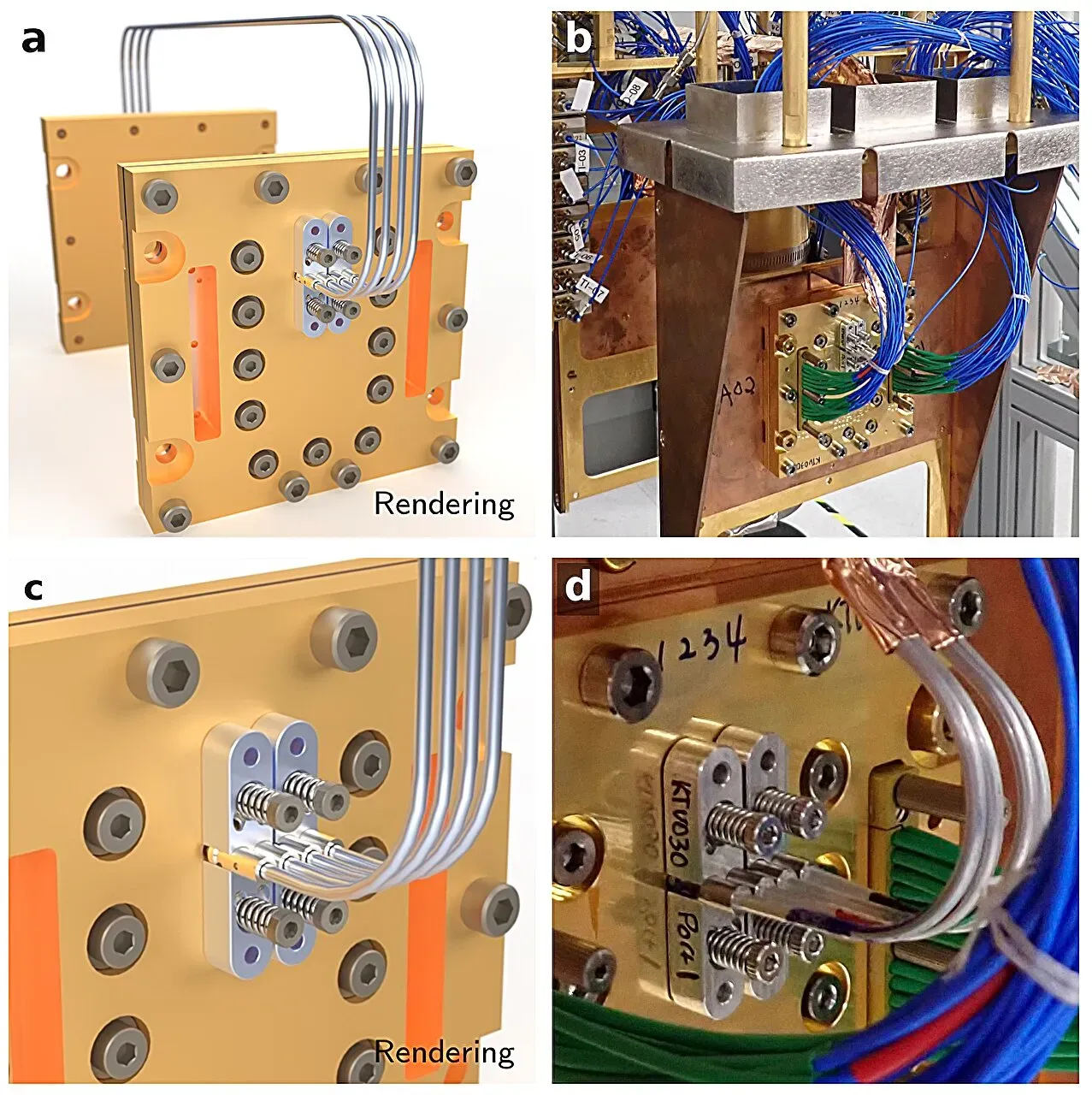
The IBM team has successfully linked two large quantum processors into one by connecting them through four superconducting cables. Each cable is approximately 31 inches long and made of aluminum. The setup allows for denser packing in the cables as they are plugged directly into the chip from above.
To enable the transfer of information between the processors, a qubit inside one processor passes its data to an interface qubit. An adjustable coupler then feeds this information into the superconducting cable, which carries it to matching components on the other chip.
The researchers tested their setup by transferring quantum states between the chips and performing logic operations involving qubits on both processors. The results show that quantum states were transferred with an average accuracy of 99%, reaching a maximum of 99.29% on one link.
Two-qubit logic operations spanning both processors achieved an average accuracy of 94.75%. Using these operations, the team created entangled states shared across both processors, including complex states involving four and six qubits. They also generated two entangled pairs simultaneously through neighboring links.
The new attachment approach enabled all four connections to remain operational after three cycles of warming and cooling without any significant signal loss or degradation.
The team's innovative approach to connecting quantum processors has significant implications for future computing systems. By linking two large quantum processors into a single system using four superconducting cables, researchers have demonstrated a scalable and reliable method for processing quantum information.
This new attachment technique allows multiple processors to be connected without compromising performance or stability. The four connections remained operational after repeated cycles of warming and cooling, ensuring that the system's integrity was maintained throughout the process.
The success of this project paves the way for more complex computing systems where quantum information is distributed across numerous processors. This would make it easier to expand and maintain these systems as they evolve.
This breakthrough has important implications for the development of future quantum computers, which will require scalable and reliable methods for processing and storing vast amounts of data.
Facts based on reporting originally published by Phys.org.
You may republish this story, in full or in part, if you credit News Central Site and link to it (licence CC BY 4.0). Photos are not included.