Groundbreaking Discovery Made in Astrophysics Using NSF VLBA
A team led by Paul Boven made a surprising discovery that both stars in DG CVn emit detectable radio waves, allowing astronomers to track their individual motions with remarkable accuracy.
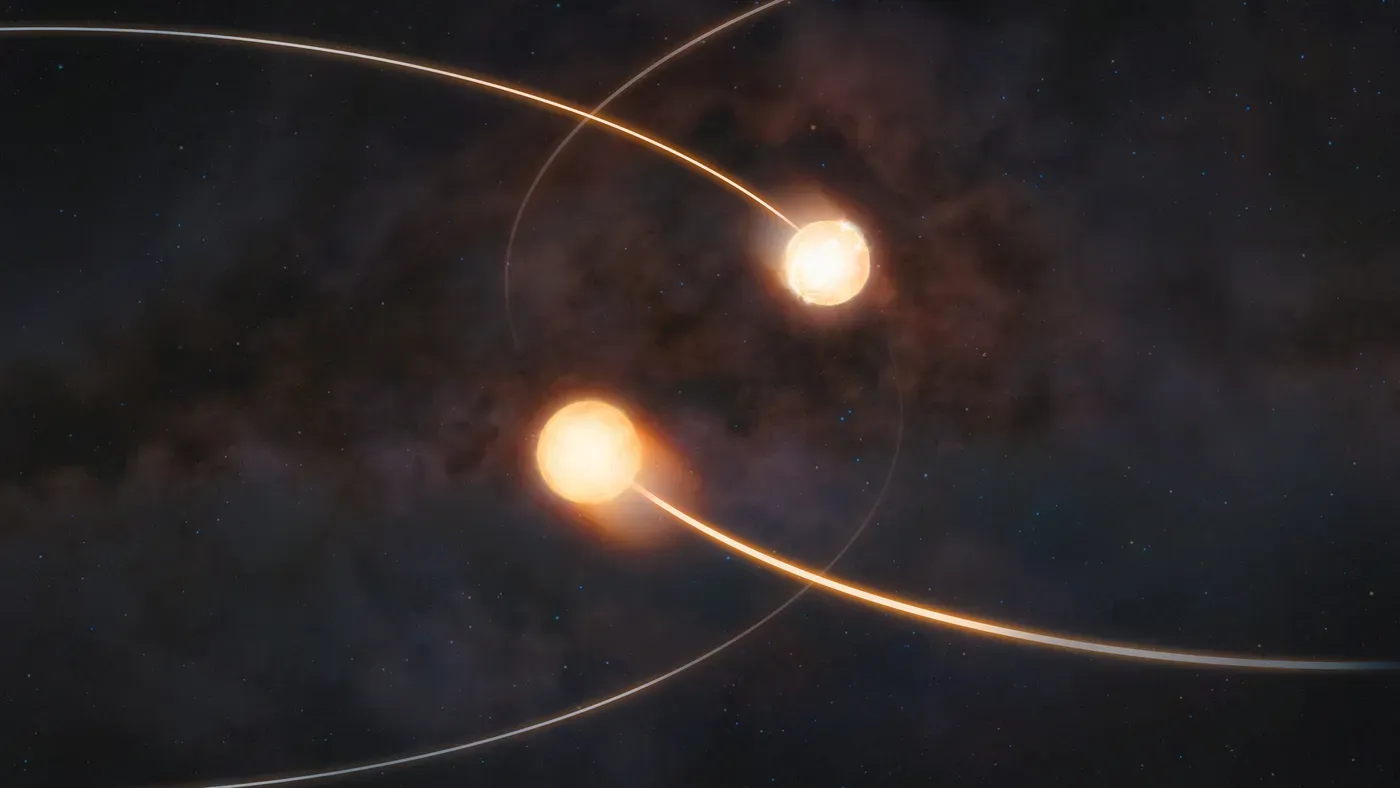
Astronomers have made a groundbreaking discovery in the field of astrophysics by measuring the orbit, masses, and distance of a pair of small, active stars with unprecedented precision. The observations were made using the U.S. National Science Foundation's Very Long Baseline Array (NSF VLBA), operated by the National Radio Astronomy Observatory (NRAO). This binary system, known as DG CVn, is located approximately 59 light-years from Earth and consists of two red dwarf stars that orbit each other.
A team led by Paul Boven, a network system engineer at the Joint Institute for Very Long Baseline Interferometry ERIC (JIVE), made the surprising discovery that both stars in DG CVn emit detectable radio waves. This allowed astronomers to track their individual motions across the sky with remarkable accuracy. The observations provide a detailed picture of this binary system, which is still relatively young, estimated to be between 30 and 150 million years old.
DG CVn is an interesting case study for astronomers because it consists of two red dwarf stars that exhibit intense activity. When these stars rotate rapidly, they generate powerful magnetic fields and intense flares that produce strong radio and X-ray emission. This makes them a rare and fascinating subject of study in the field of astrophysics.
The observations were made over an 18-year period, including new data collected between 2023 and 2025 using the NSF VLBA. By combining this data with previous observations, the team was able to determine the stars' orbit and masses with unusual accuracy. This achievement is a testament to the power of long-term observations in astronomy.
The study's lead author, Paul Boven, is a Ph.D. student at Leiden Observatory and a network system engineer at JIVE. His team's work provides valuable insights into the behavior of red dwarf stars and their potential for intense activity. The findings have been published in the journal Astronomy & Astrophysics, offering a new perspective on this fascinating binary system.
Further research is needed to understand the complex dynamics of DG CVn and its implications for our understanding of star formation and evolution. The study's results also highlight the importance of continued observations using advanced astronomical instruments like the NSF VLBA.
The system's radio emission has been found to surge dramatically following powerful X-ray outbursts, leaving astronomers with a pressing question: which star is responsible for this phenomenon?
The researchers' initial observations of DG CVn were motivated by a search for planets around nearby stars. However, the system's behavior proved far more complex than anticipated, exhibiting large and unpredictable motion that defied explanation.
We were fortunate to have developed the necessary tools to interpret these motions, said Boven, but the real surprise came when we detected a second radio-loud dwarf during our confirmation observations.
The team combined archival data from 2007-2010 with seven new observing sessions between 2023 and 2025 to produce 27 precise measurements of the system's two stars.
The team used the NSF VLBA's unique capability to combine the signals from its 10 radio telescopes across North America into a single, highly sensitive instrument. This allowed them to pinpoint the locations of the radio emission from each star with unprecedented precision.
DG CVn is an exemplary case of what can be achieved through precise radio astrometry, according to Jay Blanchard, an astronomer at the NSF NRAO and co-author on the study. By tracking the two stars over many years, researchers can observe their orbital motion directly and use that information to determine properties that would otherwise be extremely challenging to measure.
The observations revealed that the two stars orbit each other once every 4.511 years in a stretched, elliptical path. At their closest approach, they come within about 0.59 times the average distance between Earth and the sun.
DG CVn A is significantly more massive than DG CVn B, with approximately 39% of the sun's mass, while its companion has roughly 36%. These masses were determined using data from the team's observations.
The system is relatively close to Earth, situated at a distance of about 59.3 light-years away. Researchers employed a technique called parallax to calculate this distance by measuring the tiny apparent shift in the position of DG CVn as Earth moves around the sun.
Knowing both the system's distance and the way the two stars move around each other enabled the researchers to calculate their masses with exceptional accuracy, providing one of the most precise dynamical measurements yet for a binary system of this type.
The gravitational interactions between two stars in a binary system can have far-reaching consequences for their planetary systems. The close proximity of the stars in DG CVn, just 0.59 astronomical units apart, would have limited the size of the gas and dust disks surrounding each star as they formed.
This limitation likely had an impact on the formation of planets around these stars. To remain stable, a planet orbiting one of the stars would need to complete its orbit in under 23 days. Conversely, a planet that orbited both stars would require a much longer orbital period, lasting at least 36 years.
The constraints on planetary orbits imposed by the binary system provide valuable insights into how such systems can influence the formation and survival of planets. The close encounters between the two stars may have also played a role in shaping their planetary systems.
VLBI, or very long baseline interferometry, proved to be an essential tool for this research. By combining radio telescopes over vast distances, researchers were able to make extremely precise measurements of the binary system's position and motion.
The exceptional precision achieved through VLBI enabled the researchers to calculate the masses of the stars with great accuracy. This achievement highlights the power of advanced astronomical techniques in unlocking the secrets of celestial systems.
Measuring the tiny motion caused by an orbiting planet can be a key indicator of its presence. As a planet travels around its star, it creates a slight "reflex" motion that can be detected using sophisticated instruments like those employed in this study.
The study suggests that future radio telescopes could greatly expand our ability to measure the properties of binary star systems.
These new facilities will enable astronomers to detect the subtle effects caused by binary companions and distinguish them from planets orbiting nearby stars.
By achieving such precision, scientists can gain a better understanding of how these systems behave and interact with their environment. The ngVLA and SKA will be able to make precise measurements for many more distant stars.
The team hopes that future observations will allow them to detect planets in orbit around radio-loud dwarf stars, providing valuable insights into the formation and evolution of planetary systems.
Facts based on reporting originally published by Phys.org.
You may republish this story, in full or in part, if you credit News Central Site and link to it (licence CC BY 4.0). Photos are not included.