Groundbreaking Discovery Made by Japanese Researchers
A team of researchers has successfully isolated and cultivated two strains of Heimdallarchaeia, a group of archaea closely related to eukaryotes, providing valuable insights into the origins of complex cells.
A groundbreaking discovery has been made by a team of researchers led by Hiroyuki Imachi and Masaru K. Nobu from the Japan Agency for Marine-Earth Science and Technology (JAMSTEC) and Satoshi Nakagawa from Kyoto University.
The team has successfully isolated and cultivated two strains of Heimdallarchaeia, a group of archaea that are among the closest known relatives of eukaryotes - organisms that include humans, animals, plants, and fungi. This achievement provides scientists with valuable insights into the origins of complex cells.
Heimdallarchaeia is a significant find in the field of biology, as it offers clues to understanding how eukaryotic cells emerged. The team's research focuses on the archaeal ancestor of eukaryotes, which remains one of the biggest mysteries in biology.
The scientists have been studying Heimdallarchaeia for some time and previously cultivated a member of this group from deep-sea sediment in 2020. This earlier discovery led to the development of the E3 model for the origin of eukaryotes, based on the cell structure and metabolism of the isolated strain.
The team's new findings have been published in the journal Nature, providing a clearer picture than ever before of what the archaeal ancestor of eukaryotes may have looked like and how it lived. This research is an important step towards understanding the origins of complex cells.
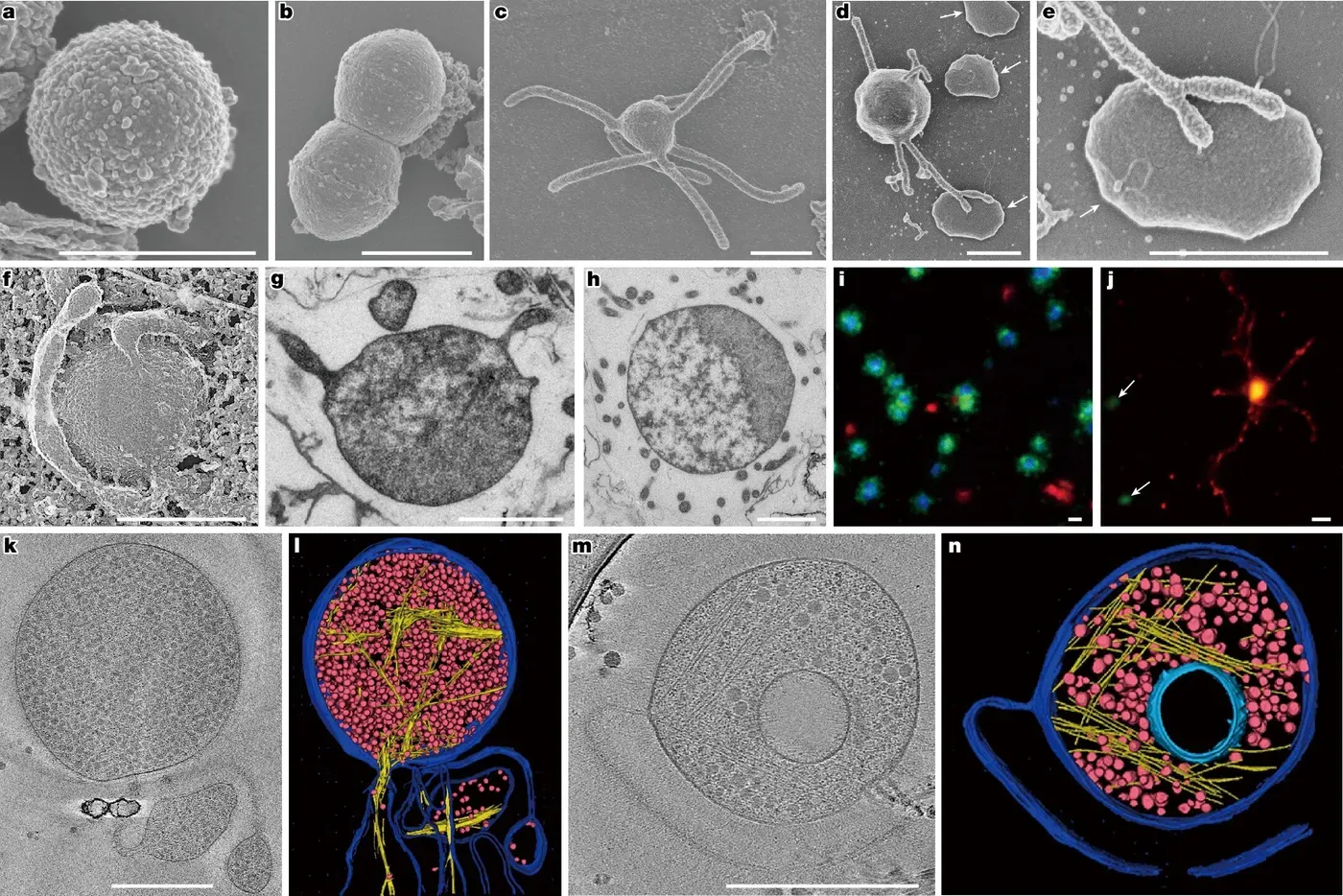
The team's success in cultivating Heimdallarchaeia strains has allowed them to directly examine their cell organization and physiology for the first time.
The internal structure of both strains was found to be simple, lacking membrane-bound organelles such as a nucleus, which is characteristic of eukaryotes. In contrast, their cell surface was complex, featuring multiple long, branching membrane protrusions that facilitate attachment to other microorganisms.
These protrusions play a crucial role in forming symbiotic partnerships between the Heimdallarchaeia strains and other microbes. This discovery sheds light on how archaea, which are typically thought of as simple organisms, can interact with their environment in complex ways.
One strain was found to have mechanisms that protect it from oxygen, despite being an anaerobic microorganism. This adaptation allows it to thrive even when small amounts of oxygen are present, as long as there are also aerobic bacteria around.
The findings suggest that the archaeal ancestor of eukaryotes may not have had a complex internal structure after all, but rather developed surface structures that enabled symbiotic relationships with other microbes.
The discovery of Heimdallarchaeia has provided significant insights into the origin of eukaryotes, with research suggesting that these ancient archaea may have formed symbiotic relationships with other microbes to survive in low-oxygen environments.
These partnerships could have played a crucial role in the evolution of complex cells, as one of the archaea may have taken in the bacterial ancestor of mitochondria, leading to major changes in cellular structure and metabolism.
The newly cultivated Heimdallarchaeia serve as valuable experimental models for studying the origin of eukaryotes, allowing researchers to investigate cell structures and interactions with microbial partners in greater detail.
Further investigation into these ancient relationships is likely to reveal more about how simple archaeal cells gave rise to the complex cells of eukaryotes.
Facts based on reporting originally published by Phys.org.
You may republish this story, in full or in part, if you credit News Central Site and link to it (licence CC BY 4.0). Photos are not included.