Rediscovered Fossil Belongs to New Dinosaur Species
A previously unknown species of dinosaur has been discovered in the collections of London's Natural History Museum after over a century of storage.
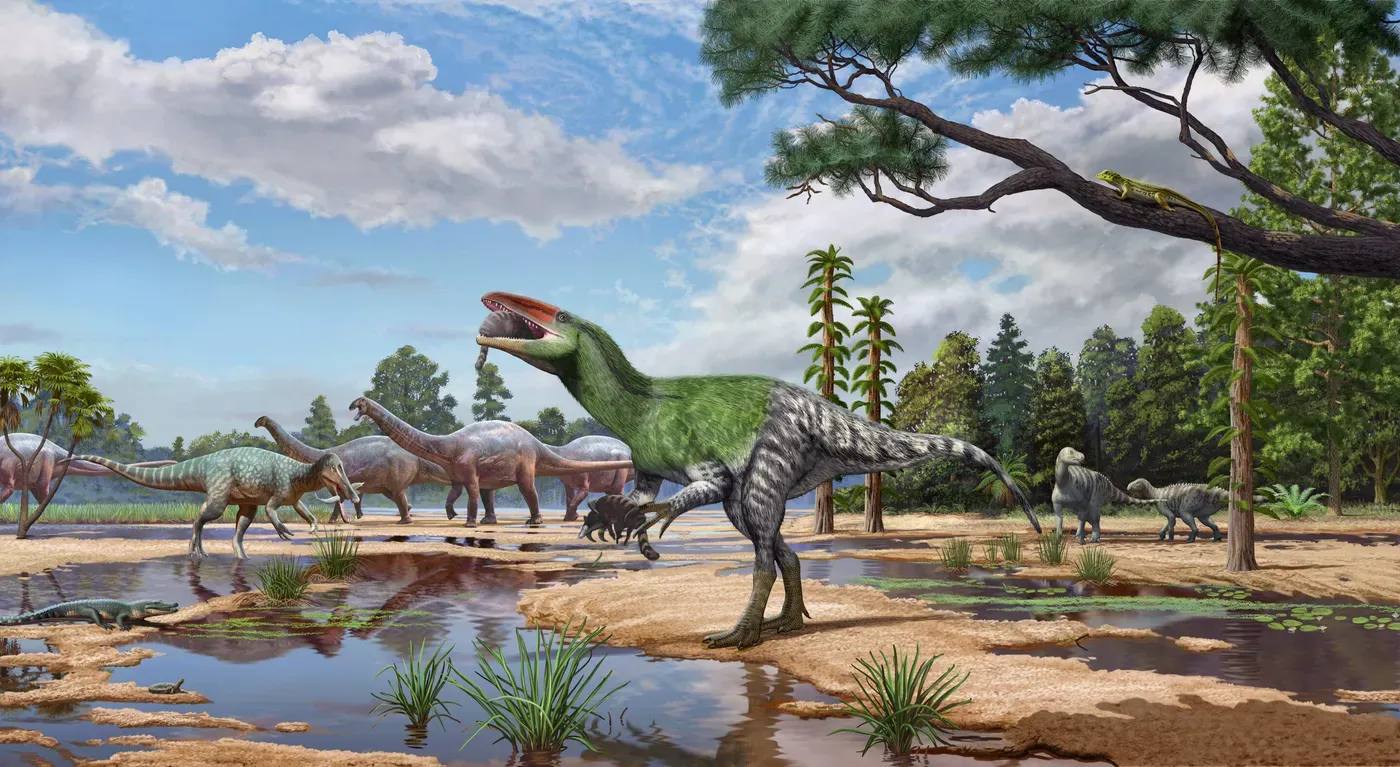
A long-lost fossil has been rediscovered in the collections of London's Natural History Museum after over a century of storage. The museum, which boasts an impressive collection of over 30 million specimens gathered over nearly 150 years, can sometimes overlook smaller items like fossils and rocks.
The newly unearthed relic belongs to a previously unknown species of dinosaur, a two-legged meat-eating theropod that has been named Invictibellatrix amberina. This discovery marks the first time a member of this particular family has been found in Europe.
Further investigation revealed that the fossil was initially discovered on a beach near Sudmoor Point on the Isle of Wight, an island renowned for its significant dinosaur fossil finds off England's south coast. The museum's paleontologists had likely overlooked it due to its small size and humble beginnings in storage.
Paul Barrett, one of the museum's experts, stumbled upon the key piece of evidence - a chunk of bone identified as part of a dinosaur skull - while reviewing the collections in 2020.
The fossil discovery on the Isle of Wight has led researchers to study it in detail and identify its origins. A Ph.D. student specializing in dinosaur braincases was enlisted to examine the fossil closely. The examination revealed that the roughly 120-million-year-old fossil belonged to a new species.
Further analysis showed that this new species is part of a mysterious family of carnivores called Megaraptora, known for their slender skulls and gigantic hand claws. These ferocious predators have been found across the globe, with most species coming from South America, particularly Argentina.
The newly discovered British species, Invictibellatrix amberina, stands out as smaller compared to other megaraptorans, measuring about 5 meters in length and weighing around that of a large tiger. This makes it the smallest known member of its family.
To determine the new species' place within the Megaraptora family tree, researchers compared it directly with skulls from other carnivores. They used computed tomography (CT) scanning to study the braincase and create detailed images inside it. This allowed them to make a more accurate analysis without bias.
The findings were then put into a computer algorithm to determine the species' place within the family tree.
The discovery of Invictibellatrix is significant because it represents an earlier stage in the evolution of megaraptoran dinosaurs, before they reached their massive sizes similar to those of tyrannosaurs.
Prior to the finding of Invictibellatrix, megaraptorans were known from only a few regions around the world. These included early Cretaceous sites in Thailand and Japan, which date back around 130-120 million years ago, as well as later Cretaceous discoveries in Australia and Argentina, which range from 85 to 66 million years ago.
The megaraptorans found in these locations were significantly larger than Invictibellatrix. This suggests that the new species may have been more widespread than its fossil record indicates, as it is unlikely that large animals such as megaraptorans could have crossed vast oceans between continents during the Cretaceous period.
The discovery of Invictibellatrix in Europe provides strong evidence for how megaraptoran dinosaurs dispersed across the globe. It appears that these animals traveled from Asia to South America and Australia, likely passing through Africa and Europe along the way.
This migration pattern implies that other megaraptoran fossils may be found in Africa and even Antarctica, which would expand our understanding of the group's global distribution during the Cretaceous period.
The discovery of Invictibellatrix amberina has shed new light on the lives of megaraptoran dinosaurs during the late Cretaceous period. These carnivorous theropods likely coexisted with other formidable predators in Europe, including Neovenator and Ceratosuchops.
These four species of dinosaurs probably occupied different ecological niches to survive, each feeding on distinct prey sources. The spinosaur, a relative of Spinosaurus, was well adapted for catching fish, while the others focused on land-based animals such as small dinosaurs, mammals, lizards, and even crocodiles.
The history of megaraptorans shares a common pattern with many successful species in nature - that of a small opportunistic organism thriving in the shadows of larger animals until it becomes the dominant force in specific ecosystems. This phenomenon is exemplified by the megaraptoran's rise to apex predator status in certain regions, including South America.
The discovery of Invictibellatrix amberina has also sparked renewed interest in understanding the evolution and behavior of megaraptorans. Despite providing valuable insights, the fossil leaves many questions unanswered, particularly regarding when this group first emerged on the planet.
The discovery of a new dinosaur species in the UK has shed light on theropod evolution and biogeography. The fossil, which dates back to the Lower Cretaceous period, was found in the Wessex Formation and features distinctive long claws on its feet.
Despite providing valuable insights, the fossil leaves many questions unanswered, particularly regarding when this group first emerged on the planet.
Facts based on reporting originally published by Phys.org.
You may republish this story, in full or in part, if you credit News Central Site and link to it (licence CC BY 4.0). Photos are not included.