Cosmic Microwave Background Provides Insights into Galaxy Cluster Composition
Researchers at Columbia University have analyzed data from the cosmic microwave background and found evidence of internal gas motions within galaxy clusters, which are massive collections of galaxies held together by gravity.
A faint glow in the universe, known as the cosmic microwave background (CMB), has provided new insights into the age and composition of the cosmos. This light, detectable for roughly 380,000 years after the Big Bang, predates the emergence of stars or galaxies.
Researchers at Columbia University have made a significant discovery by analyzing CMB data, revealing evidence that points to internal gas motions within galaxy clusters. These massive collections of galaxies are held together by gravity and represent some of the largest structures in the universe. The findings build on earlier research suggesting this phenomenon is real.
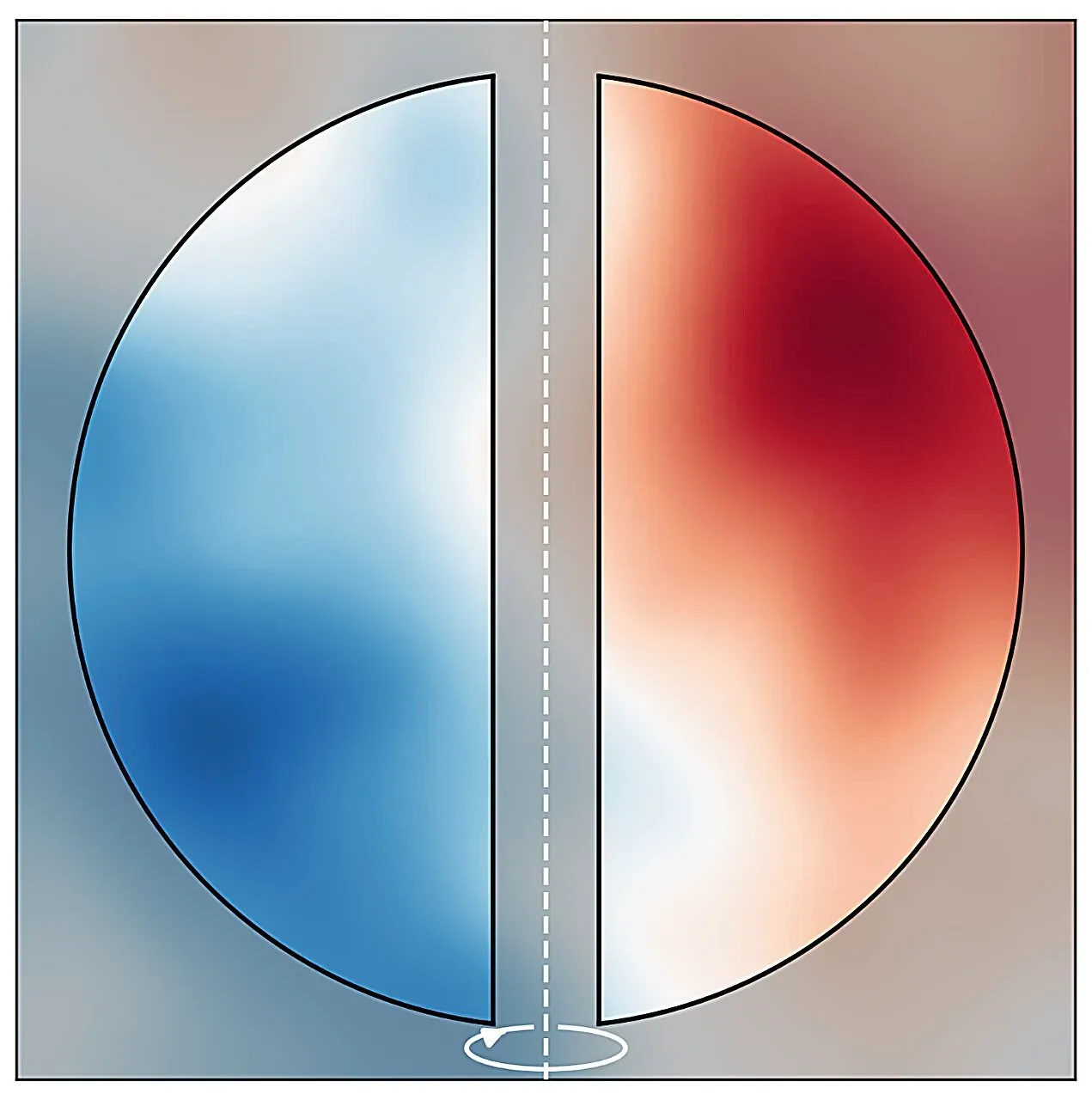
The scientists' work centers around a specific signal in the CMB that could be produced when photons pass through galaxy clusters. This process scatters the light, creating fluctuations in temperature between different sides of the cluster. If the gas within these massive structures is rotating, one side appears slightly hotter than the other.
This phenomenon is called the rotational kinematic Sunyaev-Zel'dovich (rkSZ) effect and was previously observed by other astronomers. The new findings from Columbia University's researchers strengthen this evidence and provide further insight into the behavior of galaxy clusters on a universal scale.
As part of their research, the team analyzed CMB data to gather more information about gas motions within these massive structures. Their work has shed light on how galaxies interact with each other and with the surrounding environment in which they reside.
The researchers built upon earlier work by Eric Baxter and his team, who had discovered initial hints of a phenomenon known as the rkSZ signal in galaxy clusters.
To further investigate this signal, Goldstein and Hill analyzed a larger sample of clusters than previously studied, employing new data-analysis techniques to enhance their sensitivity to the rkSZ effect.
The presence of gas flowing within galaxy clusters would leave distinct imprints on the cosmic microwave background radiation. Theoretically, it is expected to cause a slight alteration in the radiation's temperature.
Gas moving towards Earth would make the CMB appear slightly warmer, while gas receding from us would make it slightly cooler. This effect produces a characteristic dipole pattern across clusters whose rotation axis lies perpendicular to our line of sight.
The signal resulting from gas flow is typically too faint to be detected in individual galaxy clusters. To overcome this challenge, Goldstein and Hill combined CMB observations from 25 different clusters that showed signs of internal motion, such as rotation and mergers.
The researchers refined their analysis of the cosmic microwave background (CMB) maps to isolate fluctuations related to galaxy clusters.
To achieve this, they used Planck CMB maps derived from data collected by the European Space Agency's Planck satellite, carefully filtering out any unrelated variations in temperature and intensity.
A crucial step involved aligning and rescaling the CMB maps around each of the 25 selected clusters, ensuring that their internal motions were properly accounted for.
This meticulous process allowed the researchers to create a combined map of the CMB around these galaxy clusters, with each one's unique characteristics carefully incorporated into the overall dataset.
The discovery of gas motions within individual galaxy clusters has been a topic of interest for researchers in recent years. This phenomenon is particularly significant because it can provide valuable insights into the dynamics of these cosmic structures. The kinematic Sunyaev-Zeldovich (kSZ) effect, which measures the momentum of ionized gas throughout the universe, has become an increasingly important area of study.
The kSZ effect allows researchers to probe the movement and distribution of gas within galaxy clusters, providing a unique window into their internal dynamics. By analyzing cosmic microwave background (CMB) data, scientists can gain a better understanding of how these massive structures interact with their surroundings. This knowledge is crucial for advancing our understanding of the universe on large scales.
Goldstein and Hill's research has introduced a new approach to studying galaxy cluster dynamics by leveraging CMB data. Their innovative method involves analyzing the CMB signals associated with individual clusters, allowing researchers to probe gas motions within these structures in unprecedented detail. This breakthrough has significant implications for future studies of galaxy cluster formation and evolution.
The findings presented by Goldstein and Hill have sparked excitement among astronomers, who are eager to build on their research using new data sets from ongoing surveys. The Dark Energy Spectroscopic Instrument (DESI) and the Simons Observatory (SO) will provide valuable resources for studying galaxy clusters in greater detail. By analyzing these data sets, scientists can refine their understanding of gas motions within individual clusters.
The use of CMB data to study galaxy cluster dynamics has opened up new avenues for research in this field. The kSZ effect is a powerful tool for probing the internal workings of these massive structures, and future studies will likely reveal more about the complex processes that shape them. By continuing to analyze CMB signals associated with individual clusters, scientists can gain a deeper understanding of galaxy cluster formation and evolution.
As researchers continue to explore the properties of galaxy clusters using CMB data, they are also developing new techniques for extracting faint effects from existing data sets. This expertise will be essential for future searches for other subtle signals in the CMB, which could reveal more about the universe's underlying structure and evolution.
The research team's findings suggest that galaxy clusters are not static entities but rather dynamic systems with gas flowing through them. This phenomenon is thought to be driven by the gravitational interactions between galaxies within a cluster.
The presence of this gas flow in the CMB provides valuable insights into the universe's underlying structure and evolution, which will aid future searches for other subtle signals in the cosmic microwave background.
Facts based on reporting originally published by Phys.org.
You may republish this story, in full or in part, if you credit News Central Site and link to it (licence CC BY 4.0). Photos are not included.