Interstellar Comet 3I/ATLAS Found to Have High Concentration of Heavy Hydrogen
Astronomers have discovered that the interstellar comet 3I/ATLAS contains an unusually high concentration of heavy hydrogen in its methane signature.
Astronomers have discovered that the interstellar comet 3I/ATLAS contains an unusually high concentration of heavy hydrogen in its methane signature. This finding suggests that the comet's frozen ingredients were formed in a very cold environment around another star or within the cloud that preceded it.
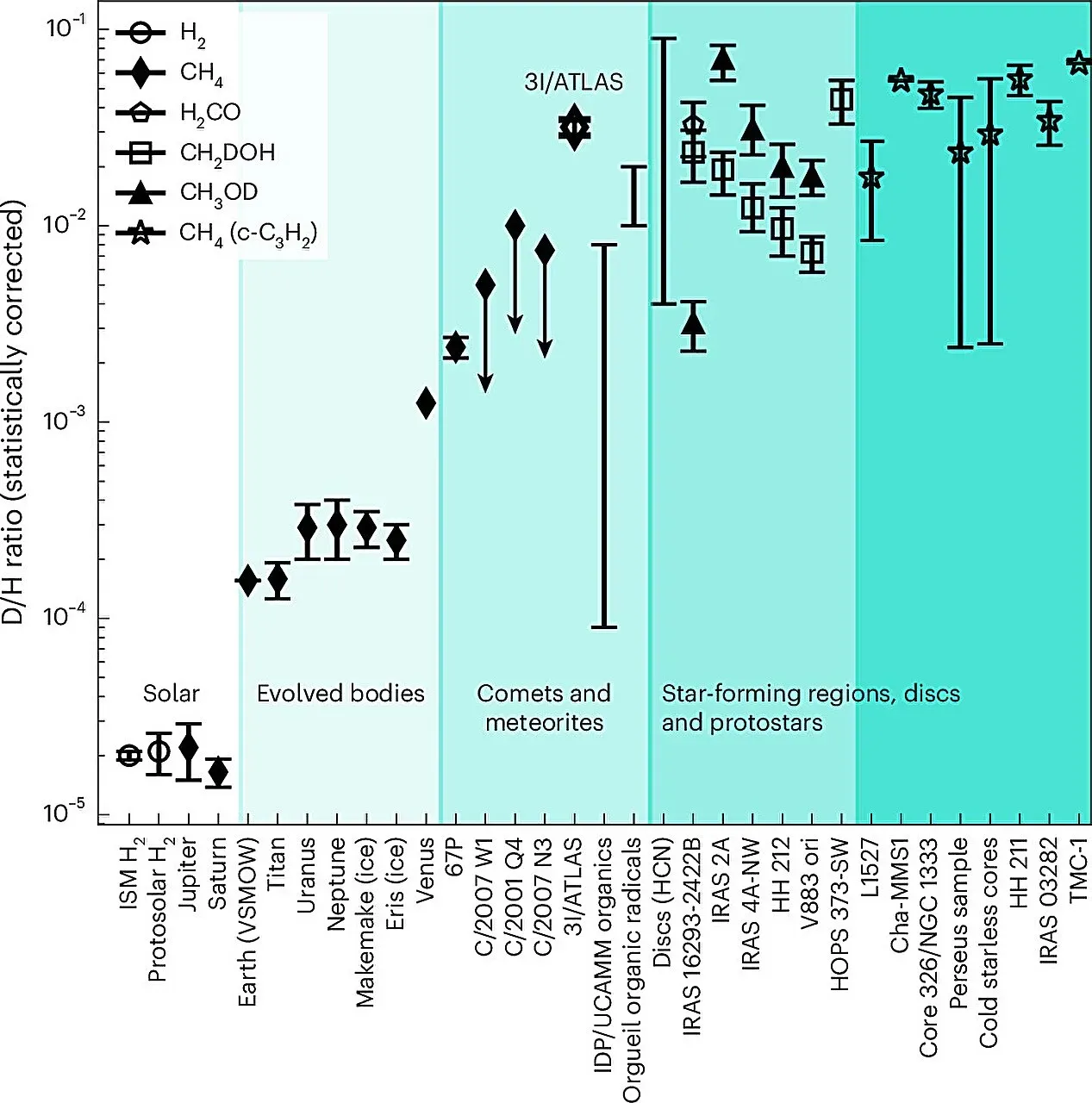
The research team, led by Nathan Roth from American University and NASA's Goddard Space Flight Center, used the James Webb Space Telescope to analyze the comet's chemical composition. Their measurements revealed a heavy-to-ordinary hydrogen ratio that is about 13 times higher than in comet 67P/Churyumov-Gerasimenko, which likely originated in our own solar system.
The high concentration of heavy hydrogen, also known as deuterium, indicates that the comet's methane molecules contain this rare isotope. Deuterium has an extra neutron in its nucleus compared to ordinary hydrogen, and it can replace ordinary hydrogen in a molecule of methane. This substitution affects the infrared signature of the molecule, allowing astronomers to distinguish between the two forms.
The presence of heavy hydrogen in 3I/ATLAS's methane signature provides scientists with valuable information about the early chemistry of another planetary system. By studying this comet, researchers can gain insights into the conditions that existed around other stars and in their surrounding environments.
Astronomers will now work to unravel the mystery behind the comet's formation, using the data from the James Webb Space Telescope as a starting point for further investigation.
The James Webb Space Telescope's observations of 3I/ATLAS have provided new insights into the composition of this unusual comet, which originated outside our solar system.
Webb observed 3I/ATLAS at a distance of about 2.4 times that between Earth and the sun, on December 22-23, 2025. The telescope focused on infrared light emanating from the coma, the cloud of gas surrounding the comet's icy nucleus. By isolating and subtracting light from other gases, researchers were able to detect faint signals of deuterium-bearing methane.
The detected D/H ratio in this methane is approximately 3.2%, a value higher than any previously recorded for methane within our solar system. This discovery has significant implications for understanding the origins of comets like 3I/ATLAS.
Comet 67P, another comet with detected deuterium-bearing methane, offers a useful comparison. Its D/H ratio is lower than that found in 3I/ATLAS, providing valuable context for further research into the comet's birthplace. The fact that 3I/ATLAS was born outside our solar system makes its composition even more intriguing.
In extremely cold environments, chemical reactions can favor the incorporation of deuterium into molecules. This process is thought to occur on interstellar dust grains, leading to the formation of deuterium-rich ice that eventually becomes part of a comet. The presence of this deuterium-enriched methane in 3I/ATLAS suggests that it was formed under conditions that allowed for such reactions to take place.
The discovery of deuterium-enriched methane in 3I/ATLAS has provided significant insights into its composition and formation process. A new measurement indicates that the D/H ratio in 3I/ATLAS's methane is approximately three times higher than previously measured in its water, suggesting a possible difference in timing.
The researchers propose that the methane may have formed later than the surrounding chemistry, allowing for more time to concentrate heavy hydrogen. This theory aligns with the notion of 3I/ATLAS originating from a cold cloud or an environment surrounding a forming star with relatively few elements heavier than helium and high rates of cosmic-ray bombardment.
Cosmic rays are believed to play a crucial role in enriching molecules in deuterium, initiating reactions that contribute to the formation of heavy hydrogen. This process is thought to occur in environments where energetic particles interact with ices, leading to the production of deuterated compounds like methane.
The measurement of high D/H ratios in 3I/ATLAS's methane presents a challenge for chemical models attempting to replicate this phenomenon. While some models have reported estimates that fall short of the measured value, direct comparisons are limited due to the scarcity of data on distant star-forming environments.
The comet's composition now serves as a stringent test for these models, requiring them to explain why its methane contains such high levels of heavy hydrogen. As 3I/ATLAS offers a unique opportunity to study the chemistry of distant environments, its findings will have significant implications for our understanding of molecular formation in space.
The analysis revealed that the interstellar object 3I/ATLAS has a higher ratio of deuterium to hydrogen in its methane than expected, suggesting that it formed in an extremely cold environment.
This finding is significant because it indicates that certain chemical processes can occur even at very low temperatures, which could have implications for our understanding of molecular formation in space.
Facts based on reporting originally published by Phys.org.
You may republish this story, in full or in part, if you credit News Central Site and link to it (licence CC BY 4.0). Photos are not included.