Breakthrough in Medical Technology: AI System Detects Rabies Virus Infection
Researchers at the University of Surrey's Institute for People-Centered AI have developed an artificial intelligence system to detect rabies virus infection in cell cultures, potentially speeding up and making more accessible the testing process.
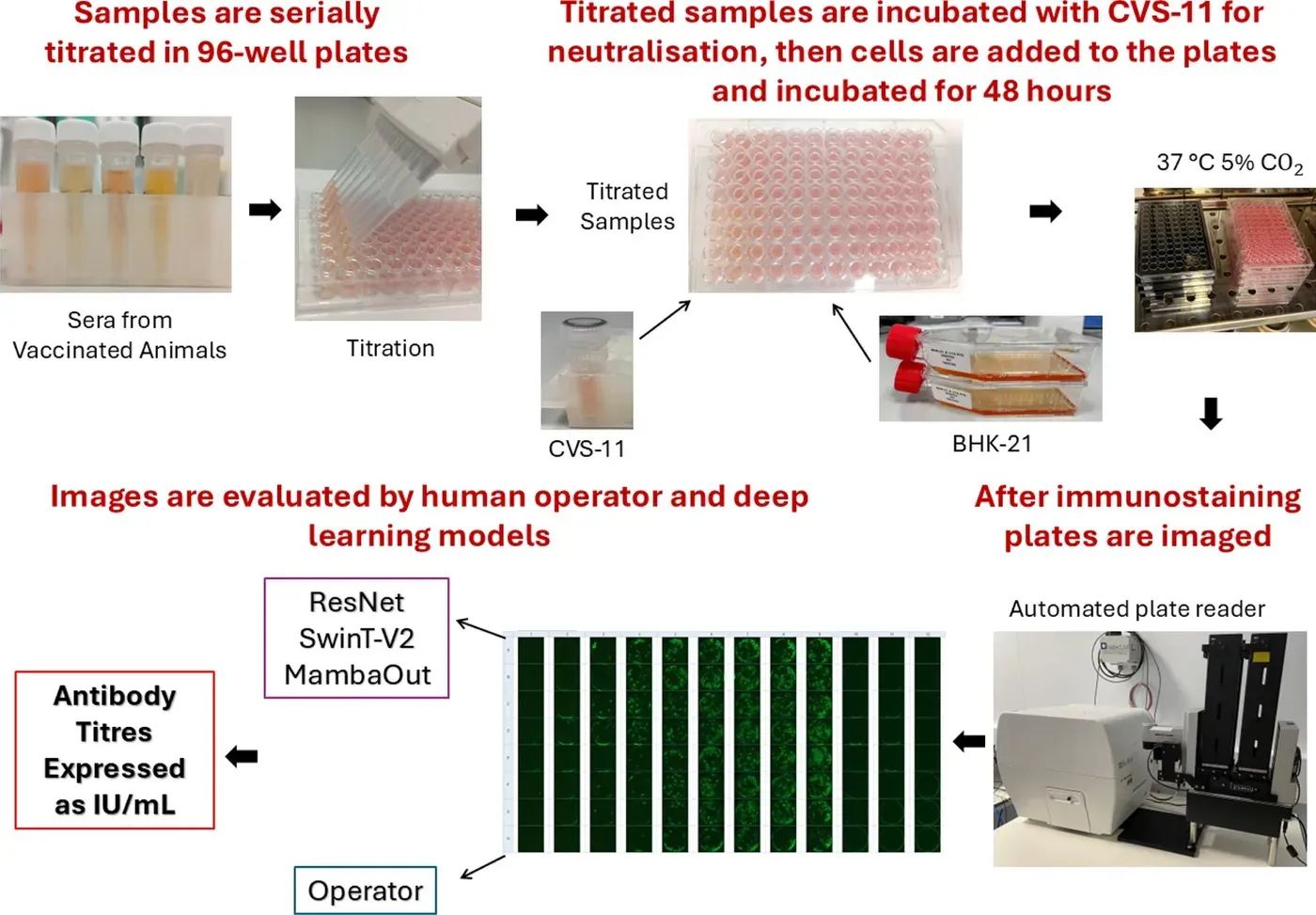
A breakthrough in medical technology has been announced by researchers at the University of Surrey's Institute for People-Centered AI (PAI), who have developed an artificial intelligence system to detect rabies virus infection in cell cultures.
The AI system is designed to speed up and make more accessible the testing process for rabies, one of the deadliest infectious diseases worldwide. According to statistics, nearly 59,000 people die from rabies each year despite vaccination being a highly effective preventive measure.
Current methods for diagnosing rabies rely on manual examination by specialists of thousands of microscope images, which is a time-consuming and labor-intensive process prone to subjective interpretation. This can lead to delays in diagnosis and treatment, exacerbating the spread of the disease in endemic countries.
The AI system was developed through collaboration with the Rabies and Viral Zoonoses team at the Animal and Plant Health Agency (APHA), with results published in a study in Scientific Reports.
The new AI system has been trained using a vast dataset of over 36,000 annotated image sections from more than 2,300 fluorescence images containing rabies virus infections within cells.
This extensive training enables the AI to accurately classify samples with a remarkably high rate of success, correctly identifying infected cells at an impressive 99.6% accuracy while minimizing false alarms.
Rabies remains one of the world's most deadly infectious diseases, claiming tens of thousands of lives annually due to difficulties in diagnosing and monitoring the condition, particularly in regions where medical expertise is scarce.
The AI system offers laboratories a more efficient and consistent method for analyzing samples, reducing reliance on manual interpretation and enabling quicker results, especially in areas where rabies is endemic and specialist knowledge is limited.
The technology also has the potential to accurately measure antibody levels used to assess vaccine protection and support international pet travel requirements, further enhancing global health standards.
The AI system developed by researchers has far-reaching implications for infectious disease research and diagnostics. The technology can be adapted to detect and analyze various pathogens, enabling its broader applications in this field.
Dr. Lorraine M. McElhinney, head of the National Reference Laboratory for Human and Animal Rabies at the APHA, expressed hope that this innovation would strengthen rabies surveillance and ultimately support global efforts to eliminate human deaths from the disease.
The AI system is being further developed to detect the virus in infected brain tissue, which could transform international rabies diagnostic laboratories.
Facts based on reporting originally published by Phys.org.
You may republish this story, in full or in part, if you credit News Central Site and link to it (licence CC BY 4.0). Photos are not included.