Breakthrough in Detecting Gravitational Pull Achieved by Researchers
A team of researchers at Shanghai Jiao Tong University has developed a new sensor capable of measuring tiny gravitational fields with high precision, potentially revolutionizing research into gravity and quantum physics.
A breakthrough in detecting gravitational pull has been achieved by researchers at Shanghai Jiao Tong University and other institutions. The team has developed a new sensor capable of measuring the tiny gravitational fields of objects just a few millimeters in size.
The force of gravity is notoriously difficult to detect on such small scales, as it is one of the weakest fundamental forces governing physical processes. Detecting its presence requires highly sensitive instruments, which are essential for advancing our understanding of quantum physics and developing new technologies.
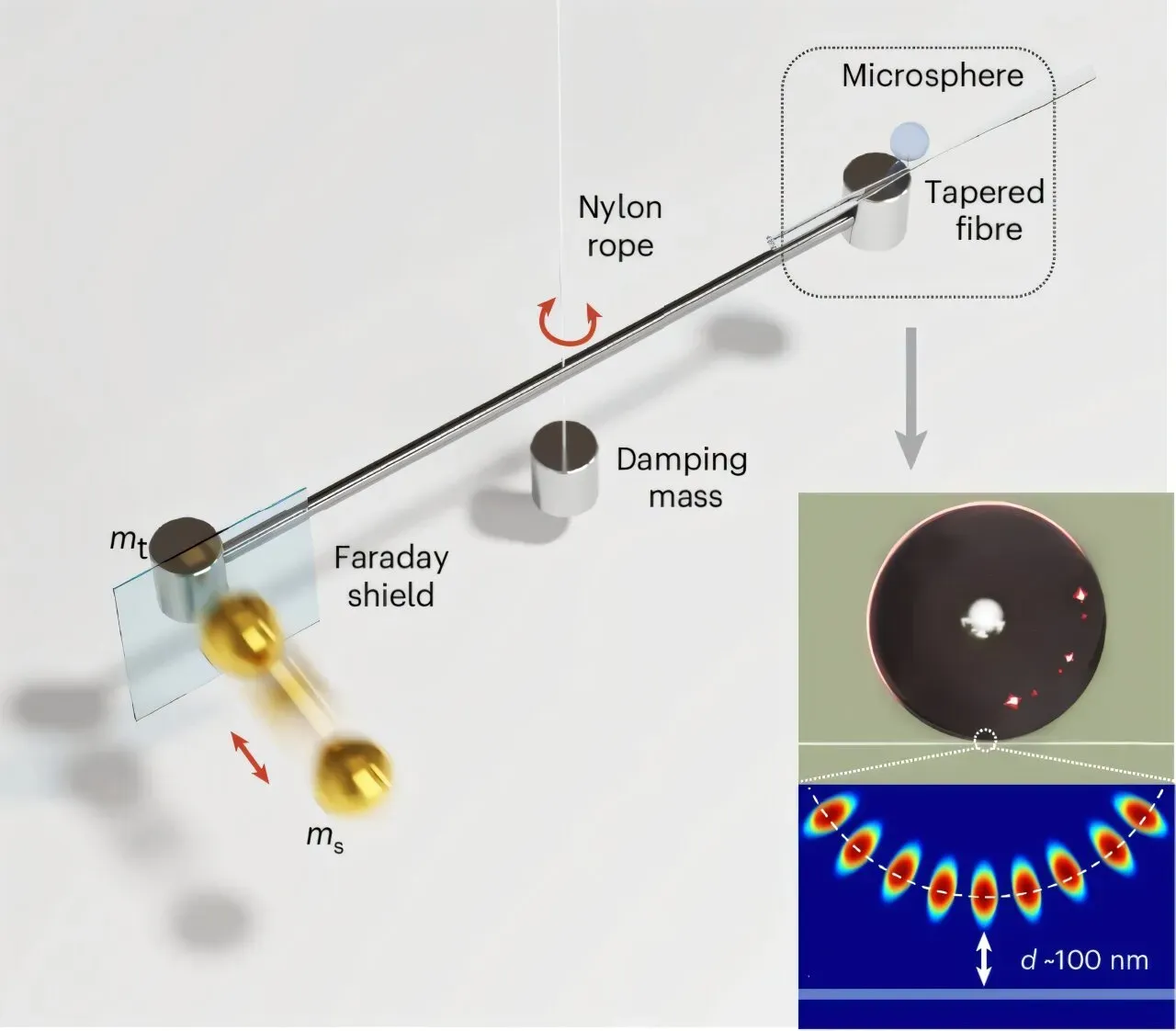
The sensor's design combines a torsion pendulum with an optical microcavity, which confines light in a tiny space. This setup allows researchers to manipulate and measure the effects of slowed light on the pendulum's motion.
This innovative approach has the potential to revolutionize research into gravity and its relationship to quantum physics, enabling scientists to explore new phenomena and develop more precise instruments for studying tiny objects.
The researchers have developed a new sensor that relies on the manipulation of slowed light to detect the gravitational pull exerted by tiny objects. This innovative approach involves using a torsion pendulum, which is a suspended structure that twists when its support is manipulated. The gravitational force from nearby objects causes a slight movement in this structure, which the sensor then measures.
The sensor uses an optical microcavity to measure these minute movements, and it's here that the slowed light comes into play. Light within the microcavity becomes linked with vibrations, resulting in a coordinated response between packets of light and vibrational energy. This interaction causes significant alterations in how light travels through the cavity.
According to the researchers' findings, this sensor has overcome one of the major challenges associated with detecting gravity from small source masses. They achieved this by integrating their torsion pendulum with optical microcavity readout, creating a highly sensitive gravitational-force sensing system.
The interaction between light and vibrations in the sensor produced "stopped light behavior," where the propagation of light pulses slows down dramatically. This phenomenon results in more pronounced changes to the measured light signal, allowing for greater accuracy when detecting tiny movements of the pendulum.
The sensor's unique design exploits a phenomenon known as coupled photon-phonon resonance, which slows down light to a mere 2,000 meters per second and produces steep optical dispersion. This slowed light behavior is crucial for the sensor's operation, as it enables the detection of tiny movements in the pendulum.
To test its capabilities, researchers used their sensor to measure the gravitational pull exerted by a millimeter-sized object on a pendulum. By periodically changing the position of this small object, they successfully detected even the slightest changes in the gravitational force acting on the pendulum.
The sensor's performance was impressive, with a displacement sensitivity of 7.85 picometers per square root hertz and an acceleration sensitivity of 3.06 times 10 to the power of negative 16 g. These exceptional sensitivities allowed researchers to detect minute changes in the gravitational force exerted by the object, with a minimum detectable change of 3.02 times 10 to the power of negative 16 Newtons.
The potential applications of this technology are vast, and could lead to new insights into the quantum nature of gravity. By using this sensor to study the gravitational field associated with small objects, researchers may be able to shed light on how the quantum state of an object affects its gravitational properties.
Researchers have made a significant breakthrough in detecting the gravitational pull of tiny objects using a novel sensor that relies on slowed light.
The new device uses a phenomenon called stopped-light to enhance its sensitivity, allowing it to detect even weaker gravitational forces than previously possible. By exploiting this effect, scientists may be able to gain a deeper understanding of how the quantum state of an object affects its interaction with gravity.
This discovery has far-reaching implications for our comprehension of the fundamental laws governing the universe and could potentially lead to new insights into the behavior of matter at the smallest scales.
Facts based on reporting originally published by Phys.org.
You may republish this story, in full or in part, if you credit News Central Site and link to it (licence CC BY 4.0). Photos are not included.