Black Holes' Secrets Uncovered Through Gravitational Waves
Physicists studying gravitational waves produced by merging black holes may gain insight into quantum gravity and the nature of black holes.
Physicists have long been fascinated by the mysteries hidden at the center of a black hole. According to Einstein's theory of general relativity, anything that falls into a black hole is compressed into an infinitesimally small point known as a singularity, where the laws of physics break down.
However, most experts believe that quantum gravity will eventually replace this concept with something more finite and understandable. The problem is that the center of a black hole lies hidden behind its event horizon, making it impossible to directly observe or measure what's happening there.
One way to potentially uncover the secrets at the heart of a black hole is by listening to the sounds it makes when disturbed. When two black holes merge, for example, they can produce a range of gravitational waves that resemble the tones produced by a struck bell.
These quasinormal modes are determined by the shape of spacetime around the black hole and have distinct frequencies and decay rates. By studying how these modes change depending on the properties of the black hole's center, researchers may be able to gain insight into the nature of quantum gravity and what lies at the heart of a black hole.
The gravitational waves produced by a merging black hole are only visible for a short period of time before they fade away, making it essential to accurately model and predict these events.
The strength of gravity has long been described by Newton's constant, a single number that determines its power. However, some theories of quantum gravity propose that this constant may not be fixed and could instead vary depending on distance. This idea is central to asymptotic safety, a concept developed by Steven Weinberg, which suggests that gravity weakens at very short distances.
Incorporating such a running constant into Einstein's theory of black holes yields interesting results. The center of the black hole changes in response to the quantum correction to Newton's law, causing gravity to grow stronger near the core. Despite this change, the singularity within the black hole remains intact but is now spread over a spherical surface marking the edge of a core with Planck density.
The researchers also examined a black hole constructed from asymptotic safety by Alfio Bonanno and Martin Reuter in 2000. This model exhibits distinct characteristics, including gravity that switches off at its center and a smooth core replacing the traditional singularity. Furthermore, an additional inner horizon appears within this black hole.
In another study, the team investigated the Hayward black hole, a simple model with no singularity that also arises from some asymptotic-safety constructions. This black hole is defined by a single number that determines its core size and exhibits a critical value of 32/27 at which two horizons merge.
The traditional shortcut for analyzing wave behavior around a black hole is the WKB approximation, which treats the barrier as a smooth hump. However, this method has limitations when dealing with complex systems like those described by quantum gravity theories.
To accurately model these events, the researchers employed an alternative approach using a Chebyshev spectral method. This technique maps the entire region outside the black hole onto a finite interval and represents the wave as a sum of polynomials, effectively transforming the problem into a large matrix eigenvalue problem that can be solved with high precision in 200-digit arithmetic.
The researchers had to develop a specialized approach to handle the extreme case of the two horizons merging.
This involved creating a separate version of the problem to follow the Hayward black hole from its initial formation to the point where it merges with the other horizon.
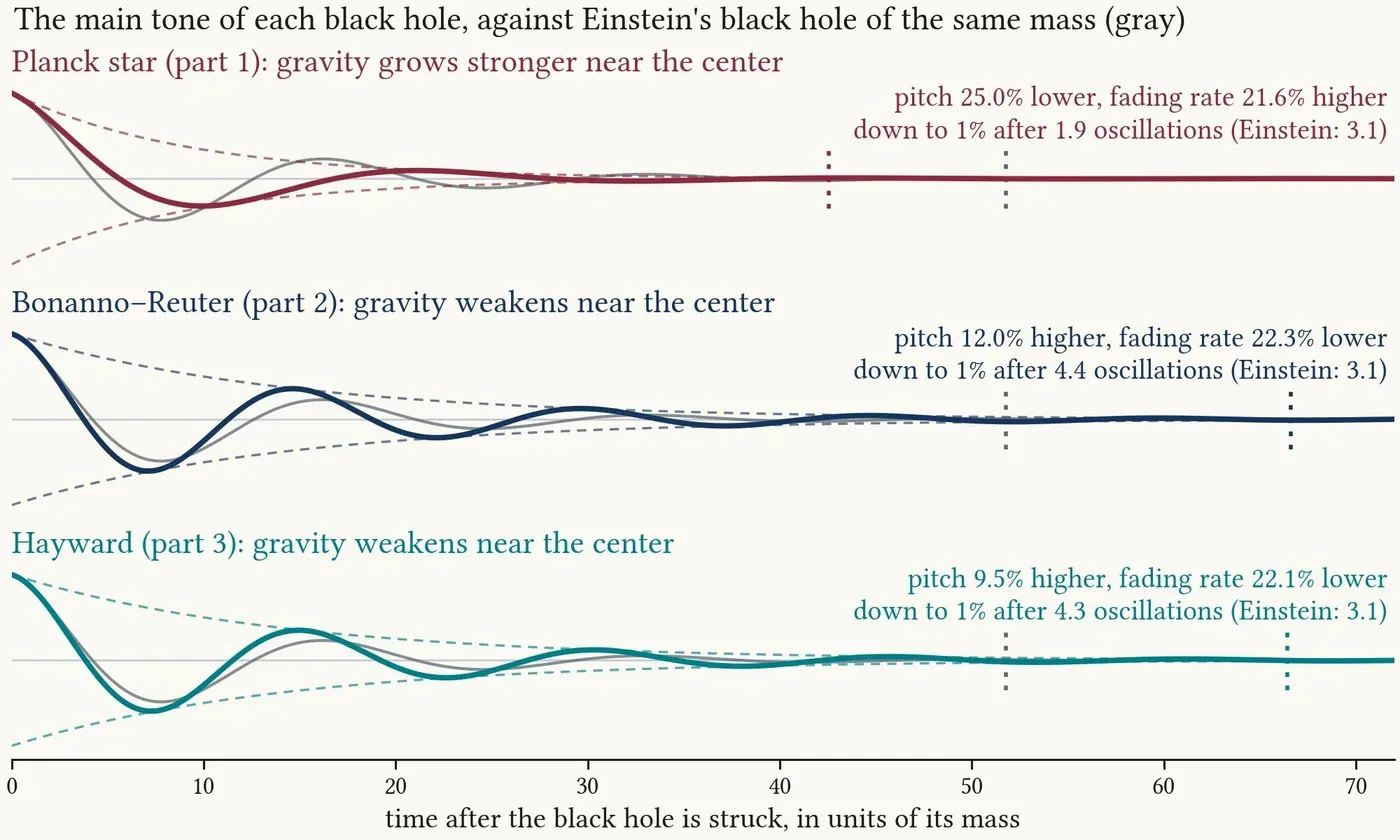
A key finding is that the main gravitational tone of the Hayward black hole differs significantly from Einstein's black hole of the same mass. Specifically, the Hayward black hole rings at 9.5% higher frequency and fades 22.1% more slowly.
This results in a longer-lasting ringing effect, with the duration increasing by 28%.
The location and size of a hidden center within a black hole play a significant role in determining the characteristics of its ringing effect. This is because the ringing occurs outside the light ring, which is the distance at which light can orbit around the black hole.
As gravity weakens near the center of the black hole, it also affects the light ring, causing it to contract or expand depending on the specific type of black hole. In extreme Hayward black holes, for instance, the light ring moves inward, resulting in a higher pitch and slower decay of the ringing effect due to increased stability.
In contrast, where gravity is stronger near the center, as seen in Planck stars, the light ring expands outward, leading to a lower pitch and faster decay. These variations in the characteristics of the ringing effect are directly tied to the unique properties of each black hole type.
The size of the hidden center also has an impact on the ringing effect, with significant changes only occurring when it approaches the mass of the black hole itself. For extremely small black holes, the effects of the core can be substantial, but for larger objects like those detected by current technology, the difference is minuscule.
These tiny variations in the characteristics of the ringing effect could potentially provide a way to distinguish between different types of black holes, particularly in the case of primordial black holes that may have evaporated in the early universe.
The researchers' findings suggest that different types of black holes can be identified by analyzing the characteristics of their ringing effect.
This subtle distinction is made possible by the unique properties of each type of core. For instance, a weaker gravitational field at the center of a black hole results in a more resonant and longer-lasting ring, while a stronger gravitational field produces a duller and shorter sound.
The team's research has also led to the creation of precise tables outlining the tones associated with each type of black hole. These tables provide a valuable resource for scientists seeking to identify and distinguish between different types of black holes.
The codes and computed spectra used in these calculations are now available on GitHub, allowing researchers to build upon this work and further explore the properties of black holes.
These detailed maps of the ringing effect can potentially be used to identify primordial black holes that may have existed in the early universe.
The research on black hole ringing effects is a significant area of study in theoretical physics. Denys Dutykh, an applied mathematician at Khalifa University of Science and Technology, has been working on high-precision numerical methods for wave problems, including the vibrations of black holes.
Dutykh's collaboration with Davide Batic, a mathematical relativist at Khalifa University, has led to significant findings in this area. Their research uses spectral methods to compute the spectra of black holes, and they have published several papers on this topic, including two written with Fabio Scardigli of the Politecnico di Milano.
These detailed maps of the ringing effect can potentially be used to identify primordial black holes that may have existed in the early universe. The development of such methods could provide new insights into the fundamental nature of gravity and the behavior of matter at extreme scales, ultimately contributing to a deeper understanding of the cosmos.
Facts based on reporting originally published by Phys.org.
You may republish this story, in full or in part, if you credit News Central Site and link to it (licence CC BY 4.0). Photos are not included.