Artificial Intelligence Adoption Sparks Job Security Concerns
Professionals are worried about becoming redundant due to efficiency gains brought by artificial intelligence tools.
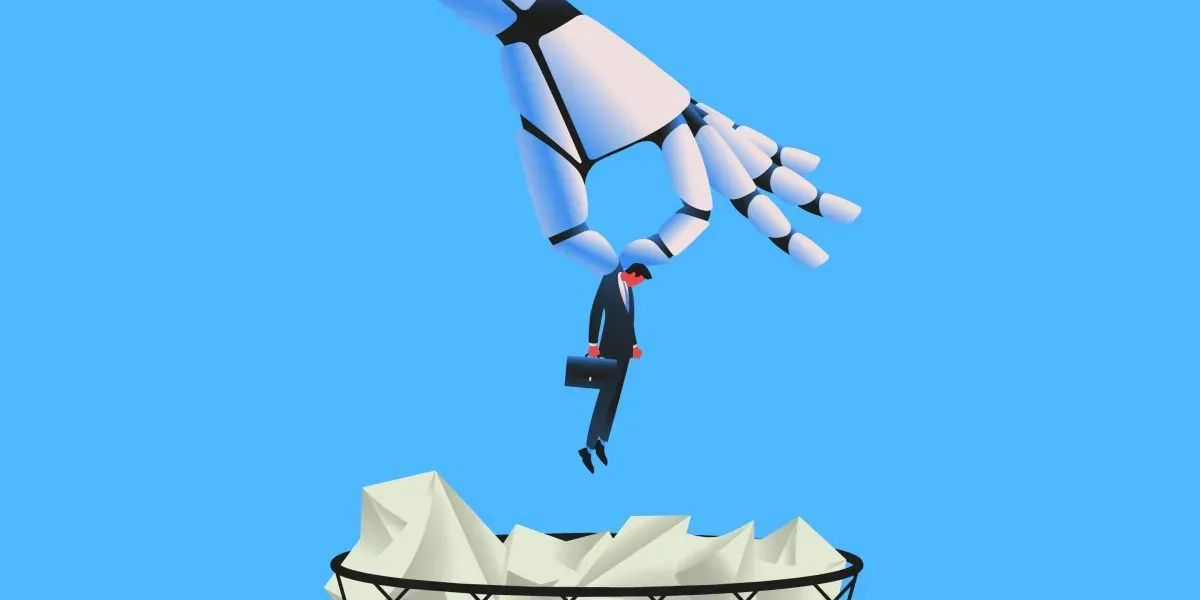
A growing concern among professionals is whether their job security will be compromised by the increasing adoption of artificial intelligence (AI) tools. The fear is not about being replaced by a machine, but rather about becoming redundant due to the efficiency gains brought about by AI.
As more companies start to leverage AI for tasks such as data analysis and reporting, employees who have mastered these tools may find themselves in a unique position. Their work may be perceived as easier and faster, potentially leading to better job prospects, including promotions or pay rises. However, this newfound attention could also have a darker side.
Colleagues who are less familiar with AI might view the increased efficiency as an opportunity to automate parts of their own jobs, making them redundant in the process. This raises questions about job security and the future of work in industries where AI is becoming increasingly prevalent. Those who know how to use these tools effectively are now wondering what will happen to their roles.
The fear is not about being replaced by a machine, but rather about becoming obsolete due to the efficiency gains brought about by AI. The worry is that as companies become more comfortable with using AI, they may start to see certain roles as unnecessary, leading to job losses and reorganization. This anxiety has sparked concerns among professionals who are well-versed in AI technology.
A workplace AI company conducted a survey among 6,000 computer-based professionals in the US, UK, and Australia, revealing mixed reactions to AI assistance. While some employees credited AI with improving their productivity and output quality, others downplayed its benefits. In fact, 36% of these workers confessed to hiding how much they relied on AI.
A separate survey conducted by Microsoft and LinkedIn in 2024 found that over half of employees using AI at work were concerned about appearing replaceable if they used it for critical tasks. This anxiety has significant implications for the adoption and utilization of AI technology in various industries.
The phenomenon of workers holding back their productivity is not a new concern, dating back to factory management practices over a century ago. Workers who were paid by the item or task often found themselves motivated to produce more only to maintain their existing income levels. This deliberate slowdown was known as "soldiering."
Frederick Winslow Taylor, a pioneer in scientific management, documented this issue in his 1911 book on the subject. He noted that workers would resist producing more than necessary if it meant a reduction in payment per item, highlighting the need for employers to develop strategies that encourage productivity without compromising employee compensation.
The introduction of AI in workplaces can be a double-edged sword for employees. On one hand, AI can automate tasks and free up time for more strategic work. However, this shift can also lead to concerns about job security and the potential for downsizing.
For instance, a manager asking team members to share their best AI shortcuts may seem like an opportunity for knowledge-sharing, but it can also create anxiety among employees who fear that sharing their expertise could lead to their own redundancy. This unease is not limited to those directly involved in implementing AI; even colleagues who use similar productivity tools may feel the same apprehension.
In Norway, a recent agreement between the government and employer-union organizations aims to address these concerns. The pact, which runs through 2029, emphasizes employee involvement when introducing AI, using existing rights to ensure workers benefit from the changes as much as businesses and society do.
The Norwegian approach draws on a long history of participatory design, dating back to the early 1970s when computer scientist Kristen Nygaard collaborated with Norway's Iron and Metal Workers' Union to introduce computers in workplaces. This pioneering work laid the groundwork for employee-centered AI implementation strategies that prioritize collaboration and mutual benefits.
A recent agreement signals a shift towards employee-centered AI implementation strategies in some American workplaces. However, its impact remains uncertain and contingent on several factors. Specifically, it does not guarantee improved working conditions or financial benefits for employees.
The agreement's success also relies heavily on the presence of trade unions within these workplaces. Currently, only 10% of American workers belong to a union, compared to around 52.6% in Norway in 2025. This stark difference raises questions about the feasibility of implementing similar agreements in the United States.
In the absence of trade unions, employers may adopt the idea of employee participation in AI decision-making but choose not to enforce it effectively. Instead, they might only pay lip service to involving employees while making decisions behind closed doors.
The company is offering a six-month trial where employees will have a say in how any time saved through AI is used. This includes deciding whether the extra time should be spent on paid training or clearing existing backlogs. Managers agree to discuss the results with employees before setting new targets, allowing for a more collaborative approach.
To ensure that employees feel secure in sharing their innovative ideas, companies must commit to transparency. This involves putting promises of fair treatment into writing, allowing employees to question any broken agreements.
Management needs to establish a clear process for acknowledging and rewarding workers who discover more efficient ways to complete tasks. This can include offering higher pay or other incentives, as seen in Taylor's approach.
Ultimately, it is crucial that companies create an environment where employees feel motivated to share their knowledge and expertise without fear of repercussions, fostering a culture of innovation and collaboration.
Facts based on reporting originally published by Fortune.
You may republish this story, in full or in part, if you credit News Central Site and link to it (licence CC BY 4.0). Photos are not included.