Unique Assisted-Living Facility Set Up in Historic Singapore Shophouse
The facility, Camino House, is a warm and welcoming space for its seven residents, who participate in activities such as art classes and cooking sessions.
A unique assisted-living facility has been set up in one of Singapore's historic conservation shophouses, providing a warm and welcoming space for its residents.
The seven older adults living at Camino House wake up to a bustling atmosphere every morning, with some residents venturing out to nearby hawker centers or convenience stores like 7-Eleven to pick up snacks. Others enjoy a leisurely breakfast, such as Aunty Lydia's oats and blueberries. Uncle Chee is often the first one up.
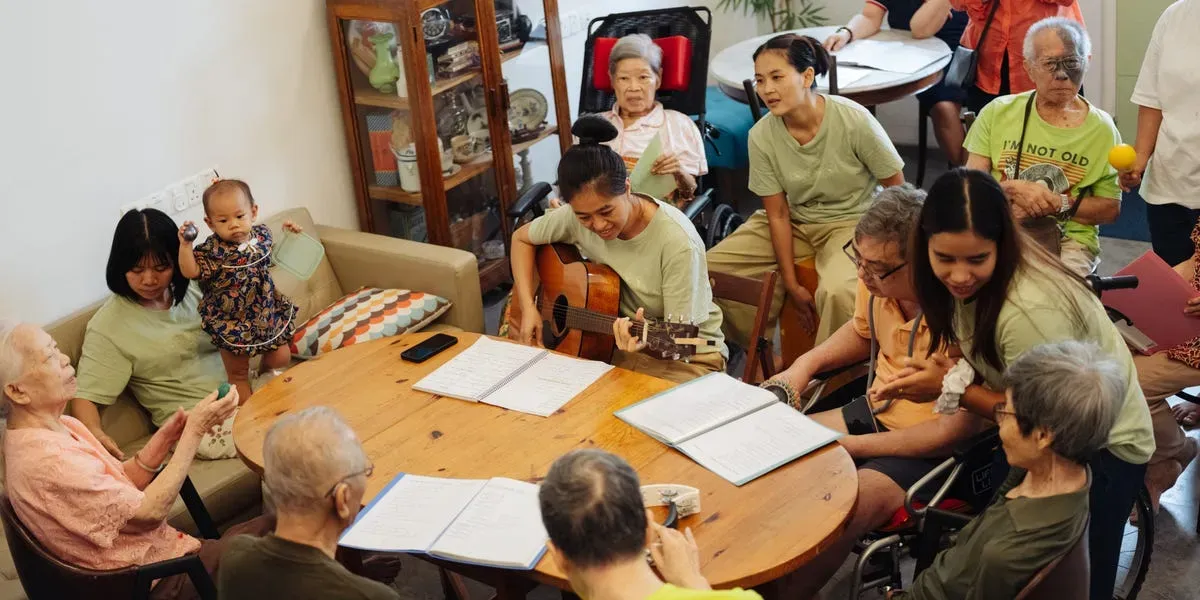
On certain days, Camino House transforms into a hub of activity, hosting events that bring together its residents with children from the local community. For example, on one Tuesday morning in September, preschoolers came to paint and filled the shophouse with laughter and chatter. This is part of an initiative by Joo Chiat Social Club, which offers art classes, cooking sessions, and other activities aimed at fostering connections between residents and outsiders.
Camino House was founded by Mariel Chee and Bennett Lee, both 32 years old, who envisioned a space where people from all walks of life could interact. Unlike traditional care facilities, they wanted to create an environment that feels more like home than an institution. "One that's beautiful and welcoming, not clinical or institutional," Chee said.
The shophouse itself is an integral part of Singapore's heritage, with its ground floor traditionally used for commercial purposes and the upper floors reserved for residential living.
The founders of Camino House and Joo Chiat Social Club, Mariel Chee and Bennett Lee, have a personal connection to eldercare that goes beyond their professional endeavors.
Lee's parents are both doctors who founded another assisted-living provider in Singapore, giving him a unique perspective on the challenges and opportunities in this field.
Chee's experience with her father's Alzheimer's diagnosis in his mid-60s had a profound impact on her family when she was still in school.
Her father's condition required care from his children, who were struggling to balance their studies with the demands of caregiving.
"It was really hard, because he was so young and none of us knew how to care for him," Chee said, reflecting on those difficult times.
Singapore is facing a pressing issue as its population ages: 4% of its citizens are now aged 65 or older, and this number is set to rise.
The country's demographics are shifting rapidly, with the number of citizens aged 80 and above increasing by 60% since 2016, from 91,000 to over 152,000.
The seven residents of Camino House are spread across the age range of 69 to 93 years old. This eclectic mix of seniors brings a unique dynamic to the shophouse, which has been converted into an assisted living facility.
Camino House is part of a small yet growing sector in Singapore that caters to older adults who require daily support but not full-time nursing care. The country's government recently formalized a model of shared caregiving for groups of seniors living together, building on an initiative launched in 2023 with five participating providers.
The shophouse itself is a testament to Singapore's rich history, with its construction dating back to the 1840s and 1960s. Originally, these buildings were designed with businesses on the ground floor and residential areas above, providing a mix of commercial and domestic spaces that defined the urban landscape before World War II.
A significant aspect of life at Camino House is the Joo Chiat Social Club, which operates from the building's ground floor. The club hosts various activities that help residents stay connected to their community, fostering social interaction and a sense of belonging among its members.
The shophouse has been renovated to meet the needs of its elderly residents, featuring six bedrooms, four singles and two twins, each with an en-suite bathroom. An elevator connects the building's two floors, making it easier for residents to move around, while three healthcare attendants work in shifts to provide round-the-clock support.
The Joo Chiat Social Club is a vibrant hub within Camino House, hosting activities that cater to various interests and skills. These half-day programs are open to all residents and include exercise, cooking, and rattan weaving sessions, often with volunteers or children from nearby preschools joining in.
One of the key features of these activities is their inclusivity, allowing residents to choose what they want to do. This approach has been intentional, according to Lee, who emphasized that residents should feel free to engage in activities that bring them joy and fulfillment. The social club also welcomes non-resident participants, offering a single-session pass for about S$100.
This pass covers the cost of the activities, lunch, and care support during the session. Multi-session pass bundles are also available for those who plan to attend more frequently. The three-hour sessions run three times a week, with plans to expand to daily programming next year.
The social club's activities have attracted participants from various age groups, although pass holders tend to be between 70 and 90 years old. Preschoolers, students, and other volunteers regularly join residents for the sessions, sometimes helping to lead them. This intergenerational interaction has been found to have a positive impact on both younger and older adults.
When younger and older adults collaborate on activities, the dynamic shifts from one of care to one of partnership, with both generations actively participating together. This approach is supported by research, which suggests that such interactions can foster a sense of community and social connection among participants.
The social club's activities are just one aspect of Camino House's comprehensive support system, which aims to provide residents with a sense of belonging and connection to their wider community. By offering a range of activities and programs, the house seeks to create an environment where residents can thrive and live fulfilling lives.
Engaging in shared activities can help bridge language and cognitive barriers, reduce social anxiety, and challenge assumptions about aging, according to experts in the field.
The concept is not new, as similar intergenerational programs have been implemented successfully in various settings, including childcare centers paired with senior care facilities in the US. For instance, Providence Mount St. Vincent in Seattle and the St. Ann Center for Intergenerational Care in Milwaukee have offered such programs, allowing residents to form connections across age groups.
Regular interactions between seniors and younger individuals can lead to genuine friendships over time. This is a welcome development, as it addresses one of the key concerns associated with aging: social isolation. By providing opportunities for intergenerational connections, these programs aim to create a more inclusive and supportive environment.
The cost of care and community living can be substantial, with the average monthly cost of assisted living in the US ranging from $5,511 to over $9,577 in areas like Boston. In Singapore, where shared-home providers are still a relatively new concept, there is limited public data on pricing due to the small scale of operations. However, one high-end development charges between S$8,900 and S$17,000 per month.
At Camino House, monthly costs start from S$4,500, depending on the room type and level of care required. This may seem like a significant investment, but it is essential to consider the benefits that these shared living arrangements offer, including access to social activities and community engagement.
Residents at Camino House also enjoy meals, laundry, and daily housekeeping services as part of their living arrangement.
Victor Lee, a 70-year-old resident, credits the social atmosphere at Camino House for helping him become more outgoing than he was before moving in.
Lee had been living alone in his two-story apartment until a bad fall three years ago, after which he realized he needed more support than he could provide for himself.
The shared living arrangement at Camino House has allowed staff to form close relationships with residents beyond just their care plans.
Facts based on reporting originally published by Business Insider.
You may republish this story, in full or in part, if you credit News Central Site and link to it (licence CC BY 4.0). Photos are not included.