Japanese Musician Creates Device Leading to Karaoke Revolution
A Japanese musician created a device that would lead to the creation of karaoke machines in 1968 after being unable to attend a gig.
A Japanese musician's innovative solution to a scheduling conflict in 1968 led to the creation of a device that would revolutionize entertainment worldwide. Daisuke Inoue, who played drums for a band in Kobe's nightlife circuit, found himself unable to make it to a gig he had booked at an insurance company's trade show.
In a moment of ingenuity, Inoue came up with the idea of creating a device that would allow him to be present remotely. He combined a standard eight-track tape player used in car stereos, a microphone, an amplifier, and a 100-yen coin slot to create what is now known as the Juke 8.
The Juke 8 was the precursor to modern karaoke machines and marked the beginning of a new era in entertainment. While some historians question whether Inoue truly invented the first such device or if credit belongs to Shigeichi Negishi's Sparko Box, one thing is certain: karaoke has become an integral part of popular culture.
The term "karaoke itself is a portmanteau of the Japanese words kara," meaning empty, and "oke, meaning orchestra. It evokes both loneliness and collective belonging, capturing the essence of a unique entertainment experience that has captured hearts worldwide.
Nearly 60 years after its invention, karaoke remains a beloved pastime for people from all walks of life. Its popularity spans across continents, with New York City being one of its major hubs. The city's nightlife offers a diverse range of karaoke experiences, from sleek lounges to decades-old dives.
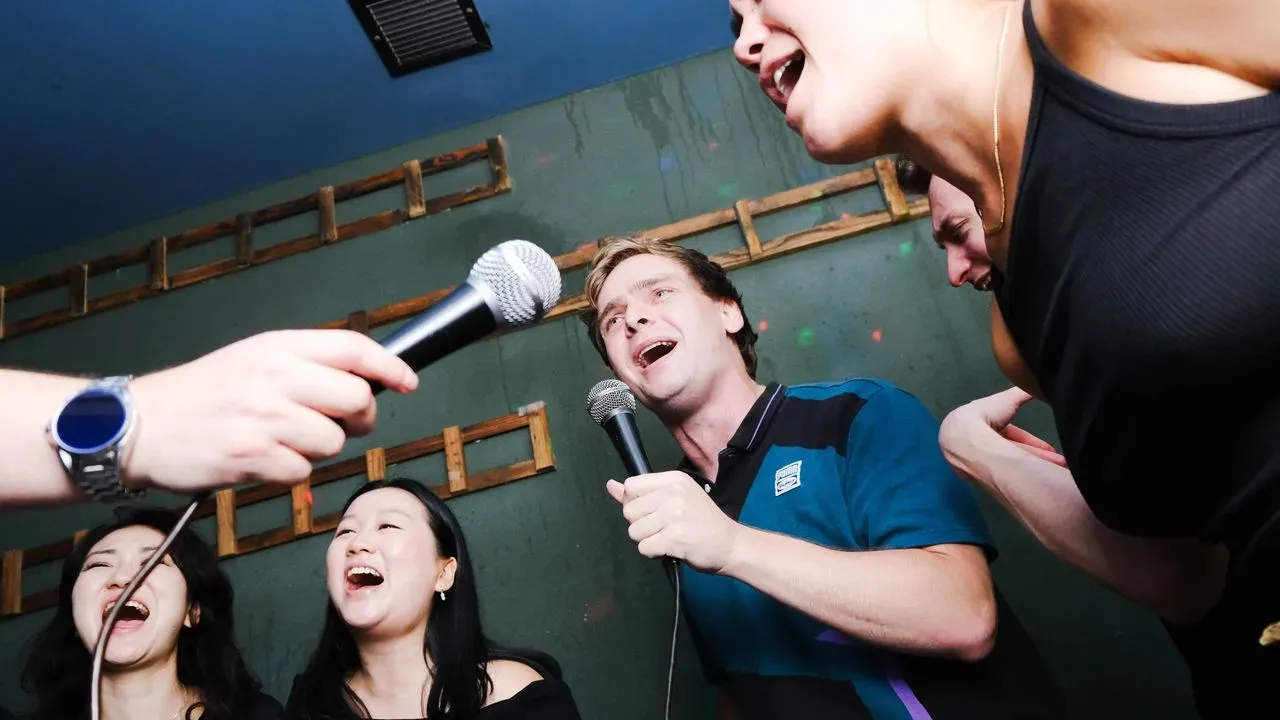
In these establishments, patrons come together to sing their hearts out, often without a hint of irony. Whether it's a post-prom date or a wedding party, career performers or enthusiasts, the karaoke machine brings people together in a way that few other forms of entertainment can.
The allure of karaoke lies not only in its social aspect but also in the chance to momentarily take center stage and forget about the world outside. As one stands behind the mic, it becomes a moment of pure liberation from the passive consumption that dominates much of the city's nightlife.
New York City's nightlife is often portrayed as fading away, with fewer parties, less drinking, and even less sex. But in one corner of the city, a different story is unfolding, one where people come together to openly embarrass themselves.
Karaoke bars are among the last bastions of this kind of communal fun. Here, individuals from all walks of life gather to sing their hearts out, often at the expense of their dignity. It's a space where inhibitions are shed and strangers become friends over a shared love of singing.
Despite the numerous karaoke options in New York City, hundreds of nights and 30-plus specialized bars listed on trackers like Karaoke Crowd, it was impossible to cover them all. So, we decided to take a more targeted approach.
For one week, we visited a different karaoke location each day, crisscrossing the city's five boroughs in search of its diverse offerings. Our goal was to experience the unique character of each neighborhood and the people who frequent these establishments.
We began our journey in Koreatown, where West 32nd Street is home to an impressive concentration of private rooms, over a dozen can be found on this single street. This area is a hub for those seeking a lively nightlife experience.
Our first stop was Gagopa, a bar that's popular among large groups and corporate clients due to its BYOB policy. However, we initially struggled to find the entrance, which lies hidden behind a nondescript sign on the fourth floor of its building.
The search for Gagopa provided an apt introduction to our crawl, navigating narrow corridors, cramped elevators, and head-scratching decor became a familiar theme throughout our journey.
As we left Chorus Karaoke Lounge, a sign near its entrance caught our eye - I sing, therefore I am. This phrase seemed fitting for a space where people come to express themselves through music.
The stark contrast between the private rooms and the main lounge at Chorus Karaoke is noticeable. To one side lies a hallway lined with portraits of legendary musicians like Madonna and Elvis. The porthole windows add an air of exclusivity, while the dim lighting creates an intimate atmosphere.
Only one karaoke room was occupied during our visit to Chorus Karaoke Lounge - a lone singer crooning to himself in the corner. It's possible that this was part of a regular routine, a vocal warm-up exercise for someone who sings regularly.
The sign near the entrance of the occupied room seems to confirm this theory. Its message is a playful take on the idea that singing can be a fundamental aspect of one's existence. Whether or not it's a serious commitment, it's clear that music has the power to bring people together and create lasting memories.
Chorus Karaoke Lounge stands out from other karaoke bars in its unique blend of style and substance. Its clubby atmosphere is tempered by the quiet intensity of the private rooms, creating an intriguing contrast between formality and informality.
As we continued our exploration of New York City's karaoke scene, it became clear that each bar has its own distinct character. From the cramped elevators to the confusing button panels, navigating these spaces can be a puzzle in itself.
In stark contrast to some of the other bars on our list, Sid Gold's Request Room is a more subdued and elegant space. Tucked away behind velvet curtains at the back of a cocktail bar, it offers a sophisticated take on the karaoke experience.
As the night wore on at Sid Gold's, a small but lively crowd began to form around Benjamin, who was holding court behind the karaoke microphone. Tourists and locals alike were drawn in by his infectious enthusiasm and impressive vocal range.
Benjamin's performance seemed to be the main draw for many of the patrons, with some coming specifically to hear him sing. However, as the night went on, it became clear that the real magic happened when others joined in, either solo or in impromptu duets with Benjamin.
The singer's ability to adapt to any style or tempo was impressive, but what really set him apart was his knack for making each performer feel like a rockstar. Whether he was harmonizing with someone who thought they were off-key or improvising riffs on a song he'd never heard before, Benjamin had an uncanny talent for making everyone shine.
One particularly memorable performance came when Eric took the stage to sing Part of Your World. To get into character, he kicked off his flip-flops and launched into the iconic Disney tune with gusto. It was clear that this wasn't just about singing, it was about embracing the moment and letting loose.
Benjamin's antics on stage were matched only by his ability to cajole others into joining in. He'd nudge someone who was hesitant, or pause mid-song to let a newcomer take over. And when they did step up to the mic, he'd harmonize and improvise with them as if they'd been singing together for years.
It's clear that Benjamin is more than just a talented singer, he's a master of creating an experience that's equal parts entertainment, community, and therapy. Whether you're a seasoned karaoke pro or just looking to let loose, Sid Gold's has something for everyone.
But if you think you can avoid getting up on stage at Sid Gold's, think again. Benjamin is always on the lookout for new talent, and he'll make sure you get your chance to shine, even if it means dragging you onto the stage by the hand.
The following night, I made my way to Barkada Social Club in Astoria, Queens, where a different kind of karaoke experience was waiting. As soon as I walked through the door, I was enveloped in a warm and welcoming atmosphere that felt like stepping into a Filipino household, complete with plates of lumpia and kwek kwek on the tables.
The night's festivities were being hosted by Barkada NYC, an LGBTQ+ Filipinx community group, who were celebrating their monthly Kikay Konek karaoke event. Joey, the group's programming coordinator, was my enthusiastic host for the evening, and it turned out to be a great night to come, as they had a full schedule of events planned, including a dance routine being recorded for Instagram.
The collective of karaoke enthusiasts at Steiny's Pub on Staten Island is a dynamic group, comprising members from all five boroughs of New York City and even some from as far away as Tenafly, New Jersey.
The crowd is constantly shifting, with people coming and going in response to the song queue, which keeps things fresh and exciting for everyone involved.
One exception to this fluidity is when a popular Tagalog ballad called Bakit Pa by Jesse Zaragoza comes on, drawing out a large crowd that seems to be united in their love of the song.
It's clear that Bakit Pa holds a special place in the hearts of these karaoke fans, with one member describing it as like our national anthem.
We visited Steiny's Pub on a Thursday evening at 3 Hyatt Street in Staten Island, where we found a lively atmosphere and a diverse group of patrons.
The pub is situated near the site of the former Mayfair Bar and Grill, which was once a favorite among St. George's queer community in the 1950s and '60s.
As we made our way inside, we noticed a small group of locals smoking outside and were soon greeted by the emcee, who goes by the DJ name Nazz Raidience.
Nazz quickly singled us out as newcomers and handed us a Sharpie and clipboard to add our names to the queue, which he seemed to be managing with a mix of chaos and flair.
As we continued to explore the city's karaoke scene, it became clear that this particular night at Bronx Beer Hall wouldn't be the one where our voices would shine.
The venue, located in the heart of Arthur Avenue's historic Italian neighborhood, is a food hall within a larger complex, and on Friday nights, it transforms into a lively karaoke spot. The surrounding businesses close by the time the music starts, leaving only the faint sound of music drifting out onto the street to guide curious patrons.
Inside, the atmosphere is electric, with a diverse crowd singing along to everything from classic rock ballads like Bon Jovi and Air Supply to modern hits like NUEVAYoL" by Bad Bunny. The eclectic mix of songs is a testament to the city's vibrant cultural melting pot, where different generations and styles come together in perfect harmony.
In the end, we left without belting out our favorite tunes, but with a deeper appreciation for the unique character of each borough's karaoke scene and the joy it brings to New Yorkers every night.
Facts based on reporting originally published by Conde Nast Traveler.
You may republish this story, in full or in part, if you credit News Central Site and link to it (licence CC BY 4.0). Photos are not included.