Archaeologists Uncover 2,000-Year-Old Warrior's Grave in Southern Russia
Researchers have discovered a 2,000-year-old grave near the Crimean Peninsula that belonged to an elite warrior, who was buried with his weapons and human sacrifice.
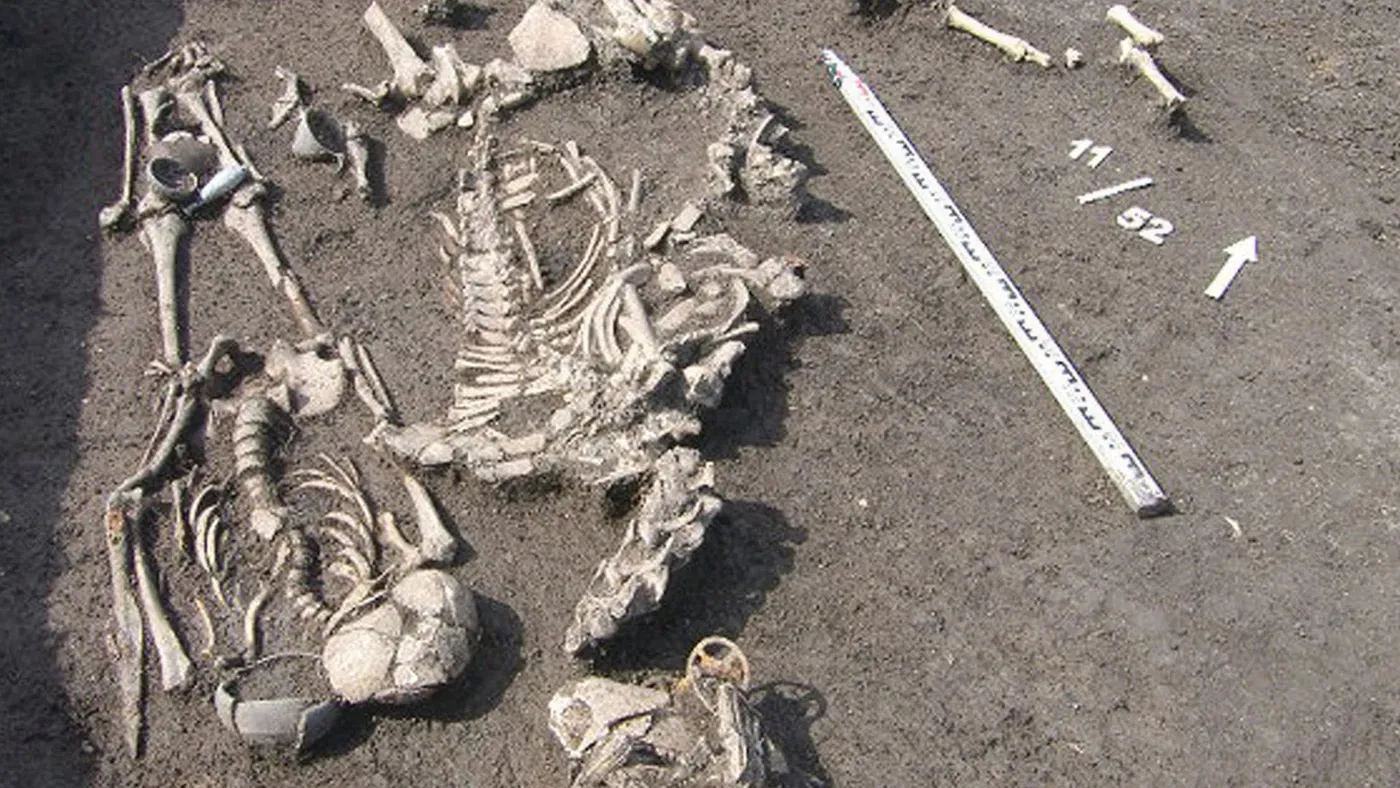
Archaeologists in southern Russia have made an extraordinary discovery at a necropolis near the Crimean Peninsula, unearthing the 2,000-year-old grave of an elite warrior who was buried with his weapons and a human sacrifice.
The site, located in the Kuban region, contains over 150 ancient graves arranged around the central burial ground. This deliberate placement suggests that the individual entombed there held a high social status within their community, according to researchers.
Evidence of a human sacrifice has been uncovered adjacent to the warrior's grave, where three horses, two cattle, a pig, and a dog were found buried alongside a fragment of a human pelvis. The remains suggest that one person was ritually killed as part of the burial ceremony.
The presence of gold coins featuring Alexander the Great among the lavish goods accompanying the warrior's burial indicates that this took place in the early first century B.C. Furthermore, the location and style of the burial are characteristic of the Indigenous Maeotian people, who were allied with the Mithridatic Empire at the time.
The two gold coins discovered alongside the ancient warrior's burial have been found to be of great significance in understanding the culture and practices of the time.
Researchers believe that these coins were not used as ordinary currency for trade, but rather as a means of storing wealth, similar to modern-day cryptocurrencies.
One of the coins was placed in a ritual shaft near the center of the necropolis, likely as an offering to the gods. This suggests that it may have been intended to provide some sort of divine protection or blessing.
In another intriguing discovery, the second gold coin was found beneath the jaw of the skeleton, indicating that it had been placed in the dead man's mouth before burial.
The Maeotians, an Indigenous people, lived in the region near the Black Sea and were integrated into the nearby Bosporan kingdom, a Greek and Scythian state that was founded on the north side of the Black Sea in the fifth century B.C.
As part of this complex cultural landscape, the Maeotians became allies with the Mithridatic Empire when it expanded to include the Bosporan kingdom in the second century B.C. This alliance likely influenced the burial practices and traditions of the Maeotians during the first century B.C.
The warrior's grave contained a range of items that reflect his status and occupation, including two iron spearheads, an iron arrowhead, riding gear, and a sacrificed horse. These finds indicate that he was a skilled and well-equipped fighter who played an important role in his community.
A small, intricately designed clay cup with two handles was also discovered in the grave. The surface of this "kantharos features a pentagram symbol, which is believed to have been used as protection against magical threats, providing spiritual safeguard for the deceased warrior.
The burial assemblages found near the warrior's grave suggest that the sacrifices may have served different purposes. The cattle could have been part of an ancient hecatomb", a mass slaughter of animals believed to appease a god. In contrast, the horses were likely intended for use in the afterlife, while the pig would provide sustenance for the deceased warrior.
The inclusion of these animals raises questions about the role of the human sacrifice found alongside them. It is possible that this person was meant to serve as a companion or servant for the dead warrior in the afterlife. However, without further evidence, their specific purpose remains unclear.
The presence of coins and other grave goods in the burial provides insight into the cultural and economic practices of the Maeotian people during this time period. These artifacts demonstrate both the local traditions and the influence of external forces, particularly from the neighboring Bosporan kingdom with its ancient Greek heritage.
The use of gold coins, specifically the Lysimachus type stater, is a notable example of the cultural exchange between these regions. This highlights the complex interplay of economic, social, and spiritual influences that shaped the lives of individuals in this ancient society.
Further research into the burial site and its contents may shed more light on the customs and practices of the Maeotian people during this period. The discovery of such artifacts also underscores the importance of continued archaeological exploration and study of these ancient cultures.
Archaeologists in Russia have uncovered a 2,000-year-old burial site containing a unique combination of artifacts, including a human sacrifice and an object believed to ward off magical threats.
The discovery also includes a ceramic cup that may have been used to protect the deceased from evil spirits, as well as other items such as bronze and gold jewelry.
Facts based on reporting originally published by Live Science.
You may republish this story, in full or in part, if you credit News Central Site and link to it (licence CC BY 4.0). Photos are not included.