Breakthrough in Measuring Quantum Property Using Ultrashort Laser Pulses
Researchers at Friedrich Schiller University Jena and the University of Regensburg have developed a new method to measure Berry curvature using ultrashort laser pulses, allowing for a deeper understanding of electron behavior in materials.
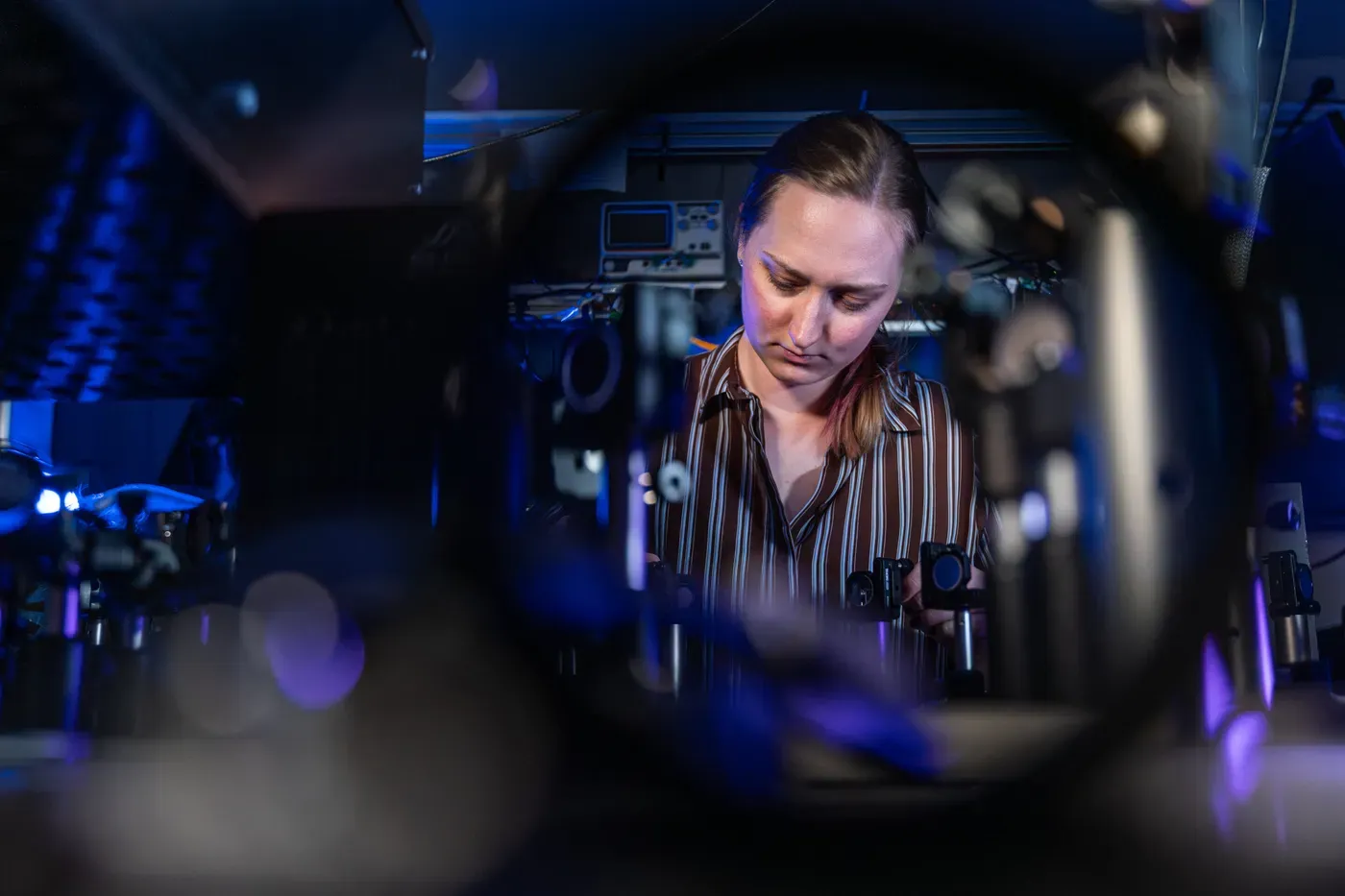
Researchers at Friedrich Schiller University Jena and the University of Regensburg have made a breakthrough in understanding the behavior of electrons in materials by developing a new method to measure a key quantum property using ultrashort laser pulses.
The focus of their research is on Berry curvature, a complex geometric concept that describes how electrons move through quantum mechanical states. This property has been notoriously difficult to access and study directly, but it plays a crucial role in determining how electrons interact with light or electric fields.
Electrons within crystalline structures do not behave like tiny particles following fixed paths; their behavior is governed by the intricate rules of quantum mechanics. The geometric properties of these states are collectively referred to as "quantum geometry," and Berry curvature is an essential component that helps explain their dynamics.
The new method developed by the Jena and Regensburg team uses a combination of optical measurements and analytical modeling to estimate the local Berry curvature within materials. This approach represents a significant departure from previous methods, which relied heavily on theoretical calculations or complex experimental techniques.
By employing ultrashort laser pulses to probe the properties of electrons in a layer of tungsten diselenide, just one atomic layer thick, the researchers have achieved remarkable results that shed new light on the behavior of these particles within crystalline structures.
The experiment used a semiconductor material called tungsten diselenide, whose layer is less than one nanometer thick, making it highly reactive to light. This property makes it well-suited for nonlinear optical experiments. The researchers took advantage of this sensitivity by directing two ultrashort laser pulses at the sample.
The first pulse altered the electronic states of the material, but only for a tiny fraction of a second. The second pulse was used to detect this change optically, producing light with a frequency twice that of the incident light. This phenomenon is known as harmonic generation.
From the polarization of the generated light, which refers to the way it oscillates, the researchers were able to gather information about the Berry curvature. This property is difficult to measure experimentally and has been the focus of much theoretical work. The effect occurs within a few hundred femtoseconds, an extremely short timescale.
The team observed that changing the direction of rotation of the first laser pulse resulted in a reversal of the measured signal's sign. This suggests that the Berry curvature is sensitive to the initial conditions set by the first pulse. By analyzing the measurement data, the researchers were able to determine the value of the Berry curvature, which matched theoretical predictions.
The agreement between experimental and theoretical results lends confidence to the validity of the technique used in this study. The combination of an optical experiment with a theoretical model has allowed for a specific property of the material to be measured directly, opening up new avenues for research into the quantum behavior of materials at the nanoscale.
The researchers' approach has been demonstrated using tungsten diselenide, but they emphasize that their method is not limited to this specific class of materials.
Both the measurement principle and the theoretical model developed in collaboration with researchers from the University of Regensburg can be applied to other materials in principle.
This versatility will enable scientists to study a wide range of materials using the same technique. By doing so, they aim to gain a deeper understanding of the quantum behavior of electronic states and their geometric properties.
The successful demonstration of this method paves the way for further research into the intricate relationships between electrons' quantum geometry and the material's optical properties.
Facts based on reporting originally published by Phys.org.
You may republish this story, in full or in part, if you credit News Central Site and link to it (licence CC BY 4.0). Photos are not included.