Polynya Forms in East Antarctica's Breid Bay During Winter
A massive polynya has opened up in Breid Bay, off the coast of East Antarctica, during the depths of winter. This vast patch of open water is surrounded by sea ice, allowing heat and moisture to freely pass between the ocean and atmosphere.
A massive polynya has opened up in Breid Bay, off the coast of East Antarctica, during the depths of winter. This vast patch of open water is surrounded by sea ice, allowing heat and moisture to freely pass between the ocean and atmosphere.
The region had remained ice-covered at this time of year since satellite records began in 1979. However, in August 2024, a significant change occurred with the formation of the polynya. The event is particularly noteworthy due to its location far from the coast, where such incidents are relatively rare.
Research suggests that several factors combined to trigger the event. Unusually warm and moist air streams, thick clouds, and snowfall all played a role in reducing winter cooling and allowing warmer water to rise from beneath the sea ice. These conditions led to the formation of a polynya larger than the size of Portugal.
Polynyas closer to the coast are more common due to strong winds pushing sea ice out to sea. However, those farther offshore have a significant impact on regional weather patterns, ocean circulation, and marine ecosystems. The Antarctic region has seen numerous studies focusing on these events, but most have centered around the Weddell Sea.
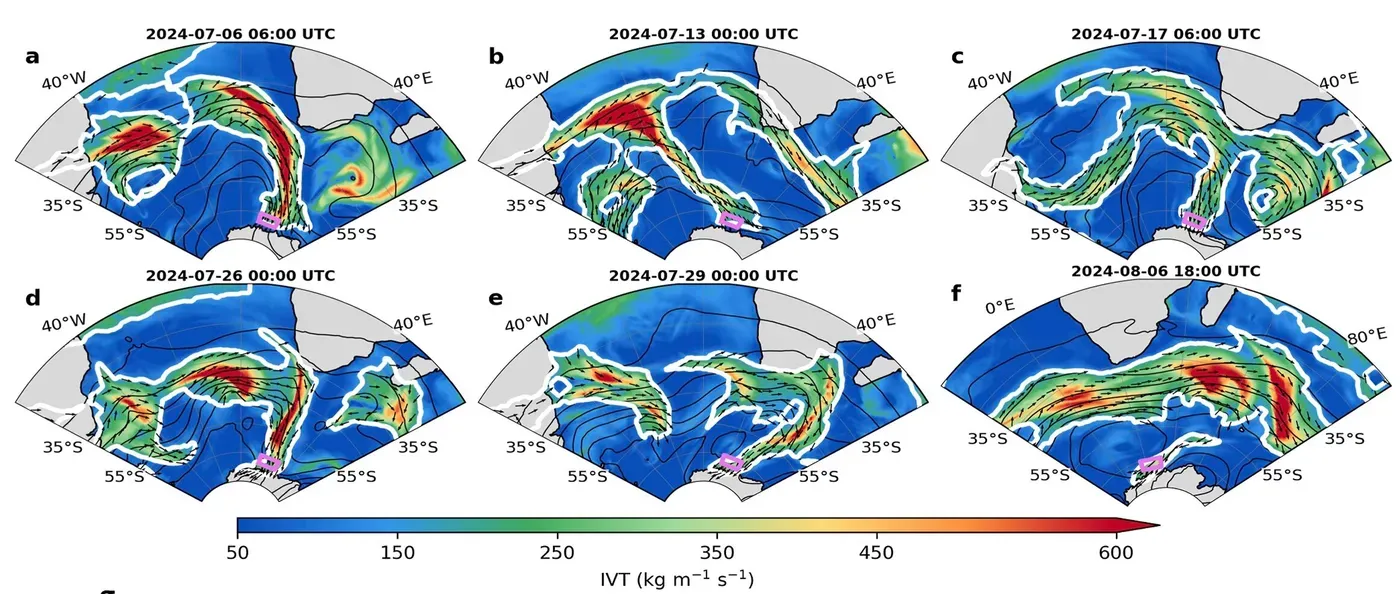
The "atmospheric river" is one climate pattern linked to polynya formation in the Weddell Sea. This phenomenon involves a long, narrow band of air carrying large amounts of warmth and moisture from lower latitudes toward the poles, which can weaken sea ice along its path.
The researchers behind a recent study on Antarctica's Breid Bay event have been examining whether similar factors contributed to this phenomenon. To gain a deeper understanding of the situation, they analyzed daily satellite records from 1979 to 2024, combining these with data collected by ships and autonomous floating sensors.
These records were then compared with reconstructions of the ocean and atmosphere based on real-world observations. This comprehensive approach allowed them to identify how unusual winter conditions in 2024 had been. By examining long-term trends alongside specific weather patterns that year, they aimed to pinpoint the exact factors that contributed to the Breid Bay event.
Throughout July and August, intense atmospheric rivers struck Breid Bay, bringing heat waves with air temperatures up to 19°C above normal. This was accompanied by thick clouds and snowfall that slowed winter cooling and hindered ice growth. Meanwhile, persistent winds drew warmer water from deeper in the ocean, creating a marine heat wave that prevented the surface from freezing.
The combination of these extreme weather patterns led to a large polynya forming over Breid Bay. By August 4th, this opening had grown to cover an area roughly the size of Portugal, spanning around 89,000 square kilometers. The researchers' findings highlight how unusual and interconnected weather events can come together to produce dramatic changes in Antarctica's sea ice.
The study's results suggest that climatologists could improve their predictions of Antarctic sea ice by incorporating these insights into their models. By taking a more comprehensive approach to understanding the complex interactions between atmospheric and oceanic conditions, scientists may be able to better forecast how sea ice will change as Earth's climate continues to warm.
A recent study has revealed that an unusually large area of open ocean was exposed during Antarctica's winter season last year. The phenomenon, known as a polynya, is believed to have been caused by a rare event in which atmospheric rivers, long streams of moisture-rich air, converged over the continent.
The research, published in Geophysical Research Letters, found that this unusual combination of atmospheric and oceanic conditions led to an unprecedented opening up of the ice cover in Breid Bay, East Antarctica. This resulted in an area roughly the size of Portugal being exposed to open water during the winter months.
By taking a more comprehensive approach to understanding the complex interactions between atmospheric and oceanic conditions, scientists may be able to better forecast how sea ice will change as Earth's climate continues.
Facts based on reporting originally published by Phys.org.
You may republish this story, in full or in part, if you credit News Central Site and link to it (licence CC BY 4.0). Photos are not included.