Android XR Platform Smart Glasses Hit Market at $1,279
The Xreal Aura smart glasses provide an immersive experience with virtual screens and augmented reality elements integrated into the wearable device.
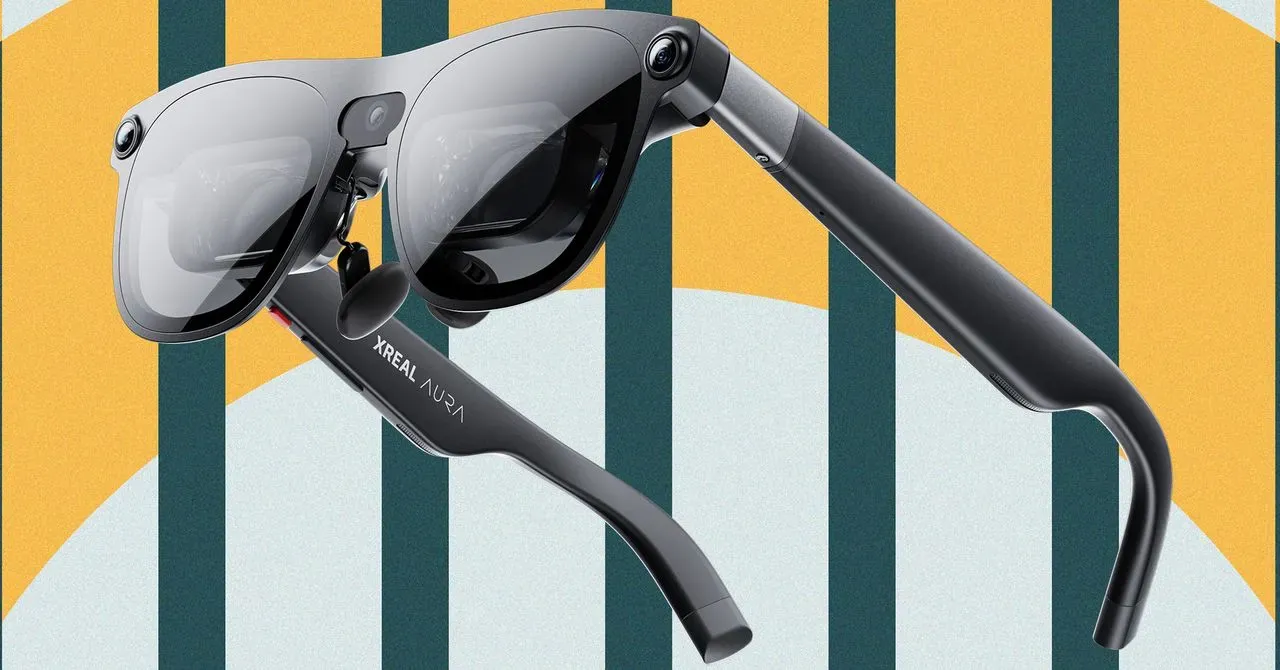
Xreal's latest offering, the Aura smart glasses, have hit the market, priced at $1,279. These extended-reality glasses run on Google's Android XR platform and are designed to provide an immersive experience for users.
The Xreal Aura can project virtual screens into the wearer's field of vision, allowing them to interact with digital content in a more natural way. Augmented reality elements are also integrated, enabling users to seamlessly blend digital information with their real-world surroundings.
In contrast to Meta's smart-glasses empire, which is being challenged by upcoming Android XR glasses from Google and Samsung, the Xreal Aura takes a different approach. Rather than focusing on sleek, stylish designs like Warby Parker and Gentle Monster, the Aura resembles a virtual reality headset in a more comfortable, glasses-like form.
The first notable drawback of the Xreal Aura is its reliance on a wired connection, which can be cumbersome to use. A long cord connects to an attached compute puck via USB-C, weighing over half a pound and housing either 12 or 16 GB storage options.
This compute puck has a battery that provides around four to five hours of constant use before needing recharging.
The Aura glasses' design allows for a seamless viewing experience, thanks to their relatively lightweight construction of just 95 grams.
When it comes to sound quality, the four-mic array in the arms of the glasses is well-tuned with Bose EQ settings that produce clear and crisp audio. Users can also opt to connect wireless headphones if desired.
A key feature of the Aura glasses is their ability to project a virtual screen directly into the user's field of vision, offering a 1920 x 1200-pixel-per-eye resolution that significantly outperforms other Xreal glasses models I've had the chance to try.
The wide 70-degree field of view provided by the screens and virtual elements means they can appear in a broad frame of the wearer's vision. This has both practical benefits, such as helping users navigate their surroundings, and immersive drawbacks.
Xreal's Aura glasses can theoretically run any existing Android app, which is organized into primary categories for user convenience. The entertainment category allows users to watch movies, TV shows, or YouTube videos directly in their field of view, with the virtual screen staying fixed or following the user as they turn their head.
The Aura can also be used as display glasses to extend the screen of devices like the Steam Deck, although I encountered issues when playing more graphics-intensive games like Cyberpunk 2077.
The Xreal Aura's capabilities extend far beyond gaming and entertainment. Its versatility is particularly evident in its productivity features. The device can host virtual workstations that allow users to juggle multiple tasks at once, making it ideal for individuals with demanding workflows.
With the Aura glasses, you can have multiple applications open simultaneously without having to navigate through multiple windows. For instance, you could keep a Google Doc on one side of your screen while listening to music on Spotify and monitoring Slack messages in real-time. The seamless multitasking capabilities make it an attractive option for professionals who need to stay organized.
The Xreal Aura's augmented reality features also offer a unique experience. Users can immerse themselves in virtual environments, such as exploring exotic locations like the Galapagos or strolling through 3D models of cities using Google Earth. The device's AR capabilities enable users to interact with digital objects in a more intuitive way.
The Xreal Aura's design is notable for its dual-lens setup. The smaller lens is responsible for projecting virtual screens and AR elements within a 70-degree field of view. Meanwhile, the outer lens can be adjusted to switch between see-through mode and a darker setting that enhances visibility of projected images.
By adjusting the darkness level, users can optimize their viewing experience. Turning up the darkness makes it easier to focus on virtual screens, while reducing it enables a clearer pass-through that helps prevent accidents when navigating through physical spaces.
Wearing the Aura glasses while walking around can be quite distracting, even without any augmented reality features enabled. The double-lens design is noticeable, and it's hard to ignore the fact that these glasses are still relatively bulky.
While they do feel lightweight at first, after a few minutes of use, the glasses start to generate heat. Removing them leaves behind red marks on the bridge of your nose, but this doesn't significantly detract from the overall experience.
The design of the Aura glasses is not without its drawbacks. They can be quite chunky, and some people may find themselves drawing attention when wearing them in public. For those who can pull off the look, however, it might not be a significant issue.
One potential annoyance with the Aura glasses is the compute puck that comes with them. While small enough to carry around, it adds another device to wear on your face, which can feel cumbersome. The puck itself has some useful features, such as a fingerprint sensor for biometric authentication, but its trackpad functionality was not particularly precise.
The use of hand movements to control the Aura glasses is an interesting feature, but it's clear that there's room for improvement. In situations where you want to interact with your device without using your hands, like on an airplane, this feature could be quite useful, if only it were more accurate and reliable.
The hand-tracking feature on the Xreal Aura glasses is its most innovative and frustrating aspect at the same time. While it generally works well, there are instances where gestures don't register properly, leaving users to repeat actions several times.
As a result, interacting with the device becomes a trial-and-error process, especially when trying to open apps or switch between windows. Users may find themselves pinching the air repeatedly before the desired action takes place, which can be quite disconcerting for onlookers.
Despite these limitations, the Xreal Aura glasses showcase significant advancements in smart-glasses technology. They offer a glimpse into what could be achieved with further refinement and development.
The product still has some way to go before it becomes user-friendly and appealing to a wider audience, but it's an encouraging step forward nonetheless.
Facts based on reporting originally published by Wired.
You may republish this story, in full or in part, if you credit News Central Site and link to it (licence CC BY 4.0). Photos are not included.