Meta's XR Glasses Compared to Xreal Aura Smart Glasses
The article discusses Meta's XR glasses and their comparison with Xreal's mixed-reality smart glasses, the Xreal Aura.
Meta's XR glasses have been making headlines for all the wrong reasons, but that didn't stop me from being impressed by their video quality and wearability when I tried them out at the company's Connect event in September.
The mixed-reality glasses were surprisingly comfortable to wear, with a level of video quality that exceeded my expectations. This is a significant improvement over earlier models of face computers, which often felt like cumbersome headsets.
However, Meta isn't the only major player in the face computer market. Xreal, known for its virtual-display glasses, has partnered with Google to develop mixed-reality smart glasses on the Android XR platform, the Xreal Aura.
The Xreal Aura is now available for preorder, but only for those who have already placed paid reservations, and will start shipping later this year in the US, Canada, Japan, and South Korea. The starting price is $1,279, which is slightly lower than Meta's VR glasses option.
The XR glasses from Meta and Xreal are poised to expand their reach in 2027, launching in additional regions beyond their current availability.
A recent demo of the Aura glasses revealed a direct competitor to Meta's VR Glasses, with eerily similar experiences that left little doubt about the intentions behind these innovative devices. Donning one of these sleek pieces of technology allows users to seamlessly switch between watching videos, playing games, and projecting complex workspaces onto virtual screens.
The smart glass market offers a range of options catering to diverse user needs. Basic models plug directly into smartphones or laptops, effectively turning them into portable displays that eliminate the need for awkward neck craning. In contrast, high-end versions like the Ray-Ban Meta come equipped with built-in cameras and AI-powered assistants, enabling users to capture photos, videos, and conversations on the go.
However, it's the mixed reality glasses that truly push the boundaries of what's possible by bridging the gap between virtual and augmented reality. These cutting-edge devices promise an immersive experience where real-time captions, translations, navigation instructions, and more can be effortlessly integrated into users' surroundings.
These augmented reality (AR) glasses are taking shape as compact, wearable devices that blur the line between everyday eyewear and high-tech headsets.
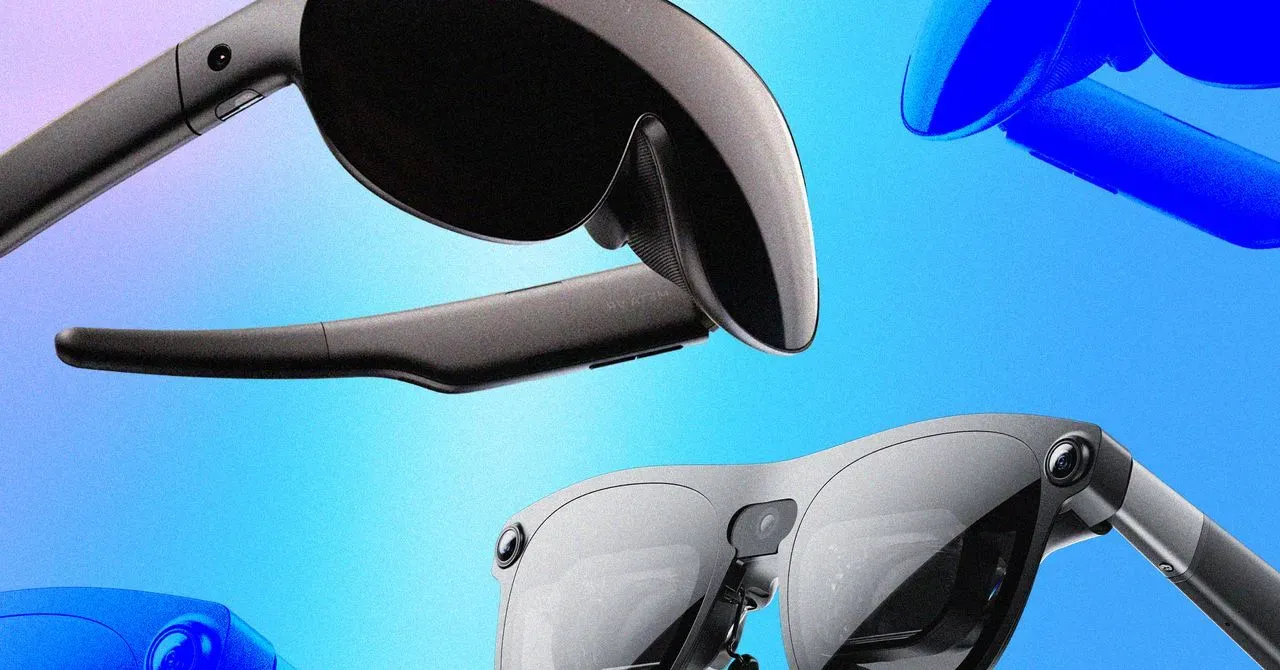
Meta's XR Glasses have a futuristic design that resembles the front half of a VR headset, while Xreal's frames are more traditional in appearance but still bulkier than regular glasses. However, it's worth noting that Snap's competing product, Specs, is significantly thicker and costs $2,195, with shipping expected later this year.
Both Meta and Xreal's models feature an attached compute puck that contains the processing power and memory, which users will need to carry in their pocket. This design choice may seem restrictive but allows for slimmer, lighter frames that are more comfortable to wear.
The interactive experiences on Meta's XR Glasses feel smooth and fluid, thanks to a 5K micro-OLED screen and advanced hand tracking features enabled by additional cameras. In contrast, Xreal's Aura glasses appear less refined, with typing on a virtual keyboard feeling somewhat clunky.
The Xreal Aura glasses' ability to run Android apps is a significant advantage over other mixed reality devices. However, this also means that some apps may not function as intended, leading to syncing issues during demos. The vastness of the Android platform can be a double-edged sword in this regard.
One area where the Xreal Aura excels is in its real-world passthrough feature, which allows users to see their surroundings even when the screen is turned off. This capability is more refined than what's offered by Meta's VR Glasses, which have video passthrough but can result in a fuzzy view of the world outside.
Ultimately, the choice between these two devices will depend on individual preferences and needs. While Meta's VR Glasses may be better suited for sitting and passive content consumption, the Xreal Aura is more adaptable to real-world environments, making it easier to navigate while wearing the device.
Facts based on reporting originally published by Wired.
You may republish this story, in full or in part, if you credit News Central Site and link to it (licence CC BY 4.0). Photos are not included.