Ancient Roman Aqueducts Featured Innovative Solutions to Overcome Gravity Challenges
The ancient Romans' engineering prowess is still awe-inspiring today, especially when it comes to their impressive aqueducts that brought water from distant sources to their cities.
The ancient Romans' engineering prowess is still awe-inspiring today, especially when it comes to their impressive aqueducts that brought water from distant sources to their cities. While gravity played a significant role in transporting water downhill through many of these structures, some aqueducts required water to flow uphill, posing a unique challenge for the Roman engineers.
To overcome this problem, the Romans employed various methods, including siphons and specialized water-lifting devices. These innovative solutions allowed them to harness the power of gravity even when it seemed counterintuitive.
One notable technique used by the Romans was an inverted siphon system, where a lower "receiving tank at one end of a valley would collect water that had been pushed upward through a series of towers and channels. This clever design took advantage of the pressure created by falling water to propel it up steep inclines.
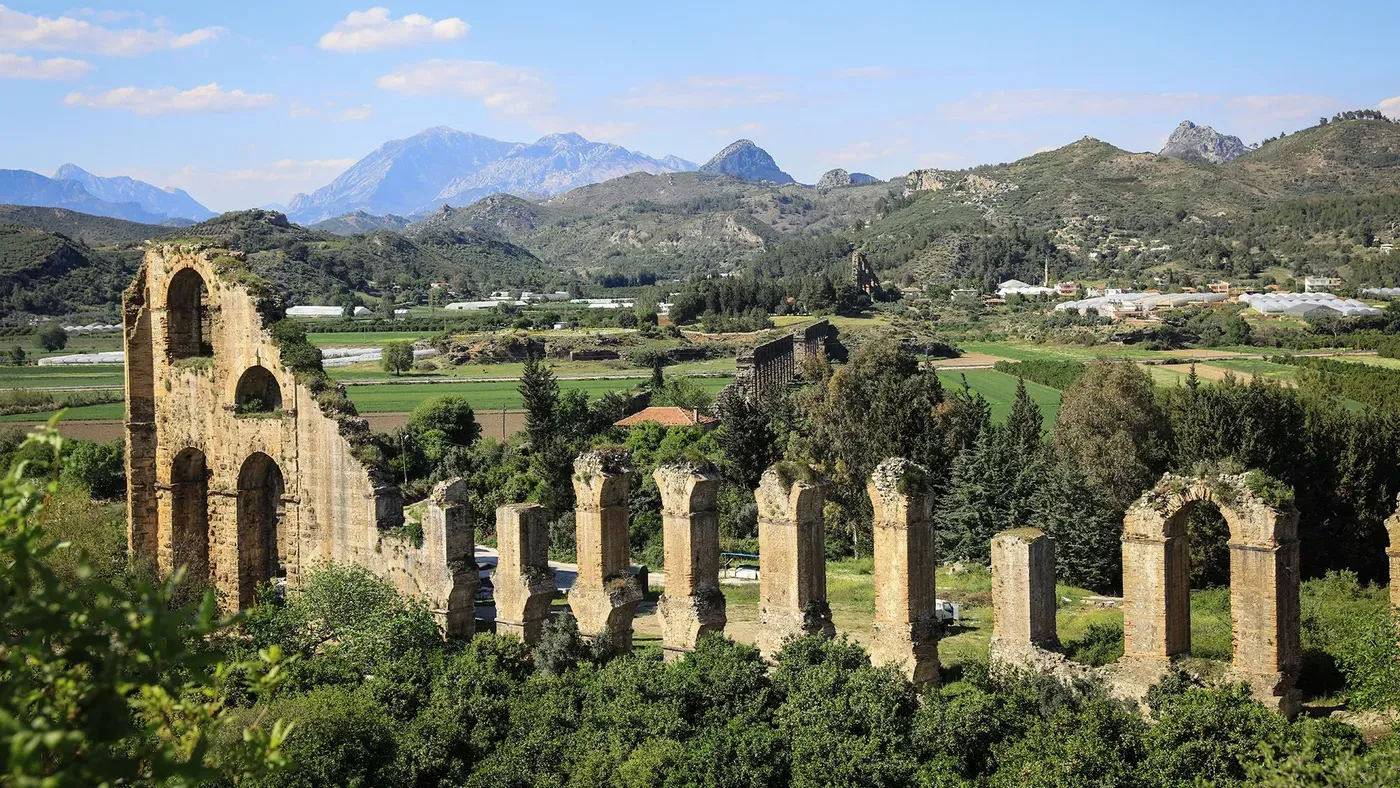
At Aspendos in southern Turkey, archaeologists have reconstructed an ancient Roman aqueduct featuring inverted siphons using advanced virtual modeling techniques. The simulation reveals how this system worked: a header tank" at one end of the valley would feed water into two towers, which were connected by a narrow channel.
The engineers behind the Roman aqueducts developed innovative techniques to prevent air pockets from forming as water flowed through inverted siphons. These structures were designed to carry water uphill, and experts believe that large header and receiving tanks played a crucial role in preventing air bubbles from accumulating.
By allowing air bubbles to rise naturally to the surface of the water, these large chambers effectively reduced the risk of air pockets forming in the system. This was particularly important for maintaining the flow of water through the aqueducts, which were designed to supply water to cities and towns across ancient Rome.
Roman engineers often preferred not to use inverted siphons, opting instead for bridges with top channels that allowed them to cross valleys without relying on these complex structures. One notable example is the Segovia aqueduct in Spain, which features a stunning bridge that still stands today, a testament to the ingenuity of ancient Roman builders.
In addition to using bridges and inverted siphons, the Romans employed other devices to push water out of their aqueducts. Among these devices was the Archimedes screw, a mechanism designed to lift water from rivers to fields.
This device, which is often credited to the Greek inventor Archimedes, used animal power to turn its spiral blades and raise water to higher elevations. Historians have noted that the invention of the Archimedes screw may predate Archimedes' lifetime, but its effectiveness in lifting water made it a valuable tool for ancient civilizations.
The use of animal power to drive the Archimedes screw allowed for efficient and reliable water supply systems, particularly in areas where manual labor was not feasible. By harnessing the strength of animals, Roman engineers were able to build aqueducts that could serve entire cities, providing clean drinking water and supporting economic growth.
While the Romans developed a range of innovative solutions for their aqueducts, including the use of bridges, inverted siphons, and the Archimedes screw, their systems were not without challenges. Maintaining the flow of water through these complex structures required careful engineering and attention to detail, but ultimately paid off in the form of reliable and efficient water supply systems that stood the test of time.
The Romans employed several innovative devices to transport water against gravity, ensuring a steady supply of this precious resource.
One such device was the Archimedes screw, consisting of a wooden shaft covered in thin and flexible branches that were stacked on top of each other, creating an endless spiral shape. This screw was placed within a pipe at an angle of 30 degrees and rotated to lift water upward.
The Romans also made use of water wheels to transport water uphill, including in their mines. These devices feature large buckets attached to a wheel, allowing the water to be lifted as the wheel turns.
Another device, sometimes referred to as Ctesibius' pump, utilized a hand-operated lever with a swinging motion to lift water. This mechanism consisted of two cylinders connected by pistons to a central chamber, from which the driven water was expelled through a nozzle.
Regardless of the method used, the Romans were determined to overcome the challenge of transporting water uphill and bring it to where they needed it.
The Roman aqueducts' engineering ingenuity was on full display as they devised creative solutions to transport water uphill. One method used by the Romans involved employing a system of lead pipes and gravity-fed channels that allowed water to flow downhill from higher elevations into lower-lying areas.
Using their advanced understanding of hydraulics, the Romans built canals and tunnels to guide water through valleys and over hills. In some cases, they even constructed elaborate systems with multiple levels and branches to distribute water throughout cities. The end result was a remarkable feat of engineering that allowed Roman cities to thrive in regions where natural sources of fresh water were scarce.
Facts based on reporting originally published by Live Science.
You may republish this story, in full or in part, if you credit News Central Site and link to it (licence CC BY 4.0). Photos are not included.