Silicon Valley's Tech Giants Have Few Chip Manufacturing Facilities Locally
A closer look at Silicon Valley reveals that many facilities powering tech companies' success are located elsewhere, including semiconductor fabrication plants.
Silicon Valley's tech giants have made the region synonymous with innovation and wealth, but a closer look at its physical landscape reveals a surprising truth: many of the facilities that power these companies' success are located elsewhere.
The lack of chip manufacturing facilities in Silicon Valley is particularly striking, given the area's rich history of technological breakthroughs. Today, most semiconductor fabrication plants are situated overseas or outside the state, leaving the region's low-slung buildings and office parks looking decidedly unimpressive.
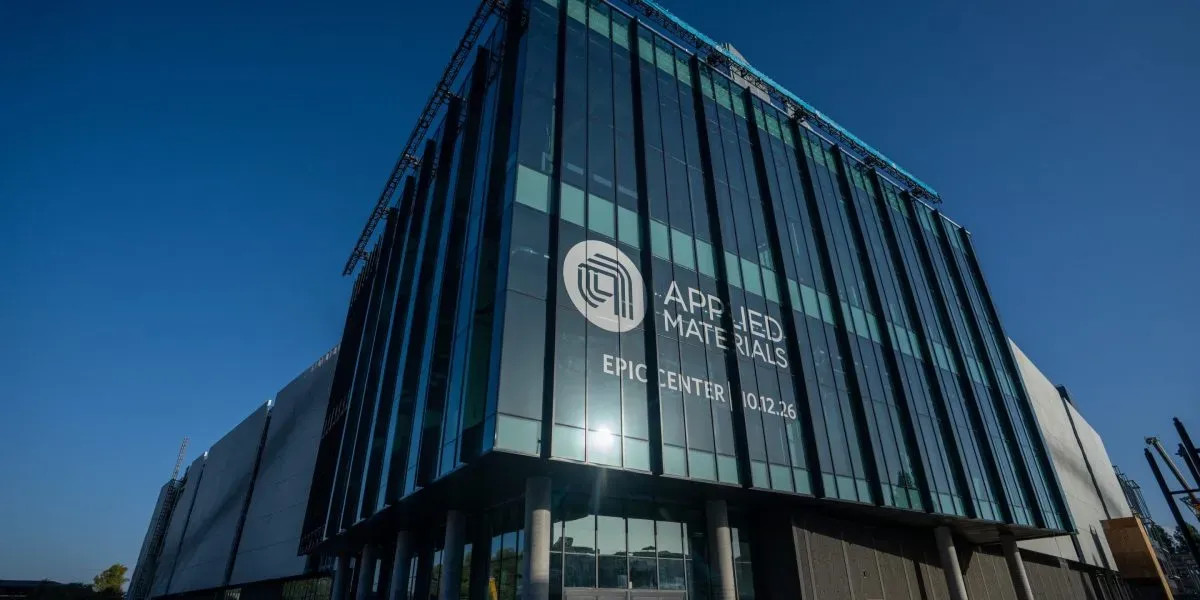
A major exception to this trend is Applied Materials, the world's leading provider of chipmaking equipment. The company has just unveiled its new EPIC semiconductor research and development facility, a massive undertaking that will serve as a hub for innovation in the industry.
The EPIC center, located at Applied Materials' Sunnyvale campus, is an impressive sight to behold. Spanning 600,000 square feet, it dwarfs its surroundings with its sleek glass, concrete, and steel design, equivalent to two Eiffel Towers' worth of steel, according to the company.
The facility's bold vision is to bring together top chip industry players under one roof, including Intel, TSMC, Micron, SK Hynix, and Samsung. Each partner will have teams on-site working alongside Applied Materials engineers to develop cutting-edge microprocessors and memory chips, with access to the latest equipment from the company.
The massive investment by Applied Materials is set to transform the landscape of semiconductor equipment research and development, with a total capital outlay expected to reach $5 billion when the project is complete.
The sheer scale of the EPIC facility is staggering, covering an area equivalent to three football fields, which will be dedicated to the creation of clean rooms where researchers can work on etching microscopic circuits into silicon wafers.
Competing companies such as Micron and SK Hynix will have their own private test facilities within the complex, equipped with cutting-edge chipmaking gear that they will use in collaboration with Applied Materials engineers to drive innovation forward.
Having innovators working together in close proximity is seen as a game-changer by industry insiders, allowing for earlier access to new technologies that can enable breakthroughs in AI architecture development.
The time it takes to develop each new generation of chip architectures is expected to be significantly reduced, cutting the typical 10-12 year timeframe down to just six years through the collaborative efforts at EPIC.
By enabling researchers to identify what's technically feasible earlier on in the process, the chances of breakthroughs increase while reducing the number of dead ends that can occur when companies work independently.
The recent breakthrough by Chinese memory maker CXMT in memory chip density has sent shockwaves through the industry, potentially allowing them to produce more power-efficient memory chips than their competitors Samsung and SK Hynix.
This achievement could have significant implications for the global semiconductor market, as it would give CXMT a competitive edge over its South Korean rivals. The news of this breakthrough sent shares of both companies plummeting by around 7% and 10% respectively in South Korea.
The development also highlights the ongoing tensions between the US and China in the field of advanced technologies such as artificial intelligence (AI). The US government has imposed restrictions on the sale of advanced chipmaking equipment to China, aiming to limit its ability to develop AI models that could surpass those created by American companies like OpenAI and Google.
Despite these restrictions, Applied Materials continues to play a crucial role in the global semiconductor industry. Founded as a chemistry supply company in 1967, it has grown into the world's largest provider of chipmaking equipment, benefiting from the recent surge in demand driven by the AI boom.
The AI boom has had a profound impact on the semiconductor market, leading to a shortage of memory chips and driving up prices. Companies like Applied Materials have been at the forefront of this trend, with their shares increasing by over 110% in the past year alone.
In August, the company reported quarterly revenue of $9.12 billion, representing a 25% increase from the same period last year. With visibility into customer demand as far out as 2030, Applied Materials is well-positioned to continue riding the wave of growth driven by the AI revolution.
The AI revolution has created a surge in demand for semiconductors, prompting concerns about overinvestment by chipmakers and equipment manufacturers if market conditions change.
Dickerson's confidence in sustained growth is fueled by the rapid development of new products and services leveraging AI capabilities, which he believes will drive increased demand for improved chip performance and power efficiency. According to him, this inflection point is unparalleled in his lifetime, with a pace that shows no signs of slowing down.
Facts based on reporting originally published by Fortune.
You may republish this story, in full or in part, if you credit News Central Site and link to it (licence CC BY 4.0). Photos are not included.