Unexpected Discovery About Stars Reveals Wide Range of Colors Beyond Traditional Red, Orange, Yellow, White, and Blue
A team of scientists has made an unexpected discovery about stars, revealing that they come in a wide range of colors beyond the traditional red, orange, yellow, white, and blue.
A team of scientists has made an unexpected discovery about stars, revealing that they come in a wide range of colors beyond the traditional red, orange, yellow, white, and blue.
The study, published this month, suggests that the color of a star is not solely determined by its temperature, as previously thought. Instead, other factors such as density and atmosphere can also play a significant role in determining a star's hue.
According to Mark Hollands, lead author of the study from Warwick University's astronomy and astrophysics group, white dwarf stars are capable of producing colors that were not anticipated. White dwarfs are incredibly dense objects with intense gravity, which affects their atmospheres.
The key to this phenomenon lies in the interactions between the atmosphere around a white dwarf and trace amounts of other elements present. The dense atmosphere, composed primarily of hydrogen and helium, can have unexpected effects when combined with these other elements.
These unusual colors were not expected by the researchers, who were surprised by the variety of hues produced by white dwarfs.
The color palette of white dwarfs has been expanded significantly by a recent study. Researchers have discovered that these stars can display a wide range of colors due to interactions between trace elements and dense helium in their atmospheres.
When helium becomes more transparent as the star cools down, it allows scientists to see deeper into the star where gas is denser. This transparency enables the observation of the effects of trace elements absorbing light across various wavelengths, resulting in a broader spectrum of colors.
The study found that white dwarfs can appear in numerous colors depending on the specific elements they have absorbed. The variety of hues observed was unexpected, given the traditional understanding of these stars.
Researchers typically analyze stars using spectroscopy, which reveals their chemical composition and brightness but not their color. However, scientists are increasingly interested in knowing what a star looks like to the human eye.
The question of how white dwarfs appear when viewed directly is a simple one that has sparked curiosity among both astronomers and the general public.
A recent study has revealed a fascinating phenomenon among white dwarf stars, with some displaying an array of unusual colours when viewed through human eyesight. The research team used data from 151 white dwarfs to simulate their appearance in colour vision, and while most appeared as bright whites or blues, five stood out for their striking hues.
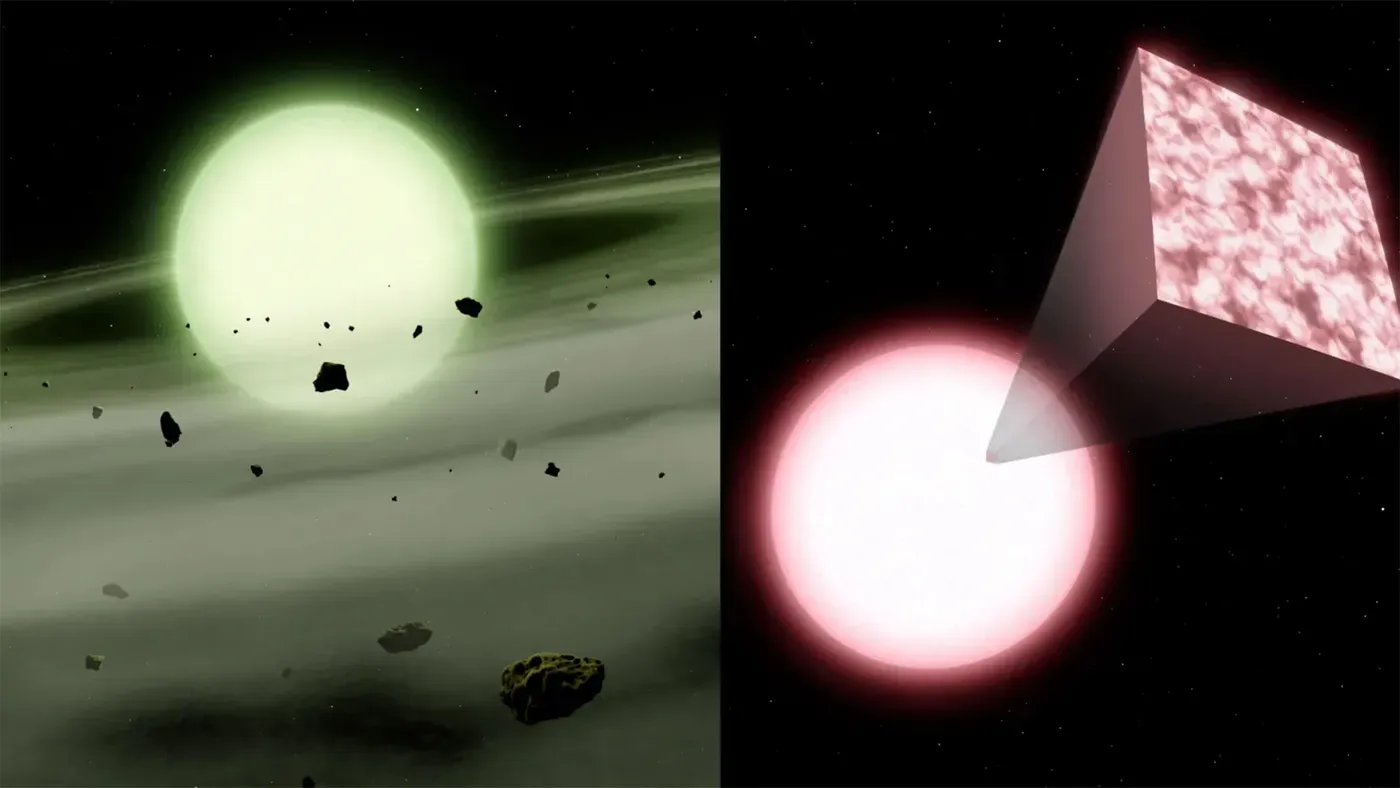
These anomalies include a star with a vibrant green complexion, designated WD J1330+6435, which is situated within a rocky planetary system. The presence of debris from this system contributes to the star's distinct appearance, imbuing it with the necessary elements to take on a "ghostly green" tone according to the researchers.
Another notable finding was WDJ0902+2010, a white dwarf that exhibits a salmon-pink colour due to an abundance of carbon in its atmosphere. The study suggests that this cooler star churns up internal carbon, which is then absorbed across various parts of the light spectrum, resulting in its distinctive pinkish hue.
The discovery of WD J1330+6435 as the first known green star has sparked interest among astronomers and scientists. Furthermore, the research team's findings also indicate that the pink and cyan colours observed in certain white dwarfs may be novel discoveries, with no previous reports of such colourations existing in scientific literature.
These extraordinary colour variations among white dwarf stars have left researchers intrigued, and further investigation into these phenomena is likely to shed more light on their underlying causes.
The intense colours of white dwarf stars are short-lived phenomena that eventually fade as they cool down and return to their normal hues. Initially, these stars emit a sky blue colour due to their extremely high temperatures, reaching up to 100,000 degrees Kelvin.
As the white dwarfs continue to cool, the colours change dramatically, resulting in the vibrant shades observed. However, this is only temporary, as the intense gravity of the star eventually pulls the trace elements into its core, restoring it to its original colour - either white or orange.
The lone exception to this rule is WDJ0902+2010, a pink star that will likely remain so for billions of years due to its internal convection forces. This sets it apart from other white dwarfs, which will transition back to their natural colours after just a few million years.
Facts based on reporting originally published by CNET.
You may republish this story, in full or in part, if you credit News Central Site and link to it (licence CC BY 4.0). Photos are not included.