Democratic Party secures control of both the US House and Senate in midterm elections
The outcome marks a significant shift in the country's political landscape, with Democrats now holding sway over key government institutions.
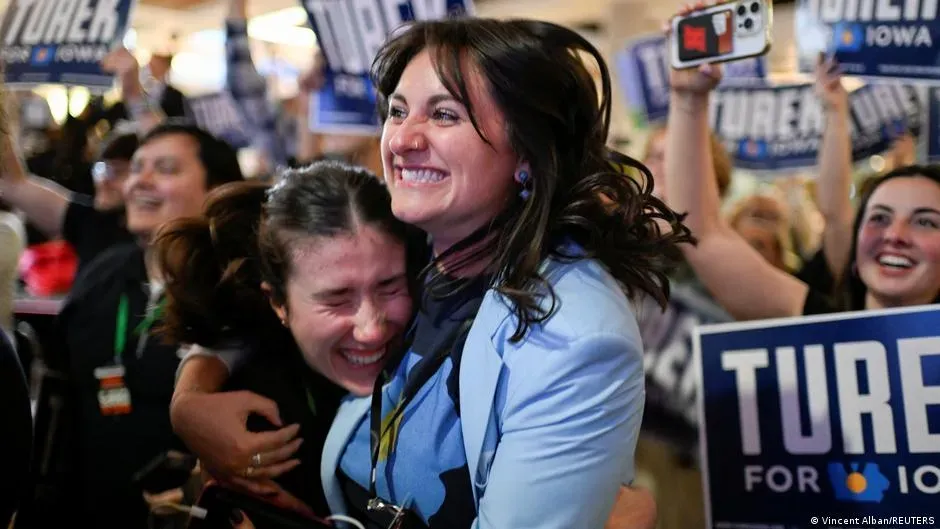
A decisive victory has been secured by the Democrats in the midterm elections, giving them control of both the US House of Representatives and the Senate. The outcome marks a significant shift in the country's political landscape, with some even describing it as a "blue tsunami".
The Democratic Party now holds sway over key government institutions, having also won gubernatorial races in traditionally Republican strongholds such as Texas. This triumph has been met with jubilation across the US, with pictures from election night showing Democrat politicians and supporters celebrating, hugging, and some even overcome with emotion.
Despite their newfound power, Democrats face a hurdle: President Donald Trump still retains authority to veto legislation proposed by Congress. His veto can only be overridden if two-thirds of both Congressional chambers agree. Furthermore, Trump has demonstrated in the past that he is willing to disregard Congressional decisions when they do not align with his interests.
Patrick Malone, a professor at American University's public administration and policy department in Washington DC, notes that a presidential veto does not necessarily signal the end of a particular issue. Even without a two-thirds majority, Democrats may still be able to overcome Trump's opposition through other means.
Malone suggests that some Republicans who survived the election have received a clear message: they must distance themselves from Trump if they hope to hold on to their seats in future elections. This is because voters have shown that they are willing to reject Republican candidates linked too closely to the outgoing president, as evident in neighboring districts where Democratic candidates triumphed.
The possibility of a joint effort by Republicans and Democrats to override a Trump veto is gaining traction, according to Malone. This could potentially lead to a rare instance of bipartisan cooperation in the US Congress.
One area where this might play out is with regards to Trump's decision to launch military action against Iran without congressional approval. The US Constitution grants Congress the power to declare war, but as commander-in-chief, the president also wields significant authority over military operations.
The Democrats will have a crucial advantage when they regain control of the House of Representatives in January 2027, allowing them to bring charges against Trump with a simple majority vote. However, even then, securing a two-thirds Senate majority for his conviction and removal from office remains out of reach.
Some Democratic lawmakers believe that initiating impeachment proceedings is essential, not only as a means of holding Trump accountable but also to demonstrate the party's commitment to upholding constitutional principles.
The Democratic Party has made it clear that they will not let up on their efforts to scrutinize President Trump and his administration following their midterm election victories.
In fact, observers expect Congress to launch a series of investigations into various aspects of the government, including members of Trump's family and inner circle. According to experts, these probes are designed not only to uncover any wrongdoing but also to sway public opinion in favor of the Democrats' cause.
One way for the Democrats to exert their influence is by linking funding for specific projects or initiatives to certain conditions. For instance, if they want more money allocated to particular conflicts, they could tie it to the removal of Secretary of Defense Pete Hegseth from his position.
The Democrats will have a significant advantage in Congress starting from January, where decisions on government spending are made. This means that they can use their newfound power to block or approve funding for various projects, depending on whether they align with Trump's agenda or not.
As the new legislative session gets underway, there is speculation about who might be next on the chopping block if Hegseth loses his job as Secretary of Defense. While no official announcements have been made, it seems likely that the president will face intense pressure from Democrats to make changes in his administration.
The unity among US Democrats following their midterm success is likely to be short-lived.
Malone believes that the party's brief moment of unity will soon give way to infighting and disagreements over policy issues.
Within the Democratic Party, there are various factions with different ideologies and agendas, making it challenging for the party to present a unified front.
One such faction is the progressive wing, which includes prominent figures like Alexandria Ocasio-Cortez, who advocate for aggressive policies on environmental and social programs.
The Democratic Party also has moderates who have won elections in traditionally Republican districts, and their views may not align with those of more liberal Democrats.
Agreeing on a unified direction will be crucial for US Democrats in Congress following their midterm victory. According to Malone, a key challenge lies ahead: finding common ground among party members to create a positive governing agenda that they can all support.
The pundit emphasizes that simply opposing Trump's policies is not enough to sustain the Democrats' current momentum.
Facts based on reporting originally published by DW English.
You may republish this story, in full or in part, if you credit News Central Site and link to it (licence CC BY 4.0). Photos are not included.