Ukrainian Prisoner of War Joins Enemy Forces to Escape Captivity
A senior lieutenant in Ukraine's armed forces, Pavlo Oliynyk, 25, has come forward claiming he joined enemy forces to escape captivity after being held prisoner of war (POW) by Russian forces.
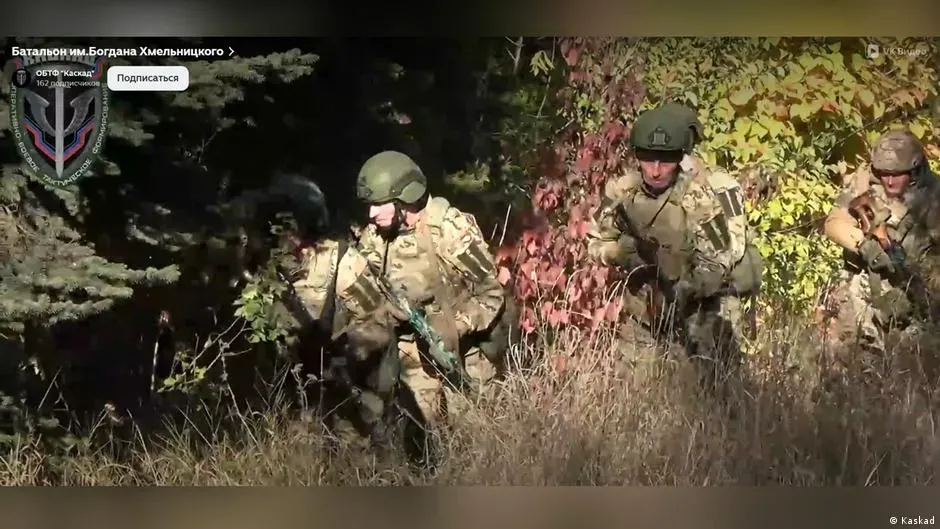
A senior lieutenant in Ukraine's armed forces, Pavlo Oliynyk, 25, has come forward claiming he joined enemy forces to escape captivity after being held prisoner of war (POW) by Russian forces.
Before his capture in the Donbas region in 2024, Oliynyk was a respected officer in Ukraine's military. However, as a POW, he alleges that he was subjected to brutal treatment, including electrocution, beatings and psychological torture.
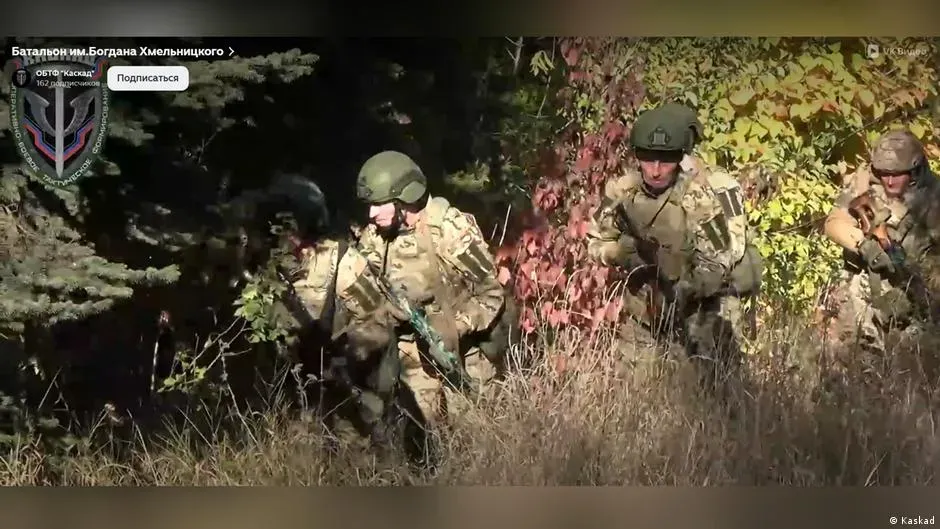
In an attempt to regain control of his situation, Oliynyk reportedly accepted an offer to join the Maksym Kryvonis battalion, named after a famous 17th-century Cossack commander. This move allowed him to potentially reach the front lines and make a break for Ukrainian-controlled territory.
The involvement of Ukrainian prisoners of war and former service members in Russian combat units has been documented since late 2022. Initially, several detachments were formed, but by August 2026, they had merged into an entity known as the "Ukrainian Volunteer Special Forces Brigade."
Details about the size of individual units remain sketchy, with estimates suggesting anywhere from dozens to hundreds of fighters. The Maksym Kryvonis battalion has garnered significant attention for its involvement in combat operations, although the exact number of members is unknown.
The exact nature and extent of Russian influence over Ukrainian volunteer units has raised concerns among experts and human rights organizations. Pavel Luzin, a specialist in Russian foreign policy and defense at the Center for European Policy Analysis, believes these units are an attempt by Moscow to create a distraction from its own military presence in Ukraine.
According to Yevhen Shybalov, author and war veteran, the creation of Ukrainian volunteer units under Russian command is seen as a way to counter the fact that many Russians are fighting on Ukraine's side. He points out that Russian troops have never tried to hide the fact that these units were formed to serve their own interests.
A 2025 report by the Office of the UN High Commissioner for Human Rights highlights the issue of torture and ill-treatment of Ukrainian prisoners of war in Russian custody. The majority of those released reported experiencing such treatment, raising questions about the conditions under which they may have been recruited into these units.
The physical and psychological state of returned combatants has also raised concerns about their recruitment being voluntary. Bill Wiley, executive director of the NGO Commission for International Justice and Accountability, notes that the procedures against several battalion members suggest a more complex situation than initially meets the eye.
Mykhailo Savva, from the Center for Civil Liberties, points to ongoing criminal investigations into some of these units' activities as further evidence that membership may not have been entirely voluntary.
The experience of Ukrainian prisoners of war under Russian command has raised questions about the nature of their involvement in the conflict.
War veteran Maksym Butkevych, who spent 28 months as a prisoner of war, has spoken about the difficult conditions that make it hard to distinguish between voluntary and involuntary recruitment. He pointed out that there is constant pressure on prisoners, but also noted that some may have defected due to ideological proximity.
Butkevich recounted receiving offers from his captors to join the Russian army between 2022 and 2023. These offers were made persistently, he said, and in his case, it followed severe mistreatment. This mistreatment was a deliberate attempt to break prisoners' spirits, making them more susceptible to coercion.
Veteran Shybalov has also spoken about attempts by their captors to force confessions of war crimes or to recruit members for Russia's intelligence services. He described how all prisoners were first interrogated and then made certain propositions under duress, with psychological pressure being used to extract compliance.
Veteran fighters from Ukraine have shared their experiences of being recruited into Russian units, revealing a complex web of coercion and persuasion. According to accounts, prisoners were first interrogated and then presented with propositions under duress, often using psychological pressure to extract compliance.
One fighter, Oliynyk, claimed he was approached multiple times by Russian recruiters before finally accepting an offer to join their forces. However, instead of signing official Defense Ministry paperwork, he entered into a private contract with an individual offering military services. This arrangement allowed him to leave Ukraine and flee the country.
As part of his training, Oliynyk was taken to a room where he watched videos and saw photos that he would later be required to retell. He described being surrounded by fellow service members who had either switched sides voluntarily or been forced into doing so. Among these recruits were former Ukrainian prisoners of war, some of whom were allegedly followed and guarded by mercenaries from the private Russian military company Redut.
In a video from an online trial in Ukraine, Oliynyk can be seen speaking about beatings and torture inflicted upon him and his comrades. He also mentioned receiving monthly wages in envelopes handed out by a member of Russia's military intelligence.
Oliynyk was given a phone by his Russian handlers but refused to use it due to constant surveillance, making him unable to contact anyone in Ukraine. He claims he never engaged in combat against Ukrainians, having fled Donetsk province in March 2025 before being deployed. Instead, Oliynyk spent two days hiding from drones in basements and houses until he managed to make contact with Ukrainian fighters.
Oliynyk has been held in a Ukrainian detention center for nearly two years while authorities investigate possible treason charges, which have yet to be formally filed against him.
Facts based on reporting originally published by DW English.
You may republish this story, in full or in part, if you credit News Central Site and link to it (licence CC BY 4.0). Photos are not included.