Russian Battalion Consists of Captured Ukrainians
A Russian battalion formed from captured Ukrainian soldiers and defectors has seen combat, sparking concerns about its purpose.
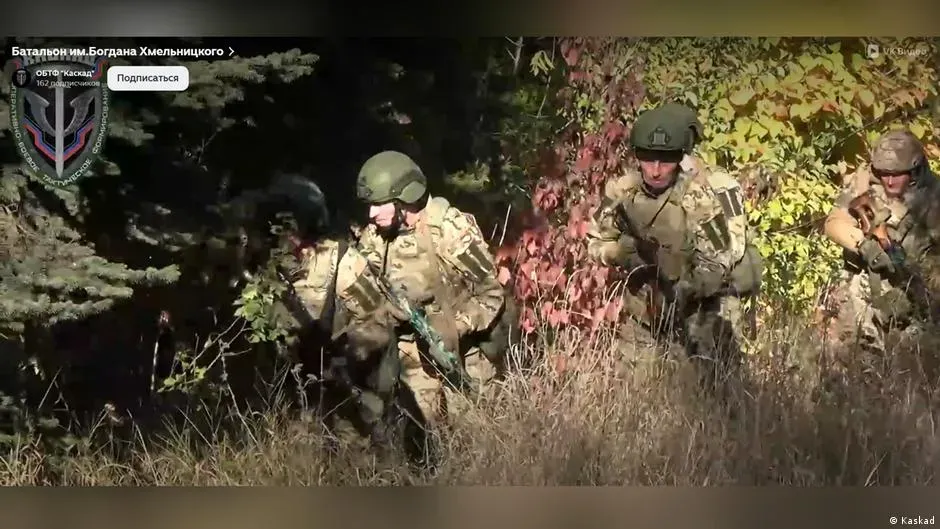
Ukrainian prisoners of war and defectors have been gathered into a Russian battalion to face their former comrades on the battlefield.
Pavlo Oliynyk, a 25-year-old senior lieutenant who was captured by Russian forces in the Donbas region in 2024, is one such individual. He claims that as a prisoner of war, he was subjected to electrocution, beatings, and psychological torture.
Oliynyk's decision to join the Maksym Kryvonis battalion, named after a famous Cossack commander, was driven by his desire to escape Russian captivity. By joining this unit, he hoped to reach the front lines and make a break for Ukrainian-controlled territory.
Reports of Russian combat units consisting of Ukrainian prisoners of war began emerging in late 2022. These detachments were initially formed separately but were eventually merged into what is known as the "Ukrainian Volunteer Special Forces Brigade" in August 2026.
The Maksym Kryvonis battalion has gained significant attention for its involvement in combat operations, although its true size remains unknown. Some reports suggest that it has around 200 fighters, while available footage indicates a much smaller number of soldiers.
The formation of a Russian battalion comprising Ukrainian prisoners of war and defectors has raised eyebrows among experts and observers. This move is seen as an attempt to replicate the structure of existing units in the Ukrainian armed forces that consist of Russian citizens.
These units are believed to be imitations of the Russian Volunteer Corps and the Freedom of Russia Legion, which have been operating within the Ukrainian ranks. The creation of such a battalion would serve as a distraction from the fact that these units exist, according to some analysts.
Ukrainian intelligence services seem to concur with this assessment, albeit for different reasons. It appears that they are concerned about the presence of Russian citizens fighting on Ukraine's side, but not willing to fight on Russia's own side. This dichotomy has been a recurring theme throughout the conflict.
The issue at hand is further complicated by reports of torture and ill-treatment of Ukrainian prisoners of war during their captivity in Russian hands. According to recent findings, nearly all released POWs interviewed reported suffering physical or psychological abuse while in custody.
The conditions in Russian captivity can make it challenging to distinguish between voluntary and involuntary recruitment of Ukrainian prisoners of war.
According to Maksym Butkevych, a war veteran and human rights activist who spent 28 months as a prisoner of war, the atmosphere in Russian custody is marked by constant pressure on the detainees.
Butkevich notes that from 2022 to 2023, all Ukrainian prisoners of war were persistently offered positions in the Russian army.
The veteran claims that these offers often came after severe mistreatment, which made it difficult for the prisoners to resist the pressure exerted upon them.
The tactics used to recruit Ukrainian prisoners of war and defectors into Russian units are often shrouded in mystery. According to one veteran's account, the pressure exerted on these individuals can be intense, making it difficult for them to resist.
Multiple bids to join Russian forces were initially turned down by a soldier from the Maksym Kryvonis battalion, who only accepted the fourth offer so he could flee. He claims that he didn't sign official paperwork but instead entered into a private contract with an individual offering military services. This arrangement allowed him to be brought to a room where he received lectures and was shown videos and photos.
He was later asked to retell these visuals, suggesting a possible propaganda component to the recruitment process. The veteran also notes that his fellow servicemembers consisted of both those who had switched sides voluntarily and those who had been forced into doing so.
The soldier's account is corroborated by a video circulating online, which appears to be footage from a trial in Ukraine. In this video, he speaks about the presence of former Ukrainian POWs in the unit being followed and guarded by mercenaries from the private military company Redut.
The former soldier's phone was under constant surveillance, making him too afraid to call anyone back home in Ukraine. He had fled his unit before being deployed in the Donetsk province in March 2025, after which he spent two days hiding from drones in basements and houses.
He eventually made contact with Ukrainian fighters, who have been holding him in detention for nearly two years as they investigate allegations of treason. Despite the lengthy investigation, no formal charges have yet been brought against him.
Facts based on reporting originally published by DW English.
You may republish this story, in full or in part, if you credit News Central Site and link to it (licence CC BY 4.0). Photos are not included.