Quantum Computing Breakthrough Achieved by Google Researchers
Google Quantum AI researchers have demonstrated magic state cultivation on a real hardware device, marking a significant milestone in quantum computing research.
A breakthrough in quantum computing has been achieved by Google Quantum AI researchers, who have successfully demonstrated magic state cultivation on a real hardware device. This innovative approach cleans up noisy quantum states directly within protected qubits, a crucial step towards building reliable quantum computers.
Quantum computers rely on fragile qubits, the digital bits of their quantum equivalent, which are prone to errors and make it extremely challenging to build reliable systems. Traditional methods for filtering out flaws have been resource-intensive, highlighting the need for more efficient solutions.
One such solution is magic state cultivation, a technique that directly cleans up noisy states within protected qubits, reducing the likelihood of errors. This method has never been tested on real hardware until now, marking a significant milestone in quantum computing research.
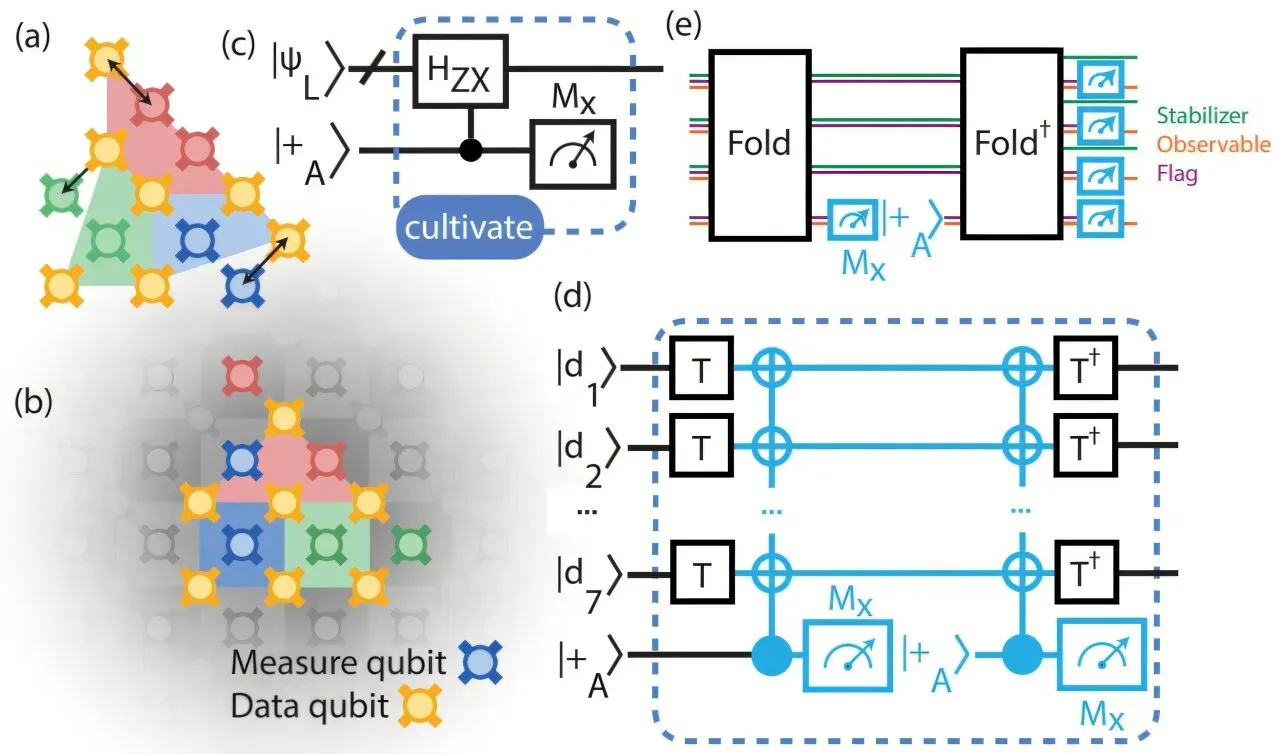
To test this approach, Google Quantum AI researchers first encoded a noisy magic state across several physical qubits, spreading the information over a small grid to protect it against errors. This deliberate introduction of errors was necessary for their experiment.
The team then attempted to weed out these errors using helper qubits that scanned the information without destroying the delicate data itself.
The checks implemented in this process were designed to detect any errors that may have occurred during the cultivation of magic states. If an error was detected, the entire attempt would be discarded and a new one started from scratch.
The results of these experiments showed a significant reduction in errors, with the team achieving a fidelity of at least 99.99%. This represents a substantial improvement over previous attempts to cultivate magic states, where errors were much more prevalent.
To accurately detect such small levels of error, the researchers developed a novel checking method called kickback tomography. This approach allows for the detection of remaining errors using significantly fewer measurements than traditional techniques.
Only about 8% of initial attempts successfully passed every check used to measure the state's fidelity. The filtering process was strict, ensuring that only those magic states with extremely high fidelity were allowed to proceed further in the processing pipeline.
The cultivated magic states were then transferred into a larger protective arrangement compatible with a surface code, which is designed to safeguard quantum information from errors. This successful transfer suggests that the cleaned-up quantum states can be integrated into more complex codes for future storage and use.
The successful transfer of quantum states to a superconducting qubit has paved the way for more complex codes to be developed in the future.
This achievement is significant because it demonstrates that the errors associated with magic state preparation can be greatly reduced. The team's findings suggest that by implementing this method, they can minimize errors by as much as 40-fold. This improvement will enable researchers to build larger and more reliable quantum computers.
The next step for this technology is to scale up its capabilities to accommodate larger quantum processors.
Facts based on reporting originally published by Phys.org.
You may republish this story, in full or in part, if you credit News Central Site and link to it (licence CC BY 4.0). Photos are not included.