PhotoTat Technology Allows Users to Switch Tattoos On and Off with Light
A revolutionary new type of tattoo ink has been developed, allowing users to switch their tattoos on and off at will using light.
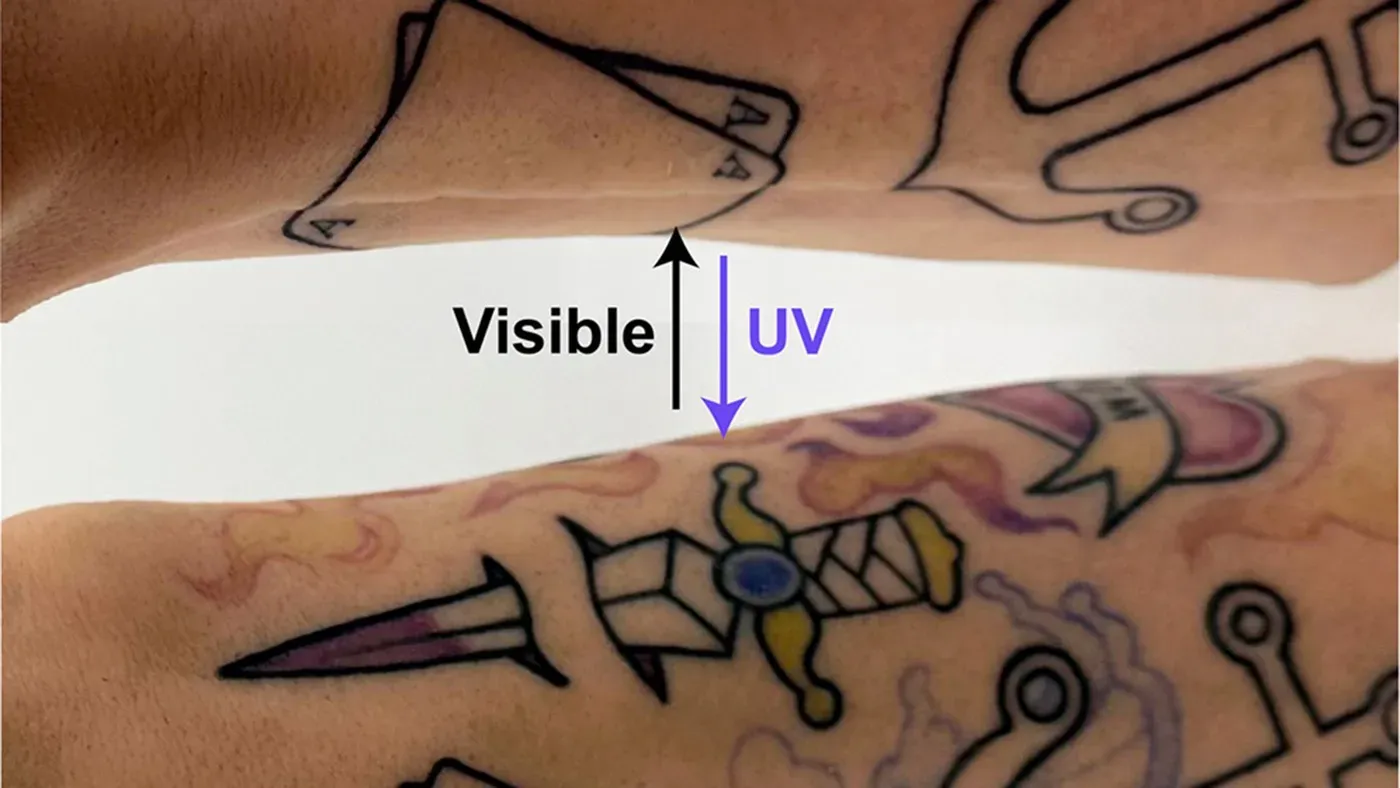
A revolutionary new type of tattoo ink has been developed, allowing users to switch their tattoos on and off at will using light. This innovative technology, dubbed PhotoTat, promises to give people greater control over their body art, potentially making it easier to conceal or change permanent tattoos without the need for painful removal procedures.
The system is based on photochromic dyes that can change color in response to different wavelengths of light. These light-sensitive compounds are encapsulated in nanoparticles of polymethyl methacrylate (PMMA), a medical-grade plastic already used in implants and dermal fillers, which form the core of the PhotoTat ink.
The new technology has been commercialized under the name PhotoTat and could have significant implications for people who want to temporarily conceal or change their tattoos. According to researchers, it could also be used for more practical purposes, such as creating medical tattoos that only become visible when a doctor needs to see them.
PhotoTat ink is composed of three primary colors - blue, magenta, and yellow - made with photochromic dyes that are sensitive to different wavelengths of light. This allows the color of the tattoo to be changed by adjusting the intensity or wavelength of the light used to "turn on the design.
The development of PhotoTat has been hailed as a major breakthrough in tattoo technology, offering users greater flexibility and control over their body art. The system is now being commercialized and could potentially revolutionize the way people think about tattoos, making them more versatile and adaptable than ever before.
The dyes used in these new tattoos undergo a transformation when exposed to specific wavelengths of light. This change occurs rapidly, taking around two to three seconds for pigments to be activated by a 365-nanometer ultraviolet LED.
Once the pigments are activated, they remain visible for several hours or even days under typical indoor lighting conditions. However, their visibility is short-lived when exposed to direct sunlight, which causes the colors to fade away in mere seconds.
The tattoo's appearance changes, but not its underlying pigment. The skin retains the color, and it is only the way it is perceived that shifts. This unique characteristic has been observed to persist for up to two years, with the three PhotoTat channels remaining switchable within this timeframe.
This technology allows for a high degree of customization and flexibility in tattoo design. By activating different wavelengths of light, various parts of the tattoo can be made visible or invisible. For instance, magenta could be turned on with green light, while yellow would be activated by blue light.
The possibilities for creative expression are vast, making PhotoTat an attractive option for those who enjoy experimenting with their tattoos. This feature is especially appealing to individuals who already have multiple tattoos and are looking for a new way to add some fun and playfulness to their designs.
Bruns has experimented extensively on his own skin using PhotoTat's inks, carefully arranging various ink formations into individual scales. Each scale serves as a unique container for an experiment, allowing him to test and refine the technology.
The resulting tattoos have taken on a whimsical quality, resembling a magical mermaid trick where certain scales seemingly appear out of nowhere or change color upon activation. This feature is particularly striking when combined with conventional tattoo ink, creating designs that remain permanent yet can be temporarily altered.
One potential application for PhotoTat technology lies in its ability to create reversible tattoos. For individuals hesitant about committing to a permanent design, this could provide an attractive solution. Additionally, people who already have tattoos but occasionally need to conceal them due to work or social obligations may find the new technology appealing.
Bruns envisions scenarios where the tattoos can be temporarily hidden for specific situations. For example, someone might want to turn off their tattoo during a family gathering or at work, only to have it reappear when they're in a more relaxed environment. This flexibility could make PhotoTat tattoos an attractive option for those seeking greater control over their body art.
The technology also holds potential benefits in medical settings, such as radiation therapy where permanent markings are used to align beams. If patients could temporarily turn off" these markings after treatment, they would no longer be reminded of their experience, allowing them to move forward without the visual reminder of their ordeal.
The development of PhotoTat has led to a new possibility: using similar markings that can be switched on during surgery and hidden afterward.
This technology could have significant implications for medical professionals who require monitoring during procedures, such as astronauts or nuclear engineers. Bruns has already developed other smart tattoos with specific applications, including one that changes color in response to UV radiation exposure.
The PhotoTat ink has undergone rigorous testing by third-party medical experts, and the purple variant is now available for purchase at a cost of $100 per small bottle. This high price point may limit accessibility, but Bruns hopes to bring down production costs as more research is conducted.
Bruns's team is working towards commercializing other colors of PhotoTat ink, which could further expand its applications and make the technology more widely available.
Researchers are making progress in developing a temporary tattoo that can change color or glow in response to external stimuli. This technology, known as PhotoTat ink, uses a chemical reaction to alter its appearance. The ink contains a molecule called leuco dye that changes color when exposed to light or heat.
The potential applications of this technology go beyond aesthetics, with possibilities for use in medical devices and even environmental monitoring. By allowing the tattoo to change color, it can provide real-time information about a person's health status or environmental conditions.
Facts based on reporting originally published by Live Science.
You may republish this story, in full or in part, if you credit News Central Site and link to it (licence CC BY 4.0). Photos are not included.