Researchers make progress in distinguishing quantum excitations within molecules
Researchers have made significant progress in distinguishing different quantum excitations within individual molecules. This achievement is crucial for understanding complex molecular...
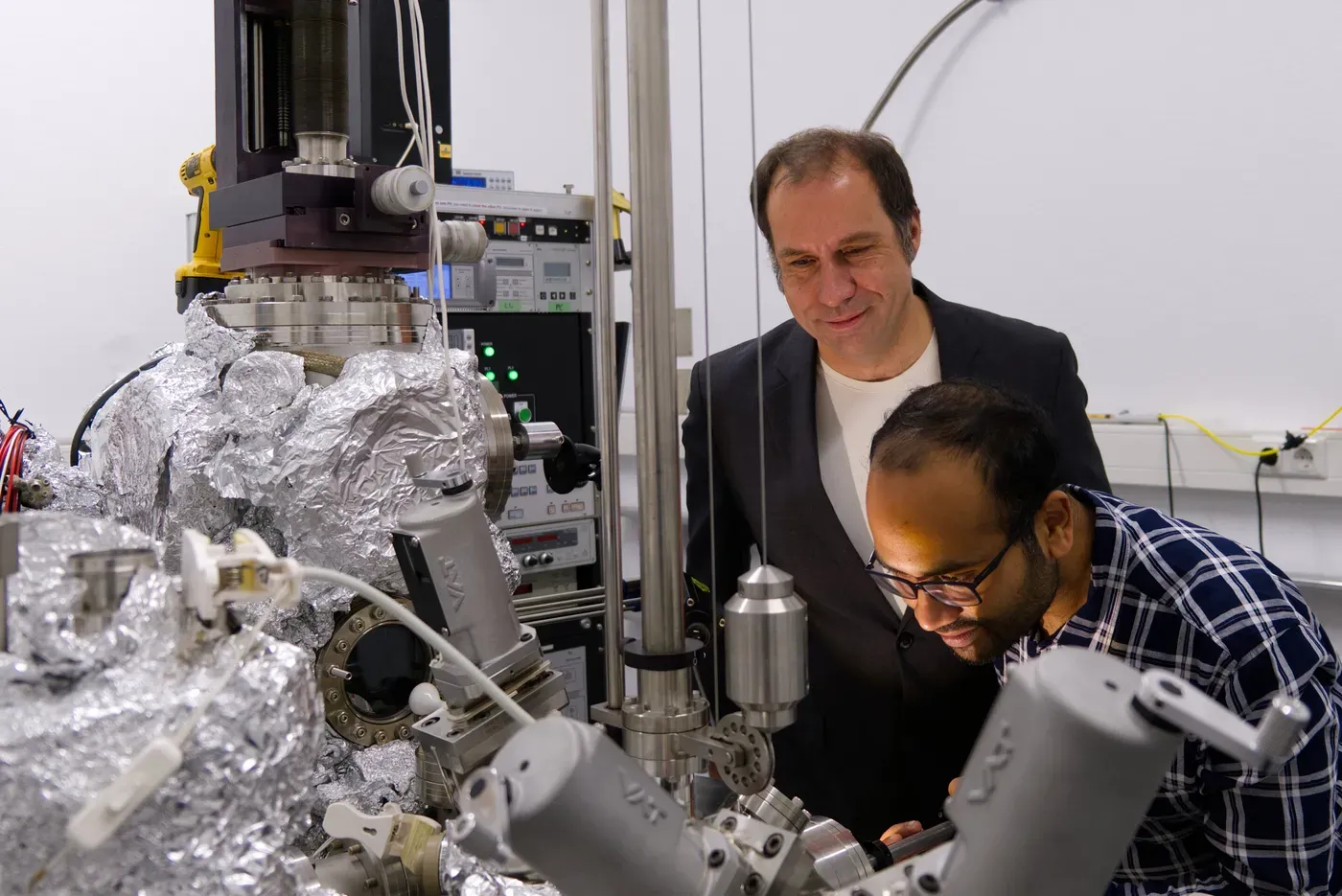
Researchers have made significant progress in distinguishing different quantum excitations within individual molecules. This achievement is crucial for understanding complex molecular behavior, which has long been a challenge due to unreliable theoretical models. By applying advanced techniques, scientists can now accurately identify the underlying processes behind various measurement signals.
Dr. Arnab Banerjee and his team tackled this issue by studying cobaltocene molecules using tunneling spectroscopy. The team's measurements revealed a multitude of excitations, making it difficult to pinpoint the specific process responsible for each signal. To overcome this hurdle, they developed a novel approach that allowed them to decipher the data and gain valuable insights.
The researchers conducted their experiments on a lead surface that exhibits superconductivity at extremely low temperatures. This unique property enables the surface to conduct electricity with perfect efficiency, providing an ideal environment for studying molecular interactions. The team employed a scanning tunneling microscope to bring its metallic tip close to the cobaltocene molecule, allowing electrons to flow between the two.
Using this setup, the researchers collected data that showed a complex pattern of excitations. However, by applying their new approach, they were able to untangle the signals and identify the distinct processes driving each measurement outcome. This breakthrough has significant implications for understanding molecular behavior at the quantum level.
The researchers employed a novel approach to analyze the behavior of individual molecules by modifying the energy of their electrons and measuring the resulting current fluctuations.
This method allowed them to identify specific points in the molecule's energy spectrum where particular processes are triggered, but it does not specify which process is occurring at each point. The situation becomes increasingly complex when multiple different excitations occur within the same energy range.
To disentangle these signals, the team used two complementary techniques: electron transfer and strong magnetic field manipulation. By moving electrons into and out of the molecule and applying a robust magnetic field, they were able to determine whether the excitation was due to molecular vibration, electron spin flipping or electron orbital hopping.
The measurements provided not only information about the energies at which excitations occur but also revealed the spatial distribution of probability for each excitation with high resolution.
The research team has made significant progress in understanding the behavior of individual molecules at the quantum level. By studying the conductance spectra of these molecules, they were able to identify different types of excitations and their corresponding energies.
These excitations can be thought of as "excited states" that occur when a molecule absorbs energy. The measurements provided not only information about the energies at which these excitations occur but also revealed the spatial distribution of probability for each excitation with high resolution.
The findings have important implications for the development of quantum computers and other technologies that rely on controlling the states of individual molecules. With this knowledge, researchers can better design and optimize materials for use in these applications.
Facts based on reporting originally published by Phys.org.
You may republish this story, in full or in part, if you credit News Central Site and link to it (licence CC BY 4.0). Photos are not included.