Chaos Theory Challenge: Researchers Develop Nonchaotic Model with Unpredictable Behavior
Researchers from the University of Illinois have published a study in Nature Communications that challenges conventional wisdom about chaotic systems by developing a nonchaotic model that exhibits unpredictable behavior.
Physicists have long sought to predict a system's final outcome based on its initial state, but chaos has often stood in their way. Chaos theory dictates that even tiny changes in the initial conditions can lead to drastically different outcomes, rendering prediction all but impossible.
In a breakthrough study published in Nature Communications, researchers from the University of Illinois have challenged this conventional wisdom by developing a nonchaotic model that exhibits unpredictable behavior. Despite being fully deterministic, the model defies computational attempts to forecast its final state based on its initial configuration.
The team's findings suggest that even in systems where every detail is known and governed by fixed rules, unpredictability can still arise. This contradicts traditional notions of determinism, which hold that a system's behavior is predetermined by its initial conditions and governing laws.
In contrast to chaotic systems, where minuscule deviations in the initial state can lead to vastly different outcomes, the Illinois researchers' model exhibits a more subtle form of unpredictability. While its dynamics are governed by fixed rules, the team discovered that topological structures emerge over time, providing a reliable predictor of the system's final fate.
The concept of determinism is often illustrated with simple physical systems, such as a block being pushed with a known force. In these cases, knowing the initial position and governing laws allows for precise prediction of the block's final position at any given time.
However, real-world systems are rarely this straightforward. Chaotic deterministic systems, where tiny variations in the initial state can snowball into drastically different outcomes, have long been recognized as a major challenge to prediction. In these cases, even with complete knowledge of the governing rules, predicting the system's behavior remains all but impossible.
Researchers at the University of Illinois were inspired by their own work on living systems, which they had been studying for over a decade. We started working on models of living systems 11 years ago, said Hyun Youk, an Illinois physics professor.
Researchers have been exploring ways in which cells can communicate through molecular signals and sensing, mimicking the complex interactions found in living tissues.
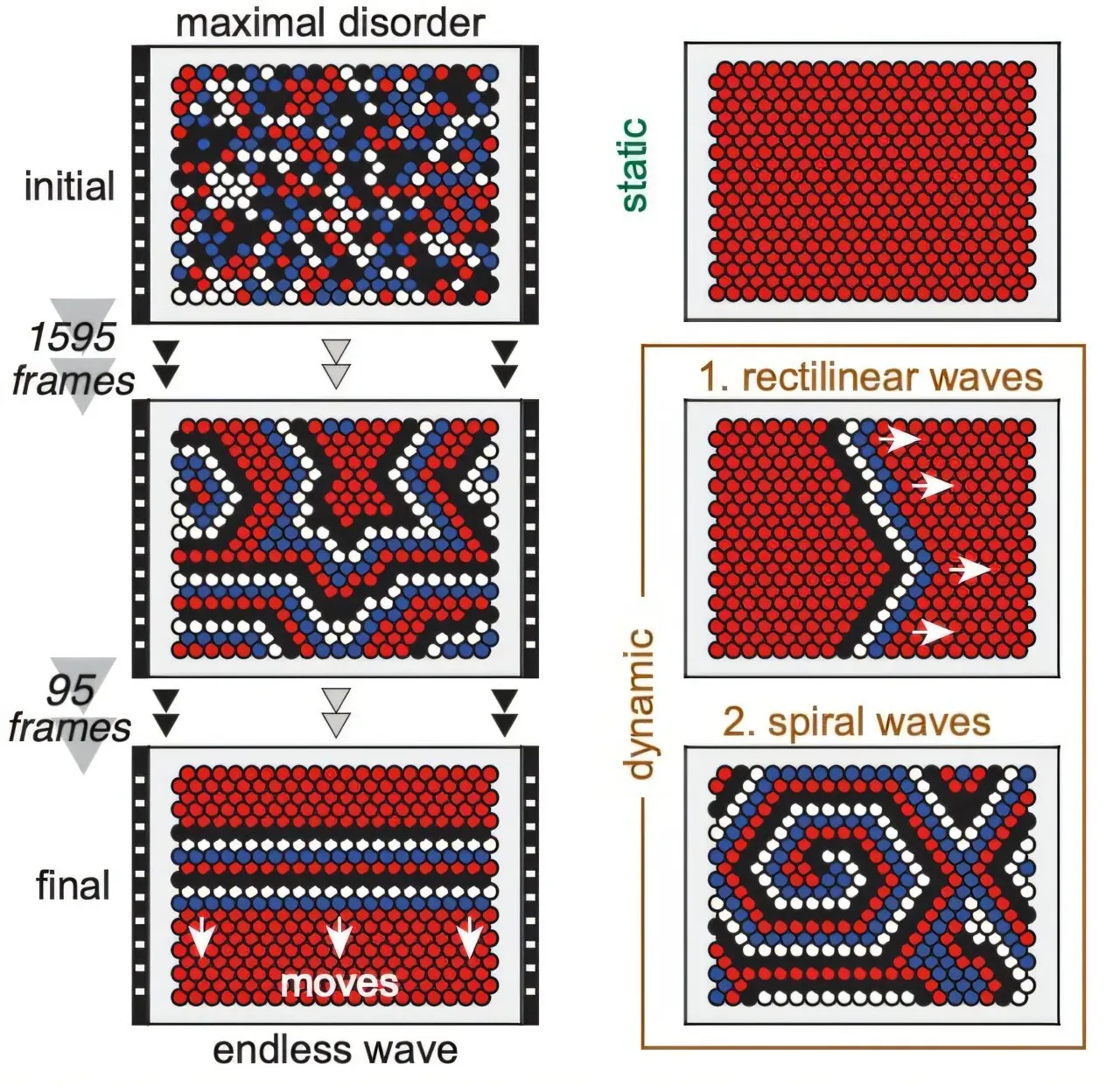
To study this phenomenon, Youk's team developed a cellular automaton (CA) model, which consists of a grid of individual cells that change their state according to fixed rules. This discrete system has proven capable of generating intricate patterns that appear to move and interact with one another.
The CA used by the researchers is particularly noteworthy because it takes into account the behavior of living cells. Each cell in the model can be in one of four possible states, represented by a color, and changes its state after each time step according to a gene circuit inspired by real cellular processes.
To facilitate simulation, the CA's grid has periodic boundary conditions (PBCs), which means that the lattice boundaries are connected, creating a seamless environment. This setup is similar to the game Pac-Man, where characters can reappear on one side of the screen if they move past the opposite edge.
When simulated, the CA begins with a randomly chosen initial configuration and evolves into one of three possible final states: a static arrangement of identical cells, a moving wave, or a spiral pattern. The number of possible configurations is vast but finite, which distinguishes this system from truly chaotic ones.
Despite its nonchaotic nature, predicting the fate of the CA from its initial state can be challenging. Even minor differences in the starting configuration, such as a single cell's state, can lead to significantly different outcomes with little indication of what causes the disparity.
The researchers' goal is to understand how predictability emerges from seemingly unpredictable dynamics, and their model provides valuable insights into this complex phenomenon. By studying the behavior of this CA, they aim to shed light on the intricate interactions within living systems.
Researchers investigating a complex system known as a cellular automaton (CA) used machine learning algorithms to test its unpredictability. The CA was given a simple binary classification task: predict whether it would settle into a static or moving-wave pattern based on its initial configuration.
To their surprise, the algorithms were correct half the time and completely wrong the other half, performing no better than random chance. This unexpected outcome suggests that the system is genuinely unpredictable despite being deterministic.
The simplicity of the CA's rules belies its complex behavior, as noted by study co-author Elinor Kay. She emphasized that even with a clear understanding of the system's underlying mechanisms, it remains difficult to predict its outcomes.
A closer examination of the CA revealed that its cells self-organized in unexpected ways, leading researchers to reframe their approach. Instead of using colors to represent cell states, they represented them as arrows pointing in one of four directions: up, down, left or right.
This new perspective uncovered striking patterns within the system, including cores surrounded by closed loops of arrows tracing out circular paths. These structures were labeled as positive, negative or neutral based on their degree of circularity and orientation.
The researchers discovered that these vortices are highly dynamic, constantly merging and annihilating each other over time.
In a short period following the simulation's start, the vortices proliferate rapidly before eventually decreasing in number. This decrease is consistent across all simulations, indicating a fundamental aspect of the system's behavior.
A notable finding was that if all vortices disappeared, the CA would settle into either a static or rectilinear wave pattern. However, if at least one vortex survived, the outcome would be a spiral wave.
The researchers found that positive and negative vortices always appeared together in their simulations, ensuring that the system's total charge remained zero throughout.
This unexpected conservation law was a surprise, as it wasn't explicitly programmed into the CA's update rules. The team began to investigate why this phenomenon occurred, looking for clues within the simulation parameters.
One key factor emerged: the periodic boundary conditions (PBCs) imposed on the lattice. Whenever a vortex loop crossed a boundary, it re-entered the lattice with opposite orientation and charge, resulting in pairs of oppositely charged vortices.
The team realized that this pairing was not an accident, but rather a direct result of the PBCs. This understanding shed new light on the seemingly trivial decision to use periodic boundary conditions in their simulations.
Further investigation revealed that the PBCs gave rise to new structures within the lattice. By examining the underlying topology, researchers discovered that the two-dimensional grid with PBCs is topologically equivalent to a torus, or doughnut shape.
This equivalence allowed the team to visualize the lattice as a doughnut, where opposite edges are "glued together. In this framework, some strings wrap around the doughnut and become noncontractible loops (NCLs), which cannot be untangled from the hole of the doughnut.
The researchers hypothesized that NCLs could serve as reliable predictors of fate within their simulations, given their unique properties. They decided to test the predictive potential of NCLs by analyzing their behavior in various scenarios.
In simulations where spiral waves are a likely outcome, the average number of nonchaotic lattice (NCL) structures remains relatively stable, fluctuating around one. This stability suggests that NCLs may not be effective predictors in these scenarios.
The researchers explored other potential predictor candidates and found that they improved the accuracy of machine learning algorithms as the simulations progressed. However, this improvement came too late to be reliable, highlighting the limitations of these approaches.
A particular algorithm, a convolutional neural network (CNN), showed exceptional performance when fed data from the entire lattice's spatial configuration. This led the researchers to introduce a new concept called the winding field, which captures the full spatial arrangement of the lattice.
The winding field is a topological quantity that assigns a pair of numbers, or winding vector, to each cell in the lattice. It quantifies how many times the connected region of same-state cells wraps around the torus, providing a more comprehensive view than traditional NCLs.
Initial simulations revealed that nearly every configuration started with a zero winding field. However, as the dynamics unfolded, vortices began to form and the field turned on" within the first 1% of each simulation's runtime.
As the vortices moved and annihilated each other, the winding field self-organized and expanded. Depending on the scenario, this expansion occurred in one of two ways: either it abruptly engulfed the entire lattice or gradually expanded to allow regions with zero winding field to persist.
The difference between these scenarios enabled researchers to reliably distinguish among all three types of fate, static, rectilinear wave, or spiral wave, using the winding field as a predictor. This breakthrough demonstrates the potential for predictive structure to emerge from seemingly unpredictable dynamics.
The emergence of predictability in this system is striking, with the CNN's accuracy increasing from random guessing at the start to almost perfect by the end of each simulation. This result underscores the ability of complex systems to develop predictive structures over time, even when initially chaotic.
The study reveals that even in systems where outcomes are predetermined, it's possible for unpredictability to emerge and eventually give rise to predictive structures over time.
This finding challenges traditional notions of predictability, which often rely on a clear distinction between determinism and uncertainty. Instead, the research suggests that these concepts can coexist, leading to more complex dynamics than previously thought.
The discovery was an accidental one, arising from the team's interest in self-organizing systems. It highlights the importance of allowing research to take unexpected turns, as it can often lead to new insights and breakthroughs.
The study's results demonstrate that predictability can emerge from seemingly unpredictable dynamics, underscoring the ability of complex systems to develop order over time.
Facts based on reporting originally published by Phys.org.
You may republish this story, in full or in part, if you credit News Central Site and link to it (licence CC BY 4.0). Photos are not included.